![Creative Commons 4.0 International Licence [CC BY 4.0]](https://melearning.online/compendium/themes/simpletwo/images/meLearning/cc-by-large.png)

Seminar Paper, Bachelor’s & Master’s Theses
these are the requirements you must follow in the ENM/ESM and FMI/FIM/FM&REM study programmes
AI-modifiedAI Use Information for this Web Page
The textual content of this page is AI modified.
- AI status: Modified with AI
- Scope: Entire page textual content
- Human oversight: Reviewed by Christian Huber before publication
- Details of AI usage: This page text was processed with AI assistance. The content was originally authored by Christian Huber and subsequently refined using language models to improve structure, consistency, and terminology. All AI-generated suggestions were manually reviewed and approved by Christian Huber before publication. The AI did not generate novel content but supported optimisation of existing material.
- Known limitations: AI-assisted text refinement may produce stylistic over-corrections; synonym suggestions may lack domain-specific precision; consistency checks may not account for intentional stylistic variation; applied grammar rules may reflect language model bias rather than prescriptive standards; estimated accuracy for editing suggestions: 94–97%.
- Example prompt used:
Example: "Improve clarity and consistency in this text whilst preserving the original voice. Check grammar, fix repetition, and ensure terminology is standardised. Suggest changes only, do not modify content." - Data flow: No personal data included. No data retention by model provider beyond session duration. No external storage or third-party sharing.
- Liability for AI errors: Liability for content accuracy rests with Christian Huber. Disclaimer: AI system recommendations are not binding and do not guarantee correctness.
- Content created: 30 August 2025
- Reviewed by: Christian Huber

Summary
Note: This summary was produced with AI support, then reviewed and approved.
- Every academic paper must follow formal requirements including length layout correct citation style and institutional regulations.
- Word count is strictly defined Bachelor thesis 4,000 to 6,000 words (up to a maximum of 7,000 words by winter 26/27) Master thesis 10,000 to 15,000 words Course and seminar paper 3,000 to 6,000 words. Exceeding or falling short results in failure. A tolerance of ±10 percent is accepted.
- Layout and templates are mandatory. Colourful or playful design is not allowed. LaTeX templates are provided for bachelor master and seminar papers.
- A graphical abstract serves as a visual short version. It should present results clearly and concisely and highlight the key findings.
- The binding citation style is APA in its latest version. Consistent use is a prerequisite for assessment.
- Publication rules differ bachelor theses are not published master theses are made digitally available in the library even after a blocking period.
- Submissions follow three stages first submission resubmission and commission assessment.
- Assessment criteria include content and methodology, research question, relevance, theory and methods, results, discussion as well as conclusion. Formal aspects such as layout citation style language quality and inclusive language count up to 20 points in the overall grade. To pass a minimum of 12 points with in the formal aspects is required.
- A checklist before submission helps students ensure compliance from formal aspects to structure sources and figures.
- The structure of a paper includes introduction literature review methodology results discussion conclusion references and appendix. Title page declaration of originality and abstract are compulsory.
- Figures and tables must be numbered labelled and referenced correctly. Consistency and readability are crucial. False precision and decorative elements should be avoided.
Topics & Content
- 1. Must-Haves & No-Gos
- 1.1 Scope
- 1.2 Layout & Template
- Download Templates
- Guidance on Using the LaTeX Template
- 1.3 Graphical Abstract
- 1.4 Referencing Guidelines
- 1.5 Publication
- 1.6 Examination Attempts
- 2. Assessment Criteria
- 2.1 Bachelor’s Thesis Assessment
- 2.1.1 Knock-out Criteria - Automatic Fail without Review
- 2.1.2 Content and Methodological Aspects (max. 80 points, minimum 48 points to pass)
- 2.1.3 Formal Aspects (max. 20 points, minimum 12 points to pass)
- Overall Assessment
- 2.2 Master’s Thesis Assessment
- 2.2.1 Knock-out Criteria - Automatic Fail without Review
- 2.2.2 Content and Methodological Aspects (max. 80 points, minimum 48 points to pass)
- 2.2.3 Formal Aspects (max. 20 points, minimum 12 points to pass)
- 2.2.4 Overall Assessment
- 2.3 Pre-Submission Checklist
- 3. Structure & Organisation
- 3.1 Title Page
- 3.2 Declarations
- 3.2.1 Statutory Declaration
- Template Bachelor's Thesis: Statutory Declaration
- Template Master's Thesis: Statutory Declaration
- Attention:
- 3.2.2 AI Disclosure
- Template: AI for brainstorming, research, analysis
- Template: LLM for proofreading
- 3.2.3 Confidentiality Clause
- Template: Confidentiality Clause
- 3.3 Abstract
- Structure of the Abstract
- 3.4 Main Text
- 3.4.1 Introduction (Section 1.)
- Background & Problem Statement (Section 1.1)
- Objectives & Research Question (Section 1.2)
- 3.4.2 Literature Review & State of Research (Section 2.)
- 3.4.3 Methodology (Section 3.)
- Research Design (Section 3.1)
- Sample or Data (Section 3.2)
- Procedure or Data Collection (Section 3.3)
- 3.4.4 Results (Section 4)
- 3.4.5 Discussion (Section 5)
- 3.4.6 Conclusion (Section 6)
- 3.5 References
- 3.6 Appendix
- 4. Figures & Tables
- 4.1 Figures
- Source requirements for figures
- Further Information about Figures - Design, Layout & Citation
- 4.2 Tables
- 5. LaTeX Commands
- 5.1 Structure
- 5.2 Text Formatting
- 5.3 Lists
- 5.4 Formulae
- 5.5 Tables
- 5.6 Figures
- 5.7 Referencing
1. Must-Haves & No-Gos ^ top
Every academic paper must comply with formal requirements. These are defined by the respective institutions or publishers for all authors. Failure to comply results in a paper not being accepted for publication or submission. Such formal requirements differ across institutions. There are no universally valid guidelines, even though numerous publications on academic writing dedicate many pages to these formal aspects.
In the study programmes Energy & Sustainability Management as well as Facility Management & Real Estate at Hochschule für Angewandte Wissenschaften Kufstein Tirol - University of Applied Sciences, the following rules apply to term papers, seminar papers, bachelor’s theses, and master’s theses:
1.1 Scope ^ top
Bachelor’s thesis: 4,000 - 6,000 words  (up to a maximum of 7,000 words by winter 26/27)
Master’s thesis: 10,000 - 15,000 words
Term paper / seminar paper: 3,000 - 6,000 words (module-specific requirements apply)
The scope is a decisive criterion in the ENM & FMI study programmes. Papers with insufficient or excessive length are rejected without review. The assessment is automatically negative and the paper is considered as failed. The word count is measured from the introduction to the conclusion, excluding the title page, statutory declaration, bibliography, and appendices.
Tolerance range ±10%: The word count of an academic paper may vary slightly depending on the software or tool used. To account for such technical differences, a tolerance of ±10% of the required word count is accepted. Within this range, a paper is considered formally compliant regarding its scope.
Word count method: Only the words in the main body of the text are counted - starting with the introduction and ending with the summary or conclusion. The following parts are not included in the count: title page, any confidentiality clauses, statutory declaration, declaration on the use of AI-supported language models (LLMs), summary and abstract, bibliographic information (such as author or supervisor details), bibliography, and appendices. The decisive factor for the count is the continuous text of the academic argumentation.
| Section of the paper | Included in word count |
|---|---|
| Title page | No |
| Statutory declaration | No |
| Confidentiality clause (if applicable) | No |
| Declaration on the use of LLMs | No |
| Summary / Abstract | No |
| Main text (Introduction to Summary / Conclusion) | Yes |
| Bibliography | No |
| Appendix | No |
1.2 Layout & Template ^ top
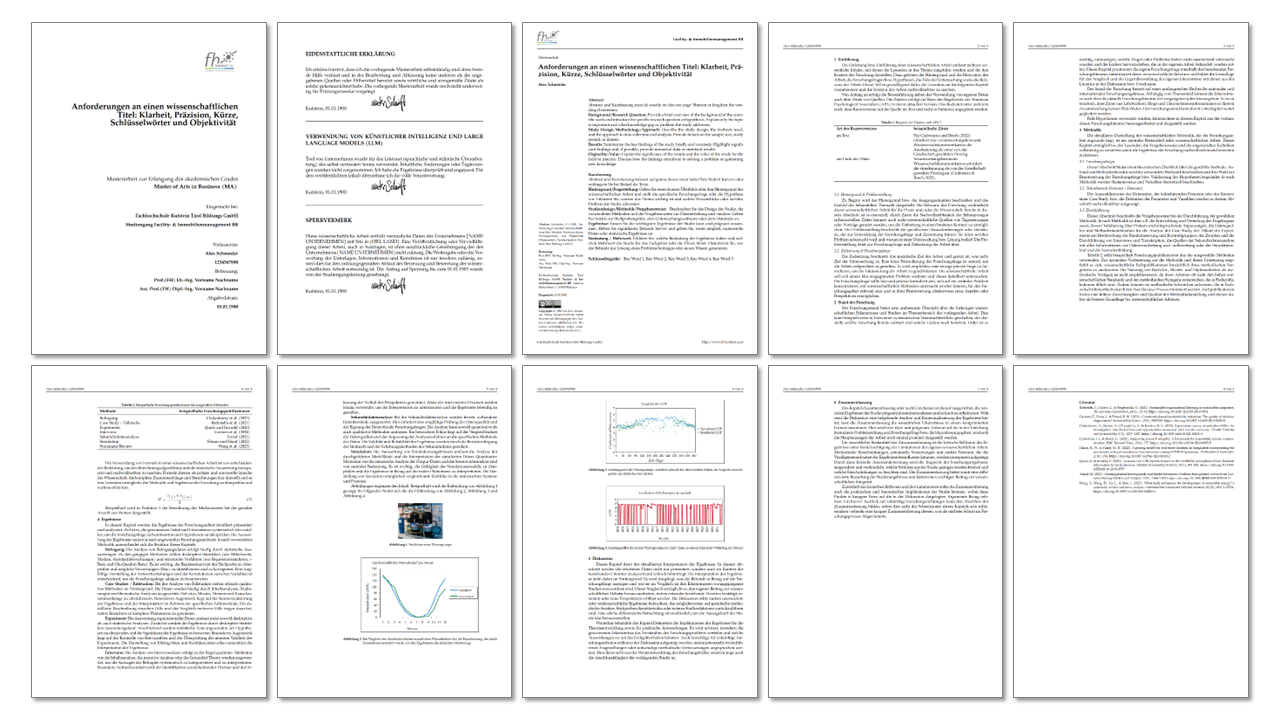
prescribed layout in the style of an academic journal articleFor bachelor’s and master’s theses, a neutral and formal layout must be used. Effects such as coloured headings or cartoon-like fonts are to be avoided in academic writing.
The layout prescribed by the study programme must be followed! This template is intended to support the preparation of bachelor’s and master’s theses in the programmes Energy & Sustainability Management (ENM) as well as Facility & Real Estate Management (FMI/FIM). It does not constitute a legal guarantee of completeness or accuracy. The exact structure remains the sole responsibility of the author in consultation with their supervisor. Hochschule für Angewandte Wissenschaften Kufstein Tirol - University of Applied Sciences accepts no liability.
Download Templates ^ top
There is only one central template that can be used for all types of academic papers. By switching certain variables on or off within the document, it can be defined whether the output should be a seminar paper, coursework, bachelor’s thesis or master’s thesis. The necessary adjustments for each type of paper and for each degree programme are already integrated. This means there is no need to create separate templates – it is sufficient to activate the required options within the existing one.
Guidance on Using the LaTeX Template ^ top
For working with the LaTeX template, two options are generally recommended by the degree programme:
-
Local installation with TeXstudio
- TeXstudio is a widely used and user-friendly development environment for LaTeX.
- Before using it, a complete LaTeX distribution must be installed (e.g. TeX Live on Windows and Linux or MacTeX on macOS).
- Important for macOS: The installation can be significantly larger, as the MacTeX distribution is very large (several gigabytes). Sufficient storage space should be planned, and the installation guide should be followed carefully.
- Once installed, a fully local working environment is available that can be used independently of the internet.
- Note on data protection & sensitive data: Since all files are stored and processed locally on your own computer, users keep full control over their data. External servers or third parties are not involved. This makes it the most data-protection-friendly option in most cases - provided that the computer itself is properly secured (e.g. with regular updates and backups).
-
Online editing with Overleaf
- Overleaf is a browser-based online editor that can be used without local installation.
- Even the free version makes it possible to prepare academic work easily and conveniently - including simple collaboration with others.
- Note on data protection & sensitive data: Overleaf hosts its servers in the USA. The company states that it complies with GDPR requirements and refers to relevant certifications. However, particularly sensitive or personal data should not be processed there without first consulting supervisors or the university. For standard texts (e.g. seminar or final papers), use is generally unproblematic.
-
Online editing with Prism by OpenAI
- Prism is a browser-based LaTeX editor that works without requiring any local installation. - The service offers a modern user interface, collaborative work features, autocompletion, and real-time preview. In addition, support through OpenAI’s AI environment is integrated.
- Note on data protection and sensitive data: Prism - formerly Crixet - is a relatively new provider. The server locations and details regarding GDPR compliance are the same as for other OpenAI applications. Therefore, the same applies here: do not upload particularly sensitive or personal data without consulting supervisors or the university. For regular academic work (such as seminar papers or theses), use is generally unproblematic as long as no confidential or copyright-protected content (e.g. behind a paywall) is included.
- Prism may display warning messages caused by differences between LaTeX versions; these are not relevant for preparing or rendering the master’s thesis
- Implementing literature and sources: besides the paid option of integrating Zotero Online, you can export selected references from Zotero via BibLaTeX (not BibTeX!) and then, copy-and-paste them into the .bib bibliography file in the template’s literature folder
-
Online editing with TeXPage
- TeXPage is a web-based system for writing and compiling LaTeX documents - no local installation is needed.
- It supports real-time collaboration, cloud-based compilation and instant preview of the generated PDF.
- Note on data protection & sensitive data: TeXPage advertises encrypted transmission and secure storage. However, details on GDPR compliance and server locations are currently not fully documented. For standard academic work (e.g. seminar or final papers), use is generally unproblematic. For particularly sensitive or personal data, prior consultation with supervisors or the university is recommended.
Common LaTeX commands are explained in the chapter LaTeX Commands.
1.3 Graphical Abstract ^ top
visual short representation of the essential content for a presentationThe graphical abstract serves to present complex content in an immediately understandable way and to convey the key findings concisely. When creating one, attention should be given to a clear structure, highlighting relevant information, and ensuring that the design is both appealing and easy to grasp. Important elements may include diagrams, symbols, short texts, or icons that illustrate and support the results. A well-designed graphical abstract attracts attention and facilitates access to the core messages of the paper.
A dedicated section on the graphical abstract can be found here in the online compendium
1.4 Referencing Guidelines ^ top
APAIn the study programmes Energy & Sustainability Management as well as Facility Management & Real Estate, the referencing style of the American Psychological Association (APA) in its most recent version is mandatory.
1.5 Publication ^ top
Bachelor’s thesis: NO
Master’s thesis: YES, digital worldwide access via library
Term & seminar paper: NO
In contrast to the bachelor’s thesis, the master’s thesis is published digitally via the library and made available for worldwide access. Even if the thesis is embargoed for 5 years, it will thereafter be accessible to the public and the academic community through the library. A printed copy or binding is not required.
1.6 Examination Attempts ^ top
as with all assessments:
- 1st submission
- Resubmission
- Committee submission
If a bachelor’s or master’s thesis receives a negative evaluation, two further resubmissions are possible. The topic does not need to be changed, and the thesis may be revised and improved. The supervision also remains the same. However, in some cases a fresh start may be advisable if too many aspects were evaluated negatively and improvement is not feasible (e.g. due to issues in empirical data collection).
2. Assessment Criteria ^ top
2.1 Bachelor’s Thesis Assessment ^ top
2.1.1 Knock-out Criteria - Automatic Fail without Review ^ top
- All required submissions must be handed in by the deadline.
- The bachelor’s thesis must contain 4,000 to 6,000 words (up to a maximum of 7,000 words by winter 26/27). Exceeding or falling short of this range results in automatic failure without content review.
- The statutory declaration must be confirmed upon upload and included in the thesis as a scan with the author’s handwritten signature.
2.1.2 Content and Methodological Aspects (max. 80 points, minimum 48 points to pass) ^ top
| Aspect | Supporting Questions | Max. Points |
|---|---|---|
| Structure |
|
5 |
| Problem Statement and Relevance |
|
10 |
| Research Question and Objectives |
|
5 |
| Selection and Quality of Sources Used |
|
10 |
| Literature Analysis and Use of Theory |
|
10 |
| Presentation, Justification and Application of Methodology |
|
10 |
| Presentation of Results |
|
10 |
| Discussion of Results |
|
10 |
| Conclusion and Outlook |
|
10 |
2.1.3 Formal Aspects (max. 20 points, minimum 12 points to pass) ^ top
| Aspect | Supporting Questions | Max. Points |
|---|---|---|
| Form and Layout |
|
5 |
| Referencing / Bibliography |
|
10 |
| Language Aspects |
|
5 |
Overall Assessment ^ top
- all knock-out criteria have been positively met
- at least 48 points in content-related aspects and at least 12 points in formal aspects have been achieved
- as with all assessments, the total score from content-related and formal aspects must be ≥ 60 points / 60 percent in order for the thesis to be passed
2.2 Master’s Thesis Assessment ^ top
2.2.1 Knock-out Criteria - Automatic Fail without Review ^ top
- All required submissions must be handed in by the deadline.
- The master’s thesis must contain 10,000 to 15,000 words. Exceeding or falling short of this range results in automatic failure without content review.
- The statutory declaration must be confirmed upon upload and included in the thesis as a scan with the author’s handwritten signature.
2.2.2 Content and Methodological Aspects (max. 80 points, minimum 48 points to pass) ^ top
| Aspect | Supporting Questions | Max. Points |
|---|---|---|
| Structure |
|
5 |
| Problem Statement, Relevance and Research Gap |
|
10 |
| Research Question and Objectives |
|
5 |
| Selection and Quality of Sources Used |
|
10 |
| Literature Analysis and Use of Theory |
|
10 |
| Presentation, Justification and Application of Methodology |
|
10 |
| Presentation of Results |
|
10 |
| Discussion of Results |
|
10 |
| Conclusion and Outlook |
|
10 |
2.2.3 Formal Aspects (max. 20 points, minimum 12 points to pass) ^ top
| Aspect | Supporting Questions | Max. Points |
|---|---|---|
| Form and Layout |
|
5 |
| Referencing / Bibliography |
|
10 |
| Language Aspects |
|
5 |
2.2.4 Overall Assessment ^ top
- all knock-out criteria have been positively met
- at least 48 points in content-related aspects and at least 12 points in formal aspects have been achieved
- as with all assessments, the total score from content-related and formal aspects must be ≥ 60 points / 60 percent in order for the thesis to be passed
2.3 Pre-Submission Checklist ^ top
The following points list the most important aspects for avoiding errors. This checklist is also suitable as a tool to support correction. The thesis should only be submitted once all points have been checked and fulfilled.
3. Structure & Organisation ^ top
The structure of an academic thesis provides a clear roadmap that makes the author’s line of reasoning comprehensible and transparent. It serves to present the research in a coherent manner and to guide readers through the argument. A well-structured organisation enhances the understanding of the content and allows the results to be presented clearly and precisely.
The outline usually begins with an introduction, in which the topic is presented, the research context explained, and the research question precisely formulated. This is followed by the literature review, which offers an overview of previous relevant studies and shows how the current research is embedded in existing knowledge. The methodology section describes in detail how the research was carried out. This includes the chosen research design, a description of the dataset or participants, and the exact procedure of data collection. The results section presents the data and findings, while the discussion interprets these results and embeds them in the scientific context. Finally, the conclusion provides a summary of the key findings and their significance, often combined with an outlook on potential future research.
This structure, which is found in many research publications, enables a logical and coherent presentation of the research process and the insights gained. Many academic publications follow a very similar structure:
| Element of Structure | Notes |
|---|---|
| Title page | in seminar and final theses, this includes the title and author’s name(s), the author’s unique ID number(s), the type of thesis, the name of the study programme & the university, as well as the examiner’s name(s) |
| Statutory Declaration | without this, seminar and final theses at universities are invalid |
| optional: Confidentiality Clause | only if the results of the thesis are not permitted to be published |
| Abstract / Executive Summary | |
| 1. Introduction |
|
| 2. Literature Review | this chapter may be further subdivided |
| 3. Methodology |
|
| 4. Results | this chapter may be subdivided if necessary |
| 5. Discussion | this chapter may be subdivided if necessary |
| 6. Conclusion | |
| Bibliography | |
| Appendices | for extensive tables, questionnaires, etc. that do not fit in the main text |
3.1 Title Page ^ top
all essential information for identifying academic thesesThe title page does not carry a page number. The following information must appear on the title page:
- Title of the thesis
- Type of thesis (bachelor’s or master’s thesis)
- Intended academic degree (e.g. Bachelor of Arts (B.A.), Master of Arts (M.A.), Master of Business Administration (MBA),...)
- Name of the university
- Name of the study programme
- Name of the author
- Name of the examiner(s)
- Date of submission
3.2 Declarations ^ top
3.2.1 Statutory Declaration ^ top
mandatory requirementBy signing the statutory declaration, the author affirms under oath that the thesis was written independently and that only the stated sources and resources have been used. Page numbering also begins here, using Roman numerals.
Template Bachelor's Thesis: Statutory Declaration ^ top
"I hereby formaly declair that I have written this Bachelor's thesis independently and without any help from another party. I have not used any sources apart from those indicated within the text and on the list of references. This Bachelor's thesis has not been submitted elsewhere for examination purposes."
__
Place, date, signature
Template Master's Thesis: Statutory Declaration ^ top
"I hereby formaly declair that I have written this Master's thesis independently and without any help from another party. I have not used any sources apart from those indicated within the text and on the list of references. This Master's thesis has not been submitted elsewhere for examination purposes."
__
place, date, signature
Attention: ^ top
Errors such as incorrect labelling of the thesis (e.g. stating "bachelor’s thesis" or "seminar paper" instead of "master’s thesis") in the statutory declaration will lead to the entire thesis being failed. It is therefore essential to check the statutory declaration carefully and repeatedly. If you are using a formatting template, verify thoroughly that the statutory declaration is correct!
Furthermore, the statutory declaration must include the place, date, and handwritten signature in order to be valid.
3.2.2 AI Disclosure ^ top
if you use it, declare it!Artificial Intelligence (AI) and Large Language Models (LLMs) can be useful tools in academic contexts. However, it is crucial to disclose transparently that such support was used and for what purpose.
Template: AI for brainstorming, research, analysis ^ top
In preparing this thesis, [NAME TOOL / SERVICE] by [NAME COMPANY] was used. After using this tool/service, I checked and revised the output as necessary. I take full responsibility for the content of the thesis.
__
Place, date, signature
Template: LLM for proofreading ^ top
[NAME TOOL / SERVICE] by [NAME COMPANY] was used for proofreading (linguistic and stylistic editing) of the self-written text. No content-related changes or additions were made. I have reviewed and adjusted the results. I take full responsibility for the published content.
__
Place, date, signature
3.2.3 Confidentiality Clause ^ top
when data are used that cannot be published, even in anonymised formIn some cases, theses use data that cannot yet be made accessible to third parties. This often applies, for example, to company data that form the basis of an empirical methodology. For this reason, it is possible to request that the publication of the thesis be embargoed for 5 years. Such an embargo must be applied for with the programme director and - if approved - clearly included in the thesis as a formal clause. Bachelor’s theses are not published at Hochschule für Angewandte Wissenschaften Kufstein Tirol - University of Applied Sciences. Master’s theses, however, are available worldwide via the library. An approved confidentiality clause prevents this publication.
If an embargo has been approved, the confidentiality clause must be included prominently before the table of contents.
Template: Confidentiality Clause ^ top
This thesis contains confidential data of the company XXX based in XXX. No part of this work may be published or reproduced without the permission of the company XXX. The dissemination or exploitation of the documents, information and knowledge is only permitted for the proper progress of the supervision and evaluation of this thesis.
The application for blocking until XX.XX.XXXX has been approved by the study management.
__
place, date, signature
3.3 Abstract ^ top
all essential information and results of the thesis
from introduction to findings
To assess whether a thesis is relevant, researchers usually read the abstract first.
An abstract condenses the entire thesis. It enables readers to quickly gain an overview of all key contents without having to read the whole text. This is particularly important in literature selection, where a rapid decision must be made as to whether a source is relevant to one’s own research question (assessment of relevance). Abstracts are also required for submitting academic work to journals and conferences. In these cases, they provide the scientific committees with a basis for deciding which presentations or articles are accepted at the conference or published in a journal. Each journal or conference has its own specifications regarding the permitted length of an abstract. Often, 700 to 1,500 characters are required, within which the entire content must be presented so that readers can obtain a comprehensive impression of the thesis.
In contrast, the blurb (Klappentext) of fictional works such as novels, found on the book cover, serves a different purpose: it aims to make the work appealing to readers without revealing too much. The blurb is not a full summary but only a brief teaser. An abstract, however, must present the complete content, including the findings.
| Features of an Abstract | Description |
|---|---|
| Objectivity | as in any academic thesis, subjective or unsubstantiated evaluations are not appropriate |
| Impersonal language | no "I" should be used in the abstract. It is often written in the present tense, e.g. "This thesis examines..." |
| Conciseness | the required length should be used precisely. Too few or too many characters are equally undesirable. In conference or journal submissions, the specified length is a knock-out criterion, and exceeding or undershooting it leads to rejection. |
| Structure | a clear structure enables readers to grasp the key points quickly and helps the author ensure that no essential content is omitted |
| Consistency with the thesis | the abstract must only include content that is also presented in the main text. Nothing new should be introduced here |
| Few or no references | the abstract is not intended to build an argument with evidence but simply to summarise the thesis (the author’s own contribution). Therefore, abstracts rarely include quotations or references, except in cases where the thesis explicitly aims to compare or demonstrate something using external sources |
The thesis written in English only requires an English summary!
Structure of the Abstract ^ top
The following template must be used for all abstracts in the study programmes Energy & Sustainability Management and Facility Management & Real Estate:
| Abstract | Content |
|---|---|
| Background / Research Question | Provide a brief overview of the background of the thesis and introduce the specific research question or hypothesis. Explain why the topic is important and which knowledge gap or problem your thesis addresses. |
| Purpose & Research Issues | Describe the study design, the methods used, and the procedure for data collection and analysis. Be sure to provide details about sample size, study period, or dataset. |
| Results / Findings | Summarise the key results of your thesis briefly and precisely. Highlight significant findings and, if possible, include numerical data or statistical results. |
| Originality / Value | Explain the significance of the results and the added value the study provides to the field or practice. Show how the findings contribute to solving a problem or generating new knowledge. |
3.4 Main Text ^ top
3.4.1 Introduction (Section 1.) ^ top
Why is this thesis important?
What is being examined / researched?
What is the aim of the thesis?
The introduction of an academic thesis covers several essential elements that familiarise readers with the topic and present the context of the research. These include the background and motivation of the thesis, the research question(s) and/or hypotheses, the objectives of the study, and the relevance of the work.
This section is fundamental in preparing readers for the following chapters and in making the structure of the thesis transparent.
From the very beginning, the argumentation is supported not only by the use of original data but also by citations from relevant sources.
Background & Problem Statement (Section 1.1) ^ top
At the start, the background or initial situation is described, and the context of the topic under investigation is outlined. The relevance highlights the importance and necessity of this research for practice and/or academia. Even at this stage, it is essential to ensure traceability of claims through references. Non-academic sources such as newspapers or lectures may also be used to embed the work within a broader context.
This section may be somewhat more detailed, as it introduces the thematic and disciplinary foundations required to understand the thesis. However, it is not intended to be a systematic literature review or a comprehensive presentation of the research state — that follows later. Instead, it frames the initial situation and provides the basis for formulating the problem statement.
The problem statement outlines the specific challenges or circumstances that lead to the development of the research question and objectives. It clarifies what problem is being investigated and why it requires examination or solution. The problem statement thus provides the transition to the research question and objectives of the thesis.
Objectives & Research Question (Section 1.2) ^ top
The objectives specify the purpose of the thesis and define its scope, clarifying what is not part of the investigation. A precise formulation of the research question is central to structuring the thesis in a focused way. It is recommended to formulate a single, clear question to ensure the thesis remains coherent and well-directed. The work should focus on a clearly defined problem and examine it in depth.
The research question should be clear and precise, address a central problem, be answerable using academic methods, be relevant to the field, and ideally provide new perspectives or insights. It is advisable to focus on one main research question, as multiple equally weighted questions may weaken the coherence and "red thread" of the thesis.
Hypotheses may follow the research question if required by the chosen methodology. These represent testable assumptions derived from the research question and can be examined empirically with appropriate methods. Hypotheses do not belong in the theoretical framework or the literature review but immediately after the research question, as they form the bridge between theoretical framing and empirical investigation. However, in many academic theses, hypotheses are not strictly necessary.
3.4.2 Literature Review & State of Research (Section 2.) ^ top
Are there already findings from other researchers?The literature review provides a systematic overview of existing academic findings and studies related to the topic of the thesis. Its purpose is to present the current state of debate and research, critically position central results, and highlight which questions or problems remain unresolved. This clarifies where the thesis is situated within the research landscape and what contribution it makes to the academic discourse.
It is important to distinguish the literature review from a textbook-style or definitional chapter. It is not a collection of general definitions or theoretical basics but rather an analytical engagement with existing studies. The task is not only to present but also to critically evaluate: Which methods were used? Which results are reliable? Where are methodological weaknesses or research gaps visible?
The literature review is based on a comprehensive search of relevant, peer-reviewed academic sources. Particular emphasis should be placed on national and international studies from recent years that have shaped the academic field. Textbooks, blogs, company information, or popular science sources are unsuitable for this section, as they do not qualify as original research.
Depending on the scope and thematic breadth, the literature review can be divided into subchapters to present different focal points - such as thematic areas, methodological approaches, or international perspectives - in a structured way.
3.4.3 Methodology (Section 3.) ^ top
How is the research question addressed?The detailed presentation of the methodology underlying the thesis is a central component of any academic work. This chapter enables readers to fully understand the research process and the techniques applied, as well as to evaluate and critically assess the validity of the findings.
Research Design (Section 3.1) ^ top
This section provides a theoretical overview of the chosen method. Based on methodological literature, the applied approach is described, and its suitability for answering the research question or testing the hypotheses is justified. Depending on the methodology, scales and variables are also explained at a theoretical level.
Sample or Data (Section 3.2) ^ top
This subsection is only relevant for methods that rely on participants or on (secondary) datasets as the basis for analysis.
The selection criteria for datasets, participants, or the context of a case study - including the definition of parameters and variables - must be presented transparently here.
Procedure or Data Collection (Section 3.3) ^ top
This section outlines the procedure for applying the chosen methodology. Depending on the method, this may include, for example, the design and distribution of a questionnaire as well as its validation through pretests and subsequent adjustments; the data sources and combination of methods for the analysis of a case study; the process of the experiment with a description of randomisation and control groups; the schedule and implementation of interviews and transcription; the sources of secondary data analysis with all information on data processing and preparation; or the simulation run and the development of scenarios.
For optimal preparation and implementation of the methodology, it is advisable to analyse scholarly publications with regard to their methodological approach. The use of Bachelor’s, Master’s or diploma theses as methodological templates is not recommended, as such works often do not meet the high academic standards and methodological rigour typically required in scholarly publications. In addition, they may contain methodological weaknesses that are minimised in journal articles through the peer-review process. Scholarly publications therefore provide a more reliable and higher-quality basis for methodological orientation and serve as a more appropriate foundation for academic work.
In academic writing, the choice between Procedure and Data Collection depends on the focus of the methodological description. The term Procedure is generally used when the emphasis lies on the overall process and practical steps of applying a chosen method. It refers to the sequence of actions, such as the timeline of an experiment, the randomisation and formation of control groups, the execution of simulations, or the steps involved in conducting and transcribing interviews. Because of its breadth, Procedure is suitable whenever the section is meant to describe the concrete implementation of a method, regardless of whether it involves collecting new data, running simulations, or analysing existing datasets.
By contrast, Data Collection is more specific and applies particularly when the central element of the methodology is the gathering of information. Typical examples include the design and distribution of questionnaires, the conduct of interviews, structured observations, or the recording of measurements. In such cases, the heading Data Collection directs the reader’s attention explicitly to the sources, instruments, and processes of data gathering.
3.4.4 Results (Section 4) ^ top
Findings and insights from the researchThis chapter presents and analyses the results of the research in detail. The aim is to systematically display the collected data and insights in order to answer the research question and test any hypotheses. The evaluation of results varies depending on the applied research method.
The structure of this chapter depends on the chosen methodology. The following examples illustrate typical approaches:
-
Survey: The analysis of survey data is usually carried out through statistical evaluations. Common methods include descriptive statistics (e.g. means, medians, standard deviations) and inferential statistical procedures (e.g. regression analysis, t-tests, chi-square tests). It is important to check the representativeness of the sample and to identify and correct possible biases. A careful presentation of response distributions and correlations between variables is essential to adequately address the research question.
-
Case Studies: In case study analysis, qualitative methods are often central. Data are usually analysed through content analysis, coding, or thematic analysis. The aim is to identify patterns, themes, and causal relationships. Particular attention should be paid to contextualising the findings and interpreting them within the specific case circumstances. A detailed description of individual cases and comparison across cases contributes to deeper insights into complex phenomena.
-
Experiment: The analysis of experimental data typically involves both descriptive and inferential statistics. Results are first summarised using descriptive statistics and then tested using statistical procedures to evaluate hypotheses and assess significance. Particular emphasis lies on controlling confounding variables and verifying the internal validity of the experiment. The reporting of effect sizes and confidence intervals supports the interpretation of findings.
-
Interview: The analysis of interview data is generally qualitative. Approaches such as content analysis, narrative analysis, or grounded theory are used to categorise and interpret participants’ responses systematically. Special attention is given to identifying recurring themes and capturing the diversity of perspectives. Quotations from interviewees are frequently used to support interpretation and to present findings vividly.
-
Secondary Data Analysis: Secondary analysis involves the examination of existing datasets. This requires careful assessment of data quality and suitability for the research question. The analysis may involve both quantitative and qualitative approaches. Particular focus should be placed on the comparability of data sources and the adaptation of methods to the characteristics of the dataset. Validity and reliability are strengthened by considering the origin and collection procedures of the data.
-
Simulation: The analysis of simulation results involves examining the model runs and interpreting the simulated data. Quantitative techniques such as statistical analysis of outputs and sensitivity analysis are key. It is essential to validate the simulation model and to interpret results in relation to real-world phenomena. Scenario comparisons provide valuable insights into the systems and processes under investigation.
3.4.5 Discussion (Section 5) ^ top
Comparison of own findings with results from other studiesThis chapter provides a detailed interpretation of the results. The collected data are not only presented but also analysed and critically examined in the context of existing literature. The emphasis lies on interpreting the findings: what they reveal in relation to the research question and how they compare to the results of previous studies. This comparison highlights the thesis’s contribution to the academic debate by showing whether existing theories are confirmed, extended, or challenged by new perspectives.
The discussion should also address unexpected or contradictory findings, which may be attributable to methodological approaches, characteristics of the sample, or external influencing factors. Such a nuanced analysis is essential for clarifying the significance and robustness of the study’s results.
Furthermore, the discussion chapter considers the implications of the findings for theory development and practical applications. It examines how the results deepen the understanding of the research problem and what impact they may have on the field. Suggestions for future research should also be included, identifying possible new questions or methodological improvements. This not only contributes to the development of the research field but also demonstrates the academic relevance and transferability of the study.
3.4.6 Conclusion (Section 6) ^ top
Repeat again: What was done & what are the findings?
Limitations of own research
Which further research should be conducted?
The conclusion summarises the main results of the study and offers a critical reflection. While the discussion provides an in-depth analysis and contextualisation, the conclusion condenses the key insights into a concise form. It delivers a clear and precise answer to the problem statement and research question or hypotheses presented in the introduction, thereby emphasising the thesis’s core findings.
A central element of the conclusion is the critical reflection of the results with reference to the limitations of the research. Methodological constraints, potential biases, and other factors that may affect the generalisability of the findings should be discussed transparently. This critical engagement helps to delineate the scope of the research results and clarifies which conclusions may be drawn and which limitations must be taken into account.
In addition to reflecting on limitations, the conclusion should also highlight the theoretical and practical implications of the study, briefly connecting to the arguments made in the discussion. A short outlook on potential future research can complete the chapter. This should not, however, be the main focus, but rather a concise indication of the possible next steps in the research process.
3.5 References ^ top
all sources used
alphabetically ordered list
All literature sources are listed here in alphabetical order. In extensive bibliographies (as a guideline, more than 90 sources), different types of sources may be distinguished (monographs, chapters in edited volumes, online sources, etc.). For the usual scope of references in a bachelor’s thesis, this distinction is not necessary.
Make sure to follow the requirements of the chosen referencing style.
3.6 Appendix ^ top
everything that does not fit into the main text but is still important
tables, questionnaires, additional figures & diagrams
The appendix contains documents, tables, etc. that are relevant to the thesis but would take up too much space in the main text. In academic journal publications, appendices are rather uncommon and should only be used in exceptional cases.
4. Figures & Tables ^ top
Figures and tables are essential elements in academic writing for presenting complex relationships, empirical results, or theoretical models in a visual form. When used appropriately, they enhance clarity, readability, and argumentative precision. In bachelor’s and master’s theses, figures must not only be visually appealing but also formally correct and compliant with academic standards.
In contrast to figures, which are mainly used to illustrate relationships, trends, or models, tables serve the purpose of presenting data precisely and compactly.
4.1 Figures ^ top
A figure is useful when it provides added value compared to a purely textual presentation. While simple results (e.g. the percentage approval of a single item) can be efficiently reported in the text or in tables, figures are particularly suitable for illustrating more complex phenomena - such as trends over time, group comparisons, theoretical models, or multidimensional relationships.
A careful selection is crucial: too many figures overload the thesis and disrupt the reading flow. Each figure must therefore be embedded in the text and directly linked to the research question or hypothesis.
-
Figures are numbered consecutively throughout the document (Figure 1, Figure 2,...).
-
Each figure carries a concise title above it describing its content, usually without full sentences.
-
Every figure must be referenced in the text (e.g. "As shown in Figure 3...").
-
Particularly in diagrams, axes must be labelled clearly and completely. This includes the variables used, their units (e.g. "Time in minutes" or "Satisfaction [scale 1-5]"), and clear legends. Abbreviations and symbols must be explained. Figures must be designed in such a way that they are understandable even without the accompanying text. Size and resolution should ensure that all elements - axes, labels, symbols - remain legible.
-
A common issue is the display of excessive precision. Decimal points should only be used to the extent justified by the method of data collection. For example, a mean of "3.5471" in a small sample can be misleading, while "M = 3.5" is more appropriate. Visual representations should also avoid false precision - e.g. through exaggerated scaling that overemphasises minor differences.
-
Empirical figures must indicate the sample size (n) clearly, either in the legend or the caption. This information is essential for assessing the significance of the presented results.
-
Figures should be formatted consistently. Using the same fonts, colours, scales, and symbols increases comparability. They should always be placed in close proximity to their first mention in the text. The appendix is reserved only for large-format or supplementary figures that are not required for direct text comprehension.
-
The key citation criterion from the Publication Manual of the American Psychological Association (APA) 7th edition is the intellectual origin of the figure, not only its visual appearance. Redrawing a figure does not remove the need to cite the original source. Original figures created by the author are not treated as sources and are therefore not included in the reference list. Adaptations must be clearly identified so that readers can distinguish between original and source-based content. Figures that rely on external data, models, or conceptual structures must always be traceable to their original sources.
Source requirements for figures ^ top
| Type of figure | Source note below figure | Reference list entry required | Explanation |
|---|---|---|---|
| Own figure (entirely original) | No | No | The figure is both conceptually and visually created by the author and does not rely on external data, images, or models. According to the Publication Manual of the American Psychological Association (7th edition), no source note or reference list entry is required. |
| Own figure based on own data | No | No | The data were collected and analysed by the author and visualised independently. No source note is required; transparency is ensured through a clear description of data collection and analysis in the methodology section. |
| Own figure illustrating a theory or concept | No | Yes (for the theory) | If a figure illustrates a theory or concept discussed in the text, the theoretical source should be cited in the running text and included in the reference list, but it does not need to be repeated below the figure. |
| Redrawn or adapted figure | Yes | Yes | The figure is newly created, but its structure, categories, or logic are derived from another source. The figure note should state that it is adapted and clearly name the original figure. Example note: The figure is a redrawn version of Figure 1: Publications by property type and geography from Huber, C., Koch, D., & Busko, S. (2014). |
| Figure based on external data | Yes | Yes | External data are visualised in a new figure. Example note: The data used in the figure originate from Figure 1: Publications by property type and geography in Huber, C., Koch, D., & Busko, S. (2014). |
| Reproduced figure (unchanged) | Yes | Yes | The figure is taken unchanged from another work. Example note: From Figure 1: Publications by property type and geography from Huber, C., Koch, D., & Busko, S. (2014). |
Further Information about Figures - Design, Layout & Citation ^ top
-
American Psychological Association. (2019, September 10). Figure Setup. APA Style - Style and Grammar Guidelines. https://apastyle.apa.org/style-grammar-guidelines/tables-figures/figures
-
American Psychological Association. (2019, September 10). Sample Figures. APA Style - Style and Grammar Guidelines. https://apastyle.apa.org/style-grammar-guidelines/tables-figures/sample-figures
| Aspect | Requirement | Common Errors |
|---|---|---|
| Content relevance | Figure directly supports the research question and is explained in the text. | Figure is decorative, adds no value, or is not referenced in the text. |
| Axis labelling | Clear, complete, with units (e.g. "Time in minutes"). | Unclear or missing labels, abbreviations not explained. |
| Sample size | Indication of sample size n in the caption or legend (e.g. n = 120). | No indication of sample size; readers cannot assess significance. |
| Precision | Decimal points reduced to a meaningful level (e.g. M = 3.5). | Misleading precision (e.g. M = 3.5471 with small samples). |
| Design | Consistent colours, clear lines, without unnecessary effects. | Colourful 3D charts, shadows, cluttered presentations. |
| Source reference | Below the figure: "Source: Author’s own illustration" or "based on...". | Missing or incomplete references; original not traceable. |
| Complexity | Used to present complex relationships, trends, or structures. | Figure shows only a simple frequency, which would be easier to present in text. |
| Legibility | Sufficiently large, labels easily readable, including in print. | Too small, blurred or illegible, overloaded with symbols. |
| Consistency | Same fonts, scales, formatting used across all figures. | Different styles and scales, making comparison difficult. |
| Redrawing | Borrowed figure redrawn consistently, marked as "based on...". | Original inserted without adaptation or acknowledgement. |
4.2 Tables ^ top
Tables are useful when they present information more clearly and concisely than is possible in continuous text. They are particularly suitable for:
- descriptive statistics (e.g. means, standard deviations, sample sizes),
- comparisons between groups or conditions,
- structured presentation of coding systems, variables, or categories,
- summaries of findings from multiple sources or studies.
For simple data or single results, it is often sufficient to report them in the text (e.g. "The mean was M = 3.4, SD = 0.8."). Tables should therefore not be used excessively, but only where they reduce the load of the main text and improve clarity.
-
Tables are numbered consecutively (Table 1, Table 2,...).
-
The table title appears above the table and precisely describes its content. The title is usually a short phrase (e.g. Descriptive statistics on study satisfaction).
-
Every table must be referenced in the text (e.g. "As shown in Table 3...").
-
Tables typically consist only of horizontal lines (one above and below the header, one at the bottom of the table). Vertical lines are rarely used in academic writing.
-
Column headings must be clear and unambiguous (e.g. "M", "SD", "n").
-
Abbreviations are explained in notes below the table.
-
Decimal places should be consistent (e.g. all values with one decimal place). It is important not to present more precision than the data justify (avoiding false accuracy). Means and percentages should be reasonably rounded. Too many decimals create a misleading impression of precision.
-
A table must be understandable on its own. Readers should be able to grasp the key findings without referring back to the text.
-
Tables should be consistently formatted throughout the document (font, spacing, decimal alignment). They should be inserted as close as possible to their first mention in the text. Only very extensive tables that would significantly disrupt the reading flow should be placed in the appendix.
| Aspect | Requirement | Common Errors |
|---|---|---|
| Content relevance | Table directly supports the research question and is explained in the text. | Table is isolated, decorative, or without clear relevance. |
| Numbering & title | Consecutive numbering (Table 1, 2,...) with a precise, italicised title above. | Missing numbering or vague title (e.g. "Results"). |
| Design | Only horizontal lines, clear structure, column headings unambiguous. | Excessive lines, cluttered structure, unclear headings. |
| Legibility | Consistent font, sufficient line spacing, easily readable also in print. | Font too small, cramped layout, difficult to read. |
| Precision | Decimal places reduced to a meaningful level (e.g. one decimal place). | Overly precise reporting with many decimals (false accuracy). |
| Sample size | Indication of n in header, column title, or subtitle. | No information on sample size. |
| Independence | Table is understandable on its own (variables, abbreviations explained). | Table requires additional text explanation to be readable. |
| Source reference | Below the table: "Source: Author’s own illustration" or "based on...". | Missing or incomplete references. |
| Number of tables | Only as many tables as necessary, each with a clear function. | Overuse of tables with little or no interpretation. |
| Consistency | Consistent style across all tables (formatting, decimals). | Different styles, formats, or scales hinder comparability. |
5. LaTeX Commands ^ top
Note: The examples are based on the prescribed template.
5.1 Structure ^ top
The structure of a LaTeX document is created using specific commands for chapters, sections, and subsections. These commands automatically manage numbering, formatting, and the table of contents.
| Type | Code |
|---|---|
| Chapter | \chapter{Introduction} |
| Section | \section{Problem Statement} |
| Subsection | \subsection{Research Question} |
| Sub-subsection | \subsubsection{Details} |
| Paragraph heading | \paragraph{Short Title} |
| Appendix | \appendix |
Adjustments for your own work:
- Choose the appropriate level of hierarchy depending on the complexity of your work.
- Ensure that the structure in the table of contents remains clear and logical.
5.2 Text Formatting ^ top
LaTeX provides a range of commands to format text within the document. These include highlighting, line breaks, and footnotes.
| Type | Code |
|---|---|
| Bold | \textbf{bold} |
| Italic | \textit{italic} |
| Emphasised | \emph{emphasised} |
| Line break | \\ |
| Paragraph | New blank line in the code |
| Footnote | \footnote{Explanatory note.} |
Adjustments for your own work:
- These commands can be combined, for example
\textbf{\emph{word}}for bold and emphasised text. - Paragraphs should be structured in a clear way to support readability.
- Footnotes are useful for providing additional information or references that should not appear in the main text.
5.3 Lists ^ top
Lists in LaTeX are an essential way to structure content clearly. In general, there are three types: unordered item lists, numbered lists, and description lists.
| Type | Code |
|---|---|
| Bulleted list | \begin{itemize} |
| Numbered list | \begin{enumerate} |
| Description list | \begin{description} |
Code Examples Explained:
-
\begin{itemize} ... \end{itemize}
Creates a simple list with bullet points. Each item starts with\item. -
\begin{enumerate} ... \end{enumerate}
Creates a numbered list. The numbering is generated automatically (1, 2, 3 …). Each item also starts with\item. -
\begin{description} ... \end{description}
Used for terms with definitions or explanations. The term is placed in square brackets[Term].
Adjustments for your own work:
- Replace the sample content after
\itemor within[Term]with your own points, definitions, or explanations. - Choose the type of list according to your structure:
itemizefor simple points,enumeratefor logical sequences,descriptionfor terms and definitions. - Lists can be nested inside one another to create multi-level structures.
5.4 Formulae ^ top
Formulae in LaTeX are created using specific environments and commands. In general, a distinction is made between inline formulae (within the running text), displayed formulae (centred in their own line), and numbered formulae.
| Type | Code |
|---|---|
| Inline | $a^2 + b^2 = c^2$ |
| Displayed | \[ E = mc^2 \] |
| With number | \begin{equation} |
Code Examples Explained:
-
$ ... $
Places a formula directly in the running text (inline). Example: “The Pythagorean theorem is given by $a^2 + b^2 = c^2$.” -
\[ ... \]
Displays a formula centred and on a separate line, without numbering. This is used for important equations that do not require continuous numbering. -
\begin{equation} ... \end{equation}
Produces a displayed formula with automatic numbering. This is especially relevant in academic writing when equations are referenced in the text (e.g. “see Equation (1)”).
Adjustments for your own work:
- Any mathematical expression can be written inside the delimiters (
$...$,\[...\],equation). - For more complex mathematical notation, additional packages such as
amsmathshould be loaded (e.g. for multi-line equations, matrices, split environments). - Numbered equations should only be used when an explicit reference in the text is required.
5.5 Tables ^ top
Tables in LaTeX are inserted using the table environment. Within this environment, columns can be defined and filled with tabular or – as shown here – with tabularx. A table always consists of three layers: the outer container (table), the caption (caption + label), and the actual content (tabularx).
| Type | Code |
|---|---|
| without notes | \begin{table}[H] |
| with notes | \begin{table}[H] |
Explanation of the code example:
-
\begin{table}[H]…\end{table}
Frames the whole table.[H](from thefloatpackage) forces the placement at the exact point in the text. -
\captionsetup{...}and\caption{...}
Control the caption. It should be meaningful and always referenced in the text with\ref{tab:...}. -
\label{...}
Provides a unique reference within the document; always use consistent and descriptive names. -
\begin{tabularx}{\textwidth}{...}
Creates the actual table across the full text width.p{0.36\textwidth}= fixed-width column (36% of text width), left-aligned.X= flexible column, fills the remaining space.>{\RaggedRight\arraybackslash}= ragged-right alignment (no justification).
-
\toprule,\midrule,\bottomrule
Provide clean horizontal rules (from thebooktabspackage). -
\textbf{...}
Makes column headings bold. -
Each row consists of two entries, separated by
&and ended with\\. -
\par\smallskip
Adds some spacing after the table. -
\raggedright\footnotesize \textit{Note.} ...
Optional note below the table, in smaller type. In APA-compliant tables this is labelled Note. (English) or Anmerkung. (German).
Adjustments for your own work:
- Change the title and
\caption{...}text. - Adapt the
\label{...}(e.g.tab:methodsortab:results). - Adjust the number or width of columns as needed.
- Fill in the content (left and right columns) with your own data or references.
- Add or omit notes depending on whether additional explanation is necessary.
5.6 Figures ^ top
Figures are used to present results, visualisations, or illustrations in academic writing. In LaTeX, they are inserted using the figure environment. Titles, captions, labels, and optional notes can be added.
| Type | Code |
|---|---|
| Bitmap graphic | \begin{figure}[tbp] |
| Vector graphic | \begin{figure}[tbp] |
Explanation of the code example:
-
\begin{figure}[...] ... \end{figure}
Frames the entire figure. The square-bracket options ([htbp]) control the preferred placement (here, top, bottom, page). -
\captionsetup{...}and\caption{...}
Manage the figure caption. The title should be clear and referenced in the text with\ref{fig:...}. -
\includegraphics[width=...]{PATH}
Embeds a bitmap graphic. The width and file path must be adapted. -
\def\svgwidth{...}and\input{...}
Load a vector graphic in PDF/LaTeX format. The width and file path must be adjusted. -
\caption*{\footnotesize\textit{Note.} ...}
Optional note below the figure, e.g. data basis, source, or methodological remarks. -
\label{fig:...}
Assigns a label so the figure can be cited in the text.
Adjustments for your own work:
- Edit the figure title (
\caption{...}) and label (\label{...}). - Replace the file path and width according to the graphic.
- Add or remove notes (
\caption*{...}) depending on whether further explanation is needed. - Ensure every figure is explicitly referenced in the text.
5.7 Referencing ^ top
In LaTeX, references are usually managed with biblatex and a bibliography file (.bib). Special commands such as \textcite or \parencite allow references to be inserted directly into the text.
| Type | Code |
|---|---|
| Narrative (author in text) | \textcite{Sample2020} |
| Parenthetical (author in brackets) | \parencite{Sample2020} |
| With page reference | \parencite[pp.~12-15]{Sample2020} |
| With chapter reference | \textcite[Ch.~3]{Sample2020} |
| Multiple sources | \parencite{Sample2020, Example2019, Another2021} |
| Author only | \citeauthor{Sample2020} |
| Year only | \citeyear{Sample2020} |
| Title only | \citetitle{Sample2020} |
| Full reference | \fullcite{Sample2020} |
| Multiple sources with details | \parencites[p.~3]{Sample2020}[pp.~12-25]{Example2019} |
The code examples show different variants – each with its result in the text:
-
\textcite{Sample2020}
Narrative citation: the author appears in the text, the year follows in brackets.Sample (2020)
-
\parencite{Sample2020}
Parenthetical citation: author and year appear together in brackets.(Sample, 2020)
-
\parencite[pp.~12-15]{Sample2020}
Reference with page numbers. The notepp.~12–15is included inside the brackets.(Sample, 2020, pp. 12–15)
-
\textcite[Ch.~3]{Sample2020}
Narrative citation with an additional note, here referring to a chapter.Sample (2020, Ch. 3)
-
\parencite{Sample2020, Example2019, Another2021}
Multiple sources in one set of brackets.(Sample, 2020; Example, 2019; Another, 2021)
-
\citeauthor{Sample2020}
Outputs the author’s name only.Sample
-
\citeyear{Sample2020}
Outputs the year of publication only.2020
-
\citetitle{Sample2020}
Outputs the title of the work.An Example Study on Referencing
-
\fullcite{Sample2020}
Outputs the full bibliographic entry in the text (as in the bibliography).Sample, A. (2020). An Example Study on Referencing. London: Academic Press.
-
\parencites[p.~3]{Sample2020}[pp.~12-25]{Example2019}
Multiple sources in one set of brackets, each with its own detail (e.g. page numbers).(Sample, 2020, p. 3; Example, 2019, pp. 12–25)
Adjustments for your own work:
- Replace the keys (
Sample2020,Example2019…) with those from your.bibfile. - Use page or chapter references when referring to specific parts of a source.
- Use
\fullcitesparingly – in most cases a short reference is sufficient.
