![Creative Commons 4.0 International Licence [CC BY 4.0]](https://melearning.online/compendium/themes/simpletwo/images/meLearning/cc-by-large.png)

Copyright, Plagiarism & AI
Master legal & ethical principles of copyright, academic integrity, and responsible AI use in scholarly work.
AI-modifiedAI Use Information for this Web Page
The textual content of this page is AI modified.
- AI status: Modified with AI
- Scope: Entire page textual content
- Human oversight: Reviewed by Christian Huber before publication
- Details of AI usage: This page text was processed with AI assistance. The content was originally authored by Christian Huber and subsequently refined using language models to improve structure, consistency, and terminology. All AI-generated suggestions were manually reviewed and approved by Christian Huber before publication. The AI did not generate novel content but supported optimisation of existing material.
- Known limitations: AI-assisted text refinement may produce stylistic over-corrections; synonym suggestions may lack domain-specific precision; consistency checks may not account for intentional stylistic variation; applied grammar rules may reflect language model bias rather than prescriptive standards; estimated accuracy for editing suggestions: 94–97%.
- Example prompt used:
Example: "Improve clarity and consistency in this text whilst preserving the original voice. Check grammar, fix repetition, and ensure terminology is standardised. Suggest changes only, do not modify content." - Data flow: No personal data included. No data retention by model provider beyond session duration. No external storage or third-party sharing.
- Liability for AI errors: Liability for content accuracy rests with Christian Huber. Disclaimer: AI system recommendations are not binding and do not guarantee correctness.
- Content created: 7 August 2025
- Reviewed by: Christian Huber



Summary
Note: This summary was produced with AI support, then reviewed and approved.
- Copyright protects intellectual creations such as texts, images, music, software or research data. It safeguards the moral and economic interests of authors and defines who decides on use and publication.
- Intellectual property includes copyright, patent law, trademark law and design law. The key requirement is originality, meaning a personal intellectual creation with recognisable individuality. Pure functionality or automatically generated content does not meet this threshold.
- AI-generated content is only protected if humans make creative contributions, for example through selection, editing or original structuring. Prompts are usually not protected unless they are individually creative in a literary or artistic sense.
- Copyright distinguishes between moral rights (attribution, integrity of the work, first publication) and economic exploitation rights (reproduction, distribution, performance, online availability). Exploitation rights can be transferred via licences.
- Terms and Conditions of software providers are binding contracts. They regulate practical use more narrowly than copyright law and violations may lead to suspension, deletion or claims for damages.
- So-called free-to-use content carries risks because rights are often unclear. Users remain responsible for legal compliance and can be liable even if they acted in good faith. Creating your own or using clearly licensed materials is safer.
- Different types of works such as images, music or videos are subject to specific protection dimensions, including personality rights, neighbouring rights or panorama freedom. The right to one’s own image applies even in public spaces.
- Infringements can have civil law consequences (injunctions, compensation, removal) or criminal penalties. Even students may face consequences, for instance when publishing seminar papers with unauthorised images or videos.
- For education and research, exceptions such as quotations or teaching provisions exist but apply only under strict conditions such as purpose, proportionality, source attribution and non-commercial context.
- Plagiarism violates academic integrity and is considered serious both legally and institutionally. It occurs not only through verbatim copying but also through inadequate paraphrasing, missing references or structural imitation.
Topics & Content
- Reflection Task / Activity
- 1 Basics of Copyright Law
- 1.1 Intellectual Property and Copyright
- 1.1.1 Types of Works
- 1.1.2 Originality and Threshold of Creativity
- AI & Copyright
- 1.1.3 Duration and Start of Protection
- 1.2 Copyright & Usage Rights
- 1.2.1 Moral Rights of Authors
- 1.2.2 Economic (Exploitation) Rights
- 1.2.3 Transferability and Licensing
- 1.3 Terms and Conditions (AGBs) and Usage Restrictions of Software
- 1.3.1 Distinction from Copyright and Licences
- 1.3.2 Practical Examples
- 1.3.3 Relevance for Study, Teaching and Research
- 1.4 Seemingly Free-to-Use Content
- 1.4.1 Responsibility of Users
- 1.4.2 Relevance for Study, Teaching and Research
- 1.5 Special Protection Dimensions by Type of Work
- 1.5.1 Images and Visual Content
- Right to One’s Own Image
- Panorama Freedom
- Indoor Spaces
- Design Protection
- 1.5.2 Music & Sound Recordings
- 1.5.3 Videos & Audiovisual Media
- Recordings of Teaching Sessions
- 1.5 Consequences of Infringement
- 1.5.1 Civil Law Consequences
- 1.5.2 Criminal Law Consequences
- 2 Limitations, Quotations & Academic Practice
- 2.1 Legal Exceptions for Education and Research
- Checklist
- 2.2 Requirements for Quotations as Legal Exception
- 2.2.1 Short Quotations vs. Extended Quotations
- 2.2.2 Citable Sources and the Obligation to Reference
- 2.2.3 Practical Guidelines for Quotation Use
- 2.3 Plagiarism and Academic Misconduct
- 2.3.1 Plagiarism vs. Permissible Use
- 2.3.2 Consequences of Academic Misconduct
- 3 Open Licences, OER & Public Domain
- 3.1 Creative Commons
- 3.1.1 Overview of Licence Types
- Compatibility Table of CC Licences
- CC Licence Selection Tool
- 3.1.2 Mandatory Elements and Wording of Licence Notices
- Example of a complete licence notice:
- Different Wording and Placement Depending on the Medium
- Additional Metadata
- 3.1.3 Avoiding Mistakes
- Checklist
- 3.2 Open Educational Resources (OER)
- 3.2.1 OER as a Tool for Participation, Innovation and Sustainable Higher Education
- 3.2.2 Use, Adaptation and Redistribution
- 3.2.3 Distinction: Creative Commons is not the same as OER
- Only the following are OER-compliant:
- OER is more than just a licence
- Reflection Task / Activity
- 3.3 Public Domain / Gemeinfreiheit
- 3.3.1 Difference from the CC0 Licence
- 3.3.2 Possibilities for Use
- 4. Artificial Intelligence in Academic Work
- 4.1 Foundations and Functionality of Artificial Intelligence
- 4.1.1 Terminological Clarification
- 4.1.2 Training Data and Model Architecture
- For further insights into how large language models (LLMs) work...
- 4.2 Legal Framework and Copyright in the Context of AI
- 4.2.1 OECD Principles for Trustworthy AI
- 4.2.2 EU AI Act
- Risk-Based Regulatory Approach
- Transparency Obligations for General-Purpose AI (GPAI)
- Extended Obligations for Systemically Risky GPAI
- 4.2.3 General Data Protection Regulation (GDPR)
- Common Data Protection Issues in the Use of Generative AI
- Recommendations for GDPR-Compliant Use of AI
- 4.2.4 Copyright and Ownership of AI-Generated Content
- 4.3.1 Potential and Opportunities
- 4.3.2 Challenges and Limitations
- 4.3.3 Scientific Standards & Disclosure Requirements
- 4.4 Effective Prompting
- 4.4.1 How Language Models Process Prompts
- 4.4.2 Examples of Effective Prompt Engineering
Reflection Task / Activity ^ top
Write down (5–8 sentences): Think of three specific situations from your everyday life as a student or at work in which you used other people’s content (images, texts, data, videos) and note down:
- How did you go about it?
- Did you even check whether you were allowed to do so?
- What was your reasoning at the time?

No research – just your honest recollection.

Then enter your notes into an AI and ask:
- “What legal or ethical issues were involved in my examples?”
- “Where should I have handled things better?”

Read the AI’s analysis and make specific notes:
– Where is the AI correct – with reference to my situation?
– Where would I disagree – and why?
– Which points did I underestimate?

Compare your practice at the time with the rules covered in the lecture notes.
- Did the AI diagnose the problems correctly?
- Where was its criticism unjustified – and where was it rightly critical?

Formulate: Which three specific rules will I take away with me for the future?
1 Basics of Copyright Law ^ top
Copyright protects intellectual creations by individuals in the form of texts, images, music, films, software, academic work and other forms of expression. It defines who holds the right to decide how a work may be used, and under what conditions third parties may use it. The purpose of copyright law is to safeguard both the moral and economic interests of creators while also balancing protection with education, research and participation in society.
In the context of academic study, teaching and research, copyright is highly relevant. Students, lecturers and researchers are both creators of original content and users of others' works. It is therefore essential to understand what counts as a protectable work, what rights creators have, how usage rights can be defined, and what legal exceptions apply to education and science.
This chapter introduces the legal foundations of copyright law and explains key concepts such as work, authorship, usage rights and exploitation rights. It clarifies what rights arise by law, when these are infringed, and what role images, music, videos and other digital content play in academic work.
1.1 Intellectual Property and Copyright ^ top
The term intellectual property refers to all legal protections for intangible goods. These include in particular:
-
copyright for creative works in the fields of art, literature and science,
-
patent law for technical inventions,
-
trademark law for product and service identifiers,
-
design law for visual and aesthetic creations.
These rights grant exclusive usage rights - even though they do not apply to tangible objects. Authors have the exclusive right to decide whether, how and by whom their work may be used. Copyright law thus protects not only economic interests but also the moral rights to the integrity and recognition of one's own work.
Copyright is a key form of protection for intellectual property in European legal systems. It protects works of literature, science and the arts - including texts, images, music, films, software and research data - from unauthorised use and grants creators the exclusive right to decide on their publication, modification and commercial use.
| Level | Legal Basis | Main Content Focus |
|---|---|---|
| EU | EU Copyright Directive 2001/29/EC | Sets minimum standards for protection scope and rights clarity in the digital EU |
| EU | Directive on Copyright in the Digital Single Market (EU 2019/790) | Modernises copyright for online platforms; exemptions for education & research |
| Austria | Copyright Act (öUrhG) | Differentiates between moral rights, economic exploitation rights & exceptions for education/research |
| Germany | Copyright Act (UrhG-DE) | Comprehensive rules on types of works, usage rights, exceptions and criminal provisions |
1.1.1 Types of Works ^ top
Copyright protects works that qualify as original intellectual creations. Several types of works are recognised, which - depending on national legislation - are typically categorised using similar systems.
| Country | Legal Basis | Legal Definition of a Work |
|---|---|---|
| Austria | Section 1, §§1-9 öUrhG | "Works of literature, musical works, visual and cinematographic arts that are original intellectual creations." |
| Germany | §2 UrhG-DE | "Personal intellectual creations" in defined categories (e.g. literary works, musical works, photographic works, etc.) |
The following table provides an overview of typical categories of works protected under copyright law:
| Type of Work | Examples | Notes |
|---|---|---|
| Literary works | academic texts, novels, articles, blogs, emails | even short forms may be protected if they are individually crafted |
| Musical works | melodies, compositions, arrangements | especially protected when they involve original sequencing and rhythm |
| Visual arts | photographs, drawings, paintings, collages | includes digital images and installations |
| Cinematographic works | feature films, documentaries, educational videos | combine multiple types of work (sound, image, editing) |
| Computer programmes | software, apps, simulations | also includes GUI design (user interfaces) |
| Technical representations | diagrams, tables, schematics | protected only if individually designed; not for pure data reproduction |
| Applied art / design | furniture, fashion, product drafts | may overlap with design or utility model protection |
| Multimedia works | websites, infographics, digital presentations | only protected if individually designed, not if made from standard templates |
1.1.2 Originality and Threshold of Creativity ^ top
Whether a work is protected by copyright does not depend solely on its form or category. The key criterion is whether it meets the required threshold of originality - meaning it must show a sufficient level of creative input. This term is rarely defined in legal texts but has been clarified through case law and academic literature.
The central question is always: Is the work the result of a personal, creative performance?
The following aspects are essential in determining whether a work is original in the sense of copyright law:
-
Personal intellectual creation
The work must be the result of a deliberate, individual process. It is not enough if the content is generated purely by chance, mechanically, or automatically - for example by a camera in automatic mode or by AI without human editorial input. -
Creative freedom / mode of expression
There must be some degree of freedom in which the author makes personal choices - for example regarding style, language, structure, perspective, melody or composition. The greater this freedom, the more likely the work will be recognised as original. -
Threshold of creativity / individuality
The work must clearly stand out from everyday, routine or purely functional expressions. Standard phrases, templates, data compilations or procedural outputs usually do not qualify. Individuality must be expressed in the form - not just in the topic or purpose. -
Personal signature
An original work bears the recognisable "handwriting" of its creator. This may be evident in the style, language, concept or design - for instance through a creative approach, a unique composition or an innovative combination of elements. -
No purely functional character
Works whose form is determined solely by technical requirements or functional use (e.g. many forms, technical drawings, instruction manuals) are generally not considered original. Factual presentations that do not deviate from the norm in their design also fail to meet the threshold. -
Fixation in a specific form of expression
Ideas, theories, concepts or methods are not protectable - only their individual expression. For example: the thought "climate change is a challenge" is free, but a personally written article about climate policy with a unique structure and wording can be protected.
In the European legal context, the European Court of Justice (ECJ) has clarified the originality requirement. According to its consistent rulings (e.g. Infopaq, C-5/08), a work must be the result of the author’s "own intellectual creation". This definition is also decisive in Austria and Germany.
Originality is not about the subject - it’s about the form. What matters is the expression, not the topic.
Depending on the type of work, the required level of creativity may vary. For art, literature and music, a low level of individuality is often sufficient. For technical or academic representations, higher standards apply due to external constraints such as functionality, norms or purpose.
AI & Copyright ^ top
Especially in connection with artificial intelligence (AI), the following applies: content that is entirely generated by algorithms or large language models (LLMs) such as Mistral, ChatGPT, DALL·E or similar systems is not automatically protected by copyright - neither in favour of the AI (which is not a legal entity), nor in favour of the user.
An AI-generated work can only be protected by copyright if the following conditions are met:
-
A natural person makes independent decisions about the content, structure or style and uses the AI output deliberately as a starting point, raw material or source of inspiration.
-
The human user makes an original contribution through selection, arrangement, editing or combination of AI-generated material - going beyond mere automation.
-
The final product shows recognisable individual characteristics contributed by the user - for example, through stylistic refinement, creative structuring or an original interpretation of a topic.
In general, prompts - i.e. the input commands to the AI - are not protected by copyright. They are usually simple instructions or functional commands.
An exception applies only if the prompt itself already shows a creative and linguistically original design - for example as a literary instruction, poetic structure, dramatic scene or intentionally composed text:
| Prompt Example | Protected by Copyright? | Reason |
|---|---|---|
| "Create an outline on the topic of sustainable urban development." | No | Functional instruction, no individual linguistic or artistic performance |
| "Write a short story in the style of Kafka about a future where architects only work for AI housing machines …" | possible | Individually formulated text, literary style, dramatic composition, personal design |
Not everything that appears creative is protected by copyright - what counts is the original contribution of a natural person.
1.1.3 Duration and Start of Protection ^ top
Copyright protection arises automatically when a work is created - regardless of whether it is published, registered or commercially exploited. Unlike patent or trademark law, no registration is required.
The key requirement is that the work qualifies as a personal intellectual creation. Once this is met, copyright protection applies.
Protection begins as soon as the work has reached a recognisable and complete form of expression. Publication is not required. Sketches, drafts, unpublished manuscripts or digital prototypes may also be protected.
The duration of protection is largely harmonised between Austria and Germany. According to §60 öUrhG (Austria) and §64 UrhG-DE (Germany), the duration is:
- 70 years after the author’s death (post mortem auctoris),
- for joint works: 70 years after the death of the last surviving co-author,
- for anonymous or pseudonymous works: 70 years after first publication (unless the author becomes known),
- for computer programs: also 70 years after the author’s death.
After this period, the work enters the public domain. It may then be used, edited, copied and shared freely - without the permission of the original author or their legal successors.
However, even when a work becomes public domain - i.e. after the protection period expires - other legal rights may still apply. These can restrict free use or require additional permissions:
-
Right to one’s own image
In Austria, the right to one’s own image is defined in §78 öUrhG. It protects individuals from unauthorised publication or distribution of their image, especially when it violates personal rights, privacy or reputation.
In Germany, this right is governed by the Art Copyright Act (KUG), particularly §§22 and 23. Here too, images of individuals may only be published with their consent, unless a legally defined exception applies (e.g. relevance to contemporary history). -
Design and trademark rights
Even if a copyright-protected product photo or packaging enters the public domain, design or trademark protection may still apply.
In Austria, this is regulated by the Design Protection Act (MuSchG), in Germany by the Design Act (DesignG). Trademark protection is regulated by the Trademark Protection Act (MSchG) in Austria and the Trademark Act (MarkenG) in Germany. These rights apply independently of copyright and may remain valid longer - particularly for logos, product designs or characteristic packaging. -
Citation requirements in academic contexts
Even for public domain texts, images or data, academic work still requires correct citation of sources. This is not a copyright rule, but part of good academic practice.
In Austria, these standards are outlined by the OeAD and the Austrian Agency for Research Integrity (ÖAWI).
In Germany, they are defined by the DFG Guidelines for Safeguarding Good Research Practice. Anyone using external works - even public domain ones - must clearly indicate their origin.
1.2 Copyright & Usage Rights ^ top
Copyright not only provides protection but also grants specific rights that arise from the creation of a work. These rights define who may do what with a work, whether others may use it, and under what conditions. In higher education, this especially concerns the use of teaching materials, academic texts, data, images, music and videos.
1.2.1 Moral Rights of Authors ^ top
Moral rights protect the personal connection between an author and their work. These rights are inalienable and non-transferable, though they may be limited or modified by contract - for example, in employment or publishing agreements. In Austria, they are regulated in §§19ff öUrhG, and in Germany in §§12-14 UrhG-DE.
| Right | Description | § & Title (AT) | § & Title (DE) |
|---|---|---|---|
| Right to attribution (naming the author) | The author has the unwaivable right to be named as the creator of the work. This applies in public communications (e.g. book covers, exhibition catalogues, video credits, online publications) as well as in metadata or reuse. | §19 öUrhG - Right to be named as author | §13 UrhG-DE - Right to acknowledgement |
| Right of first publication | Only the author may decide if, when and how a work is first made publicly available. This is a core expression of intellectual freedom. | §19(2) öUrhG - Right of first publication | §12 UrhG-DE - Right to decide on publication |
| Right to integrity of the work (protection from distortion) | The author may object to any distortion or harmful alteration of their work, especially if it affects artistic expression or meaning. | §20 öUrhG - Ban on distortion | §14 UrhG-DE - Protection from distortion |
| Right to title protection | The original title of a work enjoys independent protection under Austrian law. In Germany, titles may be protected via trademark or competition law. | §21 öUrhG - Protection of work titles | §5 MarkenG or §§3,4 UWG |
| Protection from unauthorised access or seizure | Authors may prevent their work from being used, destroyed or sold without consent - even in private or state contexts. | §22 öUrhG - Protection from interference | Derivable from §14 UrhG-DE; also general civil law |
| Inalienability of moral rights | In Austria, waiving moral rights is explicitly prohibited. In Germany, it is not legally regulated but generally considered inadmissible. | §23 öUrhG - Ban on waiver | Not explicitly regulated, but inferred from legal principles |
Example: An author can prohibit their poem from being used in a political context that does not align with their beliefs - even if it is formally cited correctly.
1.2.2 Economic (Exploitation) Rights ^ top
Economic rights govern the commercial use of a work. They give the author exclusive control over how their work is used materially or digitally. In Austria, these rights are defined in §§14-18 öUrhG, and in Germany in §§15-24 UrhG-DE.
| Right | Description | § & Title (AT) | § & Title (DE) |
|---|---|---|---|
| Reproduction right | Covers the right to copy the work in full or in part, digitise it, film it, scan it, or reproduce it by other technical means. Applies to both analogue and digital formats. | §15(1) Z1 öUrhG | §16 UrhG-DE |
| Distribution right | Covers the right to distribute the work in physical form - e.g. by selling, renting, leasing or transferring it in other ways. | §16 öUrhG | §17 UrhG-DE |
| Exhibition right | Relates to the public display of original works - e.g. paintings, sculptures, installations or other physical objects. | §18a öUrhG | §18 UrhG-DE |
| Adaptation right (derivative works) | Covers the right to alter, develop or incorporate the work into a new one - e.g. through translation, arrangement or film adaptation. | §14 öUrhG | §23 UrhG-DE |
| Broadcasting right | Covers the right to transmit the work via radio, satellite, cable or other electronic media - especially TV, radio or livestream. | §17 öUrhG | §20 UrhG-DE |
| Public performance right | Covers the presentation of the work to an audience - e.g. in cinemas, theatres, lectures, concerts or public venues. | §18 öUrhG | §19 UrhG-DE |
| Online making-available right | Covers the right to upload the work online so that it can be accessed at a chosen time and place (e.g. YouTube, websites, podcasts, e-books, LMS). | §18a öUrhG | §19a UrhG-DE |
| Rental and lending right | Refers to time-limited use by third parties - e.g. via libraries, video rentals or software licences. | §16a öUrhG | §17(2) UrhG-DE |
| Display right for works on built property | Covers buildings or artworks placed permanently in public spaces - such as buildings, sculptures or façade art. | §16(3) öUrhG | §59 UrhG-DE ("panorama freedom") |
Example: A lecturer uploading a self-produced video to YouTube exercises their right to make the work publicly available - provided they are the original creator of the video.
1.2.3 Transferability and Licensing ^ top
While moral rights are fundamentally non-transferable, exploitation rights can be transferred in whole or in part, or granted to others via licensing agreements. The following types of licences are common:
| Type of Rights Transfer | Description |
|---|---|
| Simple licence | The licensee may use the work alongside others - the author may grant additional licences to others. |
| Exclusive licence | Only the licensee may use the work - the author waives their own usage rights. |
| Time-limited | Rights are granted for a specific period only. |
| Territory-limited | Usage is restricted to certain countries or regions. |
| Scope-limited | The licence applies only to specific types of use (e.g. print only, e-learning only). |
Note: Licensing agreements should always be recorded in writing and formulated as clearly as possible - especially for projects involving multiple contributors or intended for publication.
1.3 Terms and Conditions (AGBs) and Usage Restrictions of Software ^ top
Terms and Conditions (AGBs) are standardised contractual provisions pre-formulated by companies for a wide range of agreements. Users generally accept these terms either by clicking a confirmation box ("I agree") or implicitly through the use of a service. From a legal perspective, they are not merely guidance but binding contractual components.
This means: Anyone using a programme or platform enters into a civil law contract with the provider. Even if no individual contract has been negotiated, the AGBs apply in full - as long as they do not conflict with mandatory law. A breach of AGBs is therefore not a typical copyright infringement, but it can be a violation of contract with serious consequences (e.g. account suspension, compensation claims, formal warnings).
1.3.1 Distinction from Copyright and Licences ^ top
-
Copyright: Arises automatically with the creation of a work and protects the rights of the author.
-
Licence agreement: Grants third parties the right to use specific copyright-protected content.
-
Terms and Conditions (AGBs): Define how and where such content or software may be used. They may restrict usage more narrowly than copyright law itself.
Thus, AGBs extend the legal framework: they do not affect the duration of copyright protection but regulate the practical use of software, templates or design elements.
1.3.2 Practical Examples ^ top
-
According to Canva's Content License Agreement (Chapter 9, Paragraph 10), it is prohibited to use Canva content in any product that allows for the redistribution or reuse of the content in a way that enables extraction, access, or reproduction as an electronic file. This is particularly relevant when creating PDFs, as the nature of this format makes it extremely difficult to prevent the extraction of embedded Canva content such as themes, graphics, or images. Since PDF files can be easily edited and elements can be extracted or reused, incorporating Canva content in PDFs would violate the licensing agreement. As the creator, you are responsible for ensuring that Canva’s licensing terms are followed and are liable for any claims arising from improper use of licensed content.
-
Using Microsoft Premium Creative Content in PDFs can present challenges due to the licensing restrictions outlined in Microsoft’s terms. While it is permissible to embed these graphics, themes, and icons in documents created with Microsoft 365 and export them to formats like PDF, the extraction or reuse of such content outside of Microsoft applications is prohibited. PDFs, by nature, often allow for the extraction of embedded elements, which may violate these licensing rules. Even with security settings, such as restricting editing or copying, there is no absolute guarantee against unauthorised extraction. As a creator you should be aware of these risks and ensure compliance with Microsoft’s licensing agreements to avoid potential liability.
1.3.3 Relevance for Study, Teaching and Research ^ top
The importance of AGBs is particularly evident in the academic context. Anyone working with digital tools, templates or stock materials in study or research does not act solely within the scope of copyright, but also within a contractual framework defined by the providers.
A breach of AGBs is not a classic copyright infringement but a violation of the user contract with the provider. The consequences can be significant: providers such as Canva or Microsoft reserve the right in their AGBs to suspend accounts without notice, delete content, or even take legal action for damages. This also applies to content created in the context of study programmes.
In lectures, academic publications, presentations or university projects the question often arises whether the use of specific templates or design elements is permissible. Many AGBs are deliberately broad and allow room for interpretation. For instance, it may be acceptable to show a Canva graphic in a university presentation, but not to redistribute the same graphic as an openly accessible PDF, since the design elements could be extracted. Similarly, Microsoft design templates are often subject to restrictive conditions that allow redistribution only within the Microsoft environment.
This issue becomes particularly critical in university projects involving external partners or companies: in such cases, the copyright exceptions for teaching and research do not apply. The unauthorised redistribution of files from which design elements could be extracted constitutes a clear breach of contract. Special caution is therefore required in collaborative projects.
To avoid legal uncertainty, it is advisable to create and use your own graphics and design elements or rely on content that is clearly licensed for the intended purpose.
1.4 Seemingly Free-to-Use Content ^ top
The internet hosts countless platforms offering images, music, videos or graphics as "free to use" or "royalty-free". At first glance, such content appears to be a simple and convenient solution, particularly for students, lecturers and researchers who need visual or multimedia material quickly. However, behind this apparent freedom lie significant legal risks. It cannot always be guaranteed that the works in question were genuinely released by their original authors, or that the stated licence is in fact valid.
1.4.1 Responsibility of Users ^ top
Many open platforms that provide content under CC0 or similar licences rely on user uploads. The difficulty is that there is often no verification of rights. A person can upload a photo, illustration or piece of music to which they hold no rights. If such a work is incorrectly labelled as "public domain", users may gain a false sense of security.
Another risk is the lack of reliable documentation. Most platforms do not require registration, nor do they provide a binding confirmation of who uploaded or downloaded the content. This means there is no firm evidence that the work was genuinely published with the consent of the authors and downloaded under the conditions stated.
Particularly problematic is the possibility of retrospective claims. Even if an image or graphic was originally available under CC0 or in the public domain, it may later be re-licensed, a rights holder may discover unauthorised use, or fraudulent parties may attempt to demand fees after the fact.
In all these cases, users who have already employed the material in assignments or projects may face licence claims or lawsuits for damages.
Legally, the responsibility for lawful use lies primarily with the users. Anyone who incorporates seemingly free-to-use graphics into a dissertation, publication or research project may ultimately be liable for infringements - even if the error originated with the platform or the uploader. Rights holders can demand cessation, damages or licensing fees, regardless of whether the use was in "good faith".
1.4.2 Relevance for Study, Teaching and Research ^ top
In the academic context, the uncritical use of such content can lead to serious issues. In academic writing, breaches of good research practice may occur if materials are used whose origin is unclear. In university projects involving external partners or companies, the copyright exceptions for teaching and research do not apply. Contractual breaches or licence infringements are particularly serious here, as they usually involve commercial use, where licensing costs or claims for damages may be especially high.
When in doubt, create your own content. For sensitive projects or publications this is the safest approach. If there is any uncertainty about the origin or licence of material, it is better not to use it.
1.5 Special Protection Dimensions by Type of Work ^ top
Not all works are treated equally under copyright law. Depending on the medium - such as images, music or video - specific protection dimensions, additional rights and varying legal requirements apply. These are not limited to copyright but may also include neighbouring rights such as design protection, image rights or performance rights. Anyone creating or using visual, musical or audiovisual content should carefully assess which rights are involved and what permissions are required.
The following subsections offer a structured overview of additional legal aspects that arise from the type of work - regardless of whether copyright protection applies in the strict sense.
1.5.1 Images and Visual Content ^ top
Visual works - such as photographs, illustrations, drawings, graphics, design objects and similar representations - are protected by copyright if they are personal intellectual creations. In addition, other rights often need to be considered:
-
An image is protected by copyright if it is individually crafted - through composition, lighting, choice of subject or post-processing.
-
Digital collages, scientific visualisations or creative diagrams may also qualify as protected works under copyright law.
-
Simple "snapshots" or automatically generated recordings without creative input (e.g. surveillance cameras) typically do not meet the threshold - unless performance rights apply (i.e. protection for persons or companies who significantly contribute to the exploitation of a work without being the original author - such as producers, broadcasters, performers or press publishers).
Right to One’s Own Image ^ top
Anyone who photographs or films a person infringes their personal rights. In Austria (§78 öUrhG) and Germany (§22 KUG), portraits may only be published with the consent of the person depicted.
Exceptions apply if the image is relevant to public life (e.g. at public events or of public figures), provided no legitimate interests are violated.
Extra care is needed with group photos, event recordings or scenes in public spaces. Publication is not automatically allowed just because the image was taken in a public area. What matters is whether the individual is clearly recognisable - and whether their legitimate interests could be affected.
Unproblematic are incidental images: If people appear unintentionally and only in the background, with no specific focus, this is called "incidental presence". This applies, for example, if tourists appear in the background of an architecture photo or passers-by are blurred in a street scene. In such cases, the public interest in the overall scene often outweighs personal rights.
However, explicit consent is required when:
-
a single person is clearly highlighted and portrayed as the main subject (e.g. through framing, sharpness or pose),
-
group photos are taken in private or semi-public contexts (e.g. at seminars, workshops, study groups),
-
personal data is provided, such as names, context information or geotagged metadata,
-
the image reveals behaviour, emotions, political or religious views,
-
the publication is commercial or intended for public visibility (e.g. on a university website, in social media or marketing brochures).
Particular caution is required in cases of vulnerability (e.g. children, people with disabilities, marginalised groups) and sensitive settings (e.g. during exams, in medical care, at demonstrations or in religious spaces). In these situations, publication is only lawful and ethically acceptable with informed and documented consent.
Merely being in a public space does not void the right to privacy. Even in streets, squares and lecture halls, everyone has the right not to be depicted and published against their will if personal rights are affected.
Panorama Freedom ^ top
So-called panorama freedom allows the photographing or filming and publication of works that are permanently located in public spaces - such as buildings, monuments or public artworks - without the consent of the creator or property owner.
However, this rule is not universal and varies by country. In Austria (§4(1) Z5 öUrhG) and Germany (§59 UrhG-DE), panorama freedom generally applies if:
-
the work is permanently situated in a public space (e.g. buildings, streets, parks),
-
the image is taken from a publicly accessible spot (not from drones, balconies, interiors or elevated positions with special equipment),
-
the work is not altered or portrayed in a distorting way (e.g. by offensive edits, ironic distortion or questionable contexts).
Panorama freedom is not granted everywhere - many countries lack such legislation or allow only limited use:
In France or Italy, for example, the Eiffel Tower at night or the Colosseum may not be published without permission, particularly if protected light installations, perspectives or settings are involved.
In Spain, the legal situation is unclear, meaning commercial use of photos of public buildings can be legally risky.
The same applies in the USA, Japan and Canada - especially for public artworks, logos or distinct architectural designs.
In Switzerland (§27 URG) and Liechtenstein (Art.16 LUG), a restricted form of panorama freedom exists - but it does not explicitly permit commercial use.
Many buildings in other countries serve military purposes (not always recognisable at first sight). Photographing them may be strictly prohibited.
For study abroad, field trips, research projects or social media posts, it is crucial to understand that panorama freedom is not an internationally guaranteed right. Publishing photos of buildings, artworks or installations from another country may - depending on local law - violate copyright or property rights.
Always check the legal situation before taking or sharing photos from abroad.
Indoor Spaces ^ top
Panorama freedom only applies to works in outdoor public spaces - not to those located inside buildings. As soon as an artwork, installation or architectural object is located indoors, its use generally requires permission under copyright law.
Even if entry is free or paid, these spaces are not considered public in a legal sense, but rather privately or institutionally controlled environments. The rights holders (e.g. museums, venue operators, owners) may impose conditions for photos and videos, particularly for:
- commercial use (e.g. in publications, on websites, for merchandise)
- publication in media or social platforms
- recording of tours, performances or events
Recordings used for teaching, projects or presentations are also subject to copyright law and the house rules of each institution. Just being present or holding a ticket does not entitle you to use or publish images freely.
Always check before filming or photographing indoors - and ask whether usage permission is needed. Written consent is advisable in unclear cases.
Design Protection ^ top
A visual work can, in addition to copyright, also fall under design law (in Germany: registered design, formerly known as "Geschmacksmuster"). Design protection does not cover the content or function of a work but only its external appearance - regardless of whether the design is also protected by copyright.
Design protection does not arise automatically. It must be applied for at the relevant patent office (Austrian Patent Office or German Patent and Trade Mark Office). The requirements are novelty and what is known as "individual character" - a distinctive visual appearance that differentiates the design from existing ones.
Particular attention is needed when dealing with logos, trademarks and designs that are visible in photos - for example, a bottle label on a table, a passer-by wearing a branded T-shirt, or a distinctive design object in the background of an architectural image.
If the logo or design appears only incidentally - not as the central focus of the image - this is usually not considered unlawful.
However, if a design is deliberately emphasised, highlighted or used commercially, this can infringe design or trademark rights - especially if it gives the impression that the featured product or brand is being endorsed or is part of the content.
Where possible, use neutral backgrounds or crop images to avoid showing third-party designs.
1.5.2 Music & Sound Recordings ^ top
Musical works and sound recordings are protected by multiple legal layers that go beyond classic copyright. In addition to the composition and lyrics (protected as literary and musical works), the performance, the recording itself, and the public use of the recording may all be subject to separate rights. The most relevant rights include:
-
Copyright in musical works
The composer of a musical piece is the legal author under copyright law. Protection covers melody, harmony, rhythm and structure - and possibly also song lyrics, which count as literary works.
Even a low level of creative input may be sufficient for protection. Copying short sequences of notes or rhythms can already infringe copyright if they are considered distinctive. -
Performance rights for performers
Performers - such as singers, musicians, or voice actors - are protected by neighbouring rights (§§66-71 öUrhG / §§73-75 UrhG-DE), even if they are not the original authors. This protection applies even when the performed work itself is in the public domain.
Example: An orchestra's interpretation of a classical piece is protected independently of the original composition’s copyright status. -
Protection of the sound recording ("phonogram")
The so-called phonogram producer’s right (§76 UrhG-DE / §70 öUrhG) protects the technical recording of a performance. Whoever produces the recording - such as a record label or studio - holds exclusive rights to reproduce, distribute and publicly play the recording. -
Public use and exploitation
For public performance (e.g. in lectures, videos or podcasts), a licence is usually required. This applies to the composition, the performance (e.g. singing), and the recording.
Legal exceptions for education may apply, but not for all types of use.
| Context | Typical Example | Potentially Commercial? | Rights Involved |
|---|---|---|---|
| Presentation with background music | Image slideshow, event opener | Yes (e.g. sponsorship, public appearance) | Composition, performance, recording |
| Educational video / screencast | eLearning content with music intro | Yes (YouTube, Moodle) | Composition, performance, recording |
| Podcast / interview | Degree programme podcast with jingle | Yes (e.g. on Spotify) | Composition, performance, recording |
| Social media clip | Project teaser on Instagram | Yes | Composition, performance, recording |
| Event recording | Footage containing music segments | Yes (if published) | Composition, performance, recording |
Only use music for which you have verified the necessary usage rights for commercial or educational publication (purchased and/or under a clear licence).
1.5.3 Videos & Audiovisual Media ^ top
Videos and audiovisual content typically combine multiple protected work types into one medium. This makes their legal assessment complex: in addition to copyright for visual and audio elements, other rights may apply - including personality rights, neighbouring rights, design and trademark rights, and licensing agreements.
A video may involve the following layers of protection:
-
copyright-protected works (e.g. cinematography, editing, script, music, graphics),
-
protected performances (acting, presenting, performing),
-
protected recordings (sound/image carrier rights held by producers),
-
personality rights of individuals shown,
-
visible design or trademark rights (e.g. logos, branded packaging),
-
platform-specific legal terms (e.g. YouTube, Vimeo, Instagram, Spotify).
As such, videos typically involve a combination of rights that exist simultaneously. For example, an educational video may:
- be protected as an audiovisual work under copyright law,
- include music licensed through GEMA, AKM or SUISA,
- feature speakers protected under performance rights,
- show individuals who must consent to publication.
Each relevant right must be clarified - especially before publishing, performing publicly, or using commercially.
Many platforms (e.g. YouTube, Vimeo, TikTok, Instagram) require users to agree to broad licensing terms when uploading content. These often include:
-
The platform is granted permission to distribute, edit and reuse the video.
-
While authors retain copyright, they effectively give up some control over how the video is used.
Recordings of Teaching Sessions ^ top
The legality of recording teaching sessions depends on multiple factors:
-
Consent of all parties involved (especially those visible or audible in the recording),
-
Intended use: internal (e.g. on Moodle) vs. external (e.g. YouTube),
-
Use of protected content (e.g. slides, images, videos, music).
Not every self-recorded video can be published freely - copyright, personality rights and licensing issues must always be considered together.
1.5 Consequences of Infringement ^ top
In academia, intellectual property is not just a resource - it is a legal asset. Anyone using third-party content must follow the legal rules, whether through licences, legal exceptions (limitations), or correct citation. Violating copyright law can lead to serious consequences.
1.5.1 Civil Law Consequences ^ top
Authors can assert civil claims if their rights are violated:
-
Cease and desist: The use and distribution of the work must be stopped.
-
Removal: Published content must be taken down or withdrawn.
-
Damages: Compensation may be claimed, including licensing fees and further payments for lost commercial opportunities - sometimes substantial.
-
Disclosure: Users may be required to reveal how, when and where the work was used.
Even students can face civil consequences - for example, if they publish seminar papers, photos or videos containing protected material on public platforms or social media without authorisation.
1.5.2 Criminal Law Consequences ^ top
Copyright violations can be prosecuted as criminal offences in Austria and Germany, especially when committed intentionally and for commercial gain. (§§91-92 öUrhG / §§106-108a UrhG-DE)
Penalties range from fines to imprisonment of up to two years - and in serious cases, up to five years.
Repeated or deliberate use of protected content without rights clearance can also be considered intentional - especially when warnings or notices are ignored.
2 Limitations, Quotations & Academic Practice ^ top
The legal limitations to copyright (also called "exceptions") ensure that education, science and research are not disproportionately restricted by copyright law. They provide a legal basis for using certain types of works without needing explicit permission from the rights holders - for example for analysis, criticism, discussion or teaching purposes.
However, these limitations are not unlimited. They only apply when very specific conditions are met - only then is the use considered lawful.
2.1 Legal Exceptions for Education and Research ^ top
Limitations are designed to support access to knowledge and the use of third-party works in academic contexts - for analysis, critical discussion and engagement with socially relevant content. This includes quotations, copies or digital teaching materials.
However, these exceptions are not "free passes." They only apply when all of the following conditions are fulfilled:
-
Purpose requirement
The use must serve an explicitly permitted purpose - such as teaching, academic work or educational development. Purely private or commercial use is excluded. -
Proportionality
Only the necessary part of a work may be used. Full reproduction is not allowed - except in clearly justified cases (e.g. large-scale quotation in academic work). The material must be integrated with a clear educational purpose. -
Attribution
The author, title, year of publication and (if applicable) editor and publisher must be correctly cited. In Germany, this is required under §63 UrhG-DE; in Austria, under §57 öUrhG. -
Non-commercial use in a restricted context
The use must be non-commercial and take place within a closed institutional setting - e.g. a password-protected Moodle course, a lecture or a closed study group. -
No purely decorative use (no "incidental" content)
The work must not be used solely for visual enhancement. It must be directly relevant to the teaching or research context - for example, as the subject of analysis, debate or interpretation. -
Respect for the ban on modification
Works may not be altered - even if the use is allowed under a limitation. Only technical adjustments are permitted (e.g. resizing or file conversion) - and only if they do not change the nature of the work. This is regulated in §62 UrhG-DE and §14 öUrhG.
EU-wide, these limitations must follow the "three-step test" defined in Article 9(2) of the Berne Convention:
-
Use is allowed only in certain special cases,
-
It must not interfere with the normal economic use of the work,
-
It must not unreasonably prejudice the legitimate interests of the author.
The Directive (EU) 2019/790 on Copyright in the Digital Single Market (CDSM) obliges all EU member states to harmonise exceptions and limitations for digital education. Key points include:
-
the country-of-origin principle (the law of the country where the provider is based applies),
-
the requirement for secure digital learning environments (e.g. Moodle rather than public YouTube),
-
and exemption from needing licences if no equivalent commercial offer exists.
| Country | Legal Basis | Specific Rule |
|---|---|---|
| Austria | §42g öUrhG | Limitation for teaching, education and research; non-commercial; source citation; only necessary portions allowed |
| Germany | §§60a-60h UrhG-DE | Comprehensive education exceptions (UrhWisG); e.g. 15% of a work, full articles, text and data mining; some uses require payment |
Checklist ^ top
These limitations provide legally secure ways to use content - but always under strict conditions. Before using third-party material, ask yourself:
Even when something is freely accessible online: that does not mean it can be used without restriction.
2.2 Requirements for Quotations as Legal Exception ^ top
Quotations are a legally permitted form of copyright exception - but only if they meet the specific requirements of copyright law. This so-called "freedom to quote" supports scholarly discourse, critical engagement with published ideas and the integration of one's own arguments into the broader research context.
2.2.1 Short Quotations vs. Extended Quotations ^ top
The legal basis for quoting in education and research is defined by national copyright limitations. In Austria (§42f öUrhG) and Germany (§51 UrhG-DE), a distinction is made between short quotations and extended (or large-scale) quotations:
| Type of Quotation | Feature & Purpose | Scope | Example |
|---|---|---|---|
| Short quotation | Quoting individual passages for clarification, criticism or referencing | A brief excerpt of a text, image detail or music clip | Analysing a sentence from a textbook, including a short graphic in an academic talk |
| Extended quotation | Reproducing entire works or significant parts if the quoting text engages with it in depth | Complete texts or works in justified cases | Discussing an entire poem, analysing a complete research poster, reproducing full images |
Extended quotations are only allowed in exceptional, well-justified cases!
2.2.2 Citable Sources and the Obligation to Reference ^ top
Not every text or source is automatically suitable for citation. Quotations are only permitted if both the source and the quotation meet the following requirements:
-
Public availability (this also applies to sources behind paywalls, as they are generally accessible once a licence fee is paid)
-
Recognisable purpose for quoting (e.g. evidence, analysis, critique)
-
Integrated and commented on in context (not just a collection, not "decorative" or added merely as filler or eye-catcher without meaningful integration into the line of argument)
-
Formally marked and clearly referenced so the original source can be reliably identified
-
Limited to the minimum content necessary
2.2.3 Practical Guidelines for Quotation Use ^ top
Quotations are used to support arguments in academic writing - not simply to repeat what others have said. What matters is the targeted, careful and traceable use of external content within your own line of thought.
Using reference management tools (e.g. Zotero, Citavi) helps ensure correct formatting, consistency in citation style, and efficient management of large numbers of sources.
2.3 Plagiarism and Academic Misconduct ^ top
Plagiarism is considered a serious violation of academic integrity. It undermines the credibility of scholarly work, infringes the rights of original authors, and may lead to legal and institutional consequences. Plagiarism is not only a breach of examination regulations but often also a violation of copyright law.
2.3.1 Plagiarism vs. Permissible Use ^ top
Not every use of external content automatically constitutes plagiarism. What matters is the correct referencing of the source, the clear separation between your own work and third-party content, and the academic purpose of its use. The use of third-party content is only permissible if all of the following conditions are fulfilled:
-
Academic purpose
-
Full and correct citation of the source
-
Clear distinction between own work and external content
If even one of these conditions is missing, the accusation of plagiarism may be justified - even if a formal citation is present (e.g. in cases of "hidden" plagiarism).
Plagiarism can occur in many forms - not only through direct copying, but also through paraphrasing, translations, or structural imitation. The following table presents common mistakes alongside improved, citable alternatives. The examples include extracts from original sources referenced in footnotes [^Plagiat OriginalSource1] 1 2 3
| Plagiarism Type | Description | Plagiarism Example | Improved Citation |
|---|---|---|---|
| Verbatim copy or translation without source | Original text is copied word-for-word or translated without quotation marks or indication that it is a self-made translation. | The term user satisfaction is very broad (Huber et al., 2014). In the studies of office buildings, temperature had a strong influence on user satisfaction. The term user satisfaction is defined broadly in the literature and varies by building type. |
User satisfaction is an umbrella term for various aspects in buildings (Huber et al., 2014, p.2). "In the studies of office buildings, temperature had a strong influence on user satisfaction" (Huber et al., 2014, p.8, own translation). "Der Begriff Nutzerzufriedenheit ist in der Literatur sehr weitläufig definiert und ist für die Gebäudetypologien unterschiedlich" (Busko et al., 2014, p.8). |
| Verbatim Translation Plagiarism | A foreign-language quote is translated but used without labelling it as an own translation - even if the source is correctly cited, this violates APA rules. | "Temperature had a strong influence on user satisfaction" (Huber et al., 2014, p.8). | "Temperature had a strong influence on user satisfaction" (Huber et al., 2014, p.8, own translation). |
| Paraphrase without Source | Content is taken over in meaning but no source is mentioned. | The influence factors are not clearly defined in the different studies. | According to Huber et al. (2014), no clear explanatory variables for user satisfaction can be derived from the studies (p.10). |
| Paraphrase too Close to the Original | The wording is only slightly changed and too close to the original - lacks sufficient own contribution. | The term user satisfaction is very broad and refers to different aspects in buildings (Huber et al., 2014, p.2). | Huber et al. (2014) use the term user satisfaction as an umbrella term for various usage-related aspects in buildings (p.2). |
| Wrong Source Attribution | Content is attributed to a wrong or uninvolved source. | There are no standardised questionnaires (Muhammad et al., 2013). | Huber et al. (2014) state that there is no standardised questionnaire design for measuring user satisfaction (p.10). |
| Context Plagiarism / Missing Separation | Own and external parts of text are mixed in such a way that it is not clear where the source begins or ends - despite correct attribution. | Different building types have specific requirements regarding indoor climate, which directly affects the design of user-friendly environments. This is particularly true for the perception of temperature, which has a consistent strong influence on user satisfaction in office buildings, while this connection is less studied in residential buildings - although it also shows a high impact there (Huber et al., 2014, p.8). | Different building types have specific requirements for indoor climate. Huber et al. (2014) show in their comparative analysis that the perception of temperature in office buildings has a consistently strong influence on user satisfaction, while this effect is less frequently proven in residential buildings - but still shows a clear impact (p.8). |
| Concealed Plagiarism | External content is incorporated into one's own text in such a way that it is not recognisable as such - e.g. through incomplete, unclear or deliberately misleading source attributions. | • Temperature has a strong influence on satisfaction in offices. • Updating questionnaires is absolutely necessary (own wording, but content from Huber et al., 2014). • The following aspects are derived from different sources. (No citations provided, direct and indirect usage) |
Huber et al. (2014) show that temperature in office buildings has a consistently strong impact on user satisfaction (p.8). They also point out that the data collection tools used are not standardised and need to be updated (p.10). |
| Patchwork / Mosaic Plagiarism | Content from several passages or sources is combined, with only general or incomplete source attribution. | In recent years, interest in user satisfaction has increased significantly. Differences between building types are particularly noticeable regarding the relevance of temperature as a factor. Also, the inconsistency of questionnaires and target groups is striking (Huber et al., 2014). | Huber et al. (2014) document a rise in research interest in user satisfaction (p.2) and discuss the various survey tools and their inconsistency (p.10). They also show that temperature is a strong factor for satisfaction in offices, whereas the effect is only partially confirmed in housing (p.8). |
| Adoption of Ideas | An original insight, interpretation or systematisation is used without attributing the intellectual work of another person - even if a source is mentioned. | User satisfaction varies by building type, since different factors are relevant for office and residential spaces (Huber et al., 2014). | The following reflection is based on the analysis by Huber et al. (2014, p.9), who show that user satisfaction cannot be measured in general terms, but depends significantly on the building type - e.g. due to different expectations in office vs. residential buildings. |
| Secondary Citation without Disclosure | A citation is used from a source that itself cited it - but the fact that it is a secondary source is not disclosed. | Perez et al. (2001) examine residential satisfaction of elderly people. | Perez et al. focus on the satisfaction of elderly people in housing (cited in Huber et al., 2014, p.2). |
| Structural Plagiarism | The structure, logic of argumentation or outline is copied without attributing this intellectual performance. | The following points summarise key findings on user satisfaction in buildings (Huber et al., 2014, p.10):
|
The following presentation is structurally based on the systematic outline by Huber et al. (2014, p.10):
|
Note: Even paraphrased ideas, copied structures or content-based similarities without proper source citation are considered plagiarism. The original source must always be clearly referenced and correctly cited - this also applies to translations, paraphrases or secondary citations.
2.3.2 Consequences of Academic Misconduct ^ top
Plagiarism usually leads to multi-level consequences, which may affect three main areas:
-
Academic examination regulations
- Invalidation of an assessment or exam result
- Exclusion from retake opportunities
- Dismissal from the study programme
- Withdrawal of academic degrees
-
Legal implications
- Civil claims for injunction or compensation
- Criminal prosecution for copyright violations
- Loss of reputation with long-term effects on professional careers
Academic misconduct is not a minor offence - it can permanently damage one’s career, credibility, and academic integrity.
3 Open Licences, OER & Public Domain ^ top
Open licences allow for the legal, simple and free use of copyright-protected content - especially in education, science and research. They provide a clear framework for how materials may be reused, adapted and shared - and thus strengthen the culture of sharing.
In higher education in particular, open licence models offer new opportunities: teaching materials can be more easily adapted, integrated into learning platforms or used for international cooperation. At the same time, they promote transparency, participation and the development of open educational resources (OER).
To enable lecturers, students and research teams to work legally with open content, a sound understanding of the different types of licences is necessary - as well as knowledge of their compatibility, areas of application and correct citation.
The following subsections explain open licence models (here: Creative Commons), the didactic and legal framework of OER, and the status of works in the public domain in more detail.
3.1 Creative Commons ^ top
Creative Commons was founded in the early 2000s in the USA to offer a legal alternative to traditional copyright. The initiative came from the observation that existing copyright regulations were increasingly hindering the open exchange of knowledge, education and creativity in the digital space. The aim was to develop a flexible licensing system that allows authors to release certain usage rights - without losing full control over their work.
The non-profit organisation Creative Commons was officially launched in 2001. Key founding figures included the legal scholar Lawrence Lessig, who had been dealing with digital culture and its legal regulation since the 1990s. The first version of the licences was published in 2002. It was based on the idea that specific rights - such as adaptation, reproduction or commercial use - can be released under clear conditions.
Over the years, Creative Commons developed into a global project, supported by national partner organisations in many countries. In the German-speaking world, academic institutions in Berlin and Zurich took on the localisation and legal evaluation. The original country-specific versions were later replaced by the international licence version 4.0, which has been in effect since 2013 and is available in more than 40 languages.
Today, Creative Commons is a key tool in the Open Access movement, Open Educational Resources (OER), Open Science and the free culture community. The licences are used by millions of creators worldwide - from individuals to large institutions such as Wikipedia, Flickr, universities of applied sciences and universities, museums, government agencies or publishers.
In the education sector in particular, these licences have proven to be a reliable legal means to make content freely accessible while keeping authors’ rights transparent. Creative Commons also provides supporting tools such as licence generators, informational materials, and metadata formats for digital repositories.
Based on: Creative Commons © 2025 by Wikipedia contributors, edited and summarised by Christian H. Huber (2025).
APA reference: Wikipedia contributors. (2025, August 1). Creative Commons. Wikipedia. https://en.wikipedia.org/w/index.php?title=Creative_Commons&oldid=1303694967. Licensed under CC BY 4.0.
3.1.1 Overview of Licence Types ^ top
CC licences are made up of modular elements that can be combined.
| Abbreviation | Description | Licensing Right | Typical Use |
|---|---|---|---|
| BY | Attribution | The work may only be used if the author is properly credited. This applies to all forms of use: copying, redistribution, adaptation, and commercial use. The exact form of credit can be specified by the author. | Standard module of every CC license; recommended for OER, Open Access publications due to transparency and compatibility. |
| NC | Non-Commercial | The work may only be used for non-commercial purposes. This includes, for example, use in free educational offerings. Use in paid online courses or ad-supported platforms can be considered commercial. The distinction is not always clear. | Suitable for content meant to be openly accessible but not exploited commercially (e.g. research projects, educational initiatives, NGOs). |
| ND | No Derivatives | The work may only be redistributed in its unchanged, original form. No translations, cuts, or redesigns are allowed. This also applies to technically necessary conversions (e.g. format requirements). | Only suitable when the content's integrity must be maintained (e.g. legal texts, declarations, official documents). Not OER-compatible. |
| SA | Share Alike | Anyone who adapts the work or builds on it must publish the new work under the same license. This prevents open material from being incorporated in closed systems. | Common in open ecosystems (e.g. Wikipedia, open source), useful for OER to ensure open distribution. |
These elements are combined into six standardised licence types used globally:
-
CC BY = Attribution
This licence permits the freest use. Users may copy, distribute, make publicly accessible, adapt and use the work commercially, as long as the author is properly credited. -
CC BY-SA = Attribution, Share Alike
This licence builds on CC BY but requires that derivative works be shared under the same licence. If the material is changed or incorporated into a new work, that work must also be published as CC BY-SA. -
CC BY-NC = Attribution, Non-Commercial
The work may be used, distributed and adapted, but not for commercial purposes. Non-commercial use includes, for example, public education institutions, but potentially excludes advertising revenue, paid courses or commercial platforms. -
CC BY-ND = Attribution, No Derivatives
This licence allows use and distribution only in unchanged original form - including commercial use. Adaptations (e.g. translations, abridgements, graphic modifications) are not permitted. -
CC BY-NC-SA = Attribution, Non-Commercial, Share Alike
This licence combines the restrictions "non-commercial" and "share alike". Adaptations are allowed but must also be shared under CC BY-NC-SA and not used commercially. -
CC BY-NC-ND = Attribution, Non-Commercial, No Derivatives
The most restrictive CC licence: The work may only be used in its original form and for non-commercial purposes. No adaptations, no translations, no modifications allowed. -
CC0 = Public Domain Dedication
In this special form, the author voluntarily waives all rights - as far as legally possible. It is equivalent to public domain but is a conscious act of release.
Compatibility Table of CC Licences ^ top
| License Origin ↓ New Work → |
CC BY | CC BY-SA | CC BY-ND | CC BY-NC | CC BY-NC-SA | CC BY-NC-ND |
|---|---|---|---|---|---|---|
| CC BY | ✔ allowed | ✔ allowed | ✔ allowed | ✔ allowed | ✔ allowed | ✔ allowed |
| CC BY-SA | ✖ not allowed | ✔ allowed | ✖ not allowed | ✖ not allowed | ✖ not allowed | ✖ not allowed |
| CC BY-ND | ✖ not allowed | ✖ not allowed | ✔ allowed but no editing | ✖ not allowed | ✖ not allowed | ✔ allowed but no editing |
| CC BY-NC | ✖ not allowed | ✖ not allowed | ✖ not allowed | ✔ allowed | ✔ allowed | ✔ allowed |
| CC BY-NC-SA | ✖ not allowed | ✖ not allowed | ✖ not allowed | ✖ not allowed | ✔ allowed | ✖ not allowed |
| CC BY-NC-ND | ✖ not allowed | ✖ not allowed | ✖ not allowed | ✖ not allowed | ✖ not allowed | ✔ allowed but no editing |
The choice of a suitable Creative Commons licence depends on how openly a work should be used, adapted, and shared. To support this decision, the tool below offers a simple selection aid.
CC Licence Selection Tool ^ top
Based on two or three questions - about commercial use, permission for edits, and licence requirements for derivative works - this form identifies which of the six standard CC licence types (CC BY to CC BY-NC-ND) best matches the desired conditions.
3.1.2 Mandatory Elements and Wording of Licence Notices ^ top
Creative Commons licensed content may only be used and shared under specific conditions. These conditions are clearly defined in the chosen licence - and must be respected and transparently documented by users for every reuse.
To make this process as easy and consistent as possible, Creative Commons recommends the so-called T.A.S.L. principle as a mnemonic for the required citation elements:
| Memory Aid | Explanation |
|---|---|
| T | Title of the work (if possible with link to the work) and year of publication |
| A | Name of the Author(s), creator(s), or rightsholder(s) |
| S | Source: Direct link to the source or publication page |
| L | Full Licence reference including a link to the licence description |
If the content has been adapted, translated, or shortened, a corresponding modification notice is mandatory - for example:
- "shortened"
- "translated"
- "content adapted"
- "combined with own material"
Example of a complete licence notice: ^ top
Copyright, Plagiarism & AI © 2025 by Christian H. Huber is licensed under Creative Commons Attribution 4.0 International
If the material has been edited - for example, through structural or content modifications or through graphical and other changes - this must be made transparent:
Based on Copyright, Plagiarism & AI © 2025 by Christian H. Huber is licensed under Creative Commons Attribution 4.0 International. Content adapted by Hochschule für Angewandte Wissenschaften Kufstein Tirol - University of Applied Sciences, 2025. Didactic revision and visual enhancements by Bente Morgen, 2025.
Different Wording and Placement Depending on the Medium ^ top
The wording and placement of licence notices may vary depending on the medium - but the content of the citation (T.A.S.L.) remains the same.
| Medium | Recommended Implementation | Example Formulation |
|---|---|---|
| Text document | Full T.A.S.L. reference in a footnote or bibliography; at minimum including author name, title, licence type + link, URL of the original source. | Copyright, Plagiarism & AI © 2025 by Christian H. Huber, licensed under CC BY 4.0, https://melearning.online/compendium/de/base/copyright. |
| Presentation | Short version on each used slide | © 2025 Christian H. Huber, CC BY 4.0 |
| Video | T.A.S.L. in end credits, video description or overlay; for longer videos, ideally shown at the beginning and end. | Contains content from Copyright, Plagiarism & AI © 2025 Christian H. Huber, CC BY 4.0, https://melearning.online/compendium/de/base/copyright. |
| Podcast / Audio | Licence notice in the spoken outro or in the show notes (ideally with clickable licence URL). | Extract from Copyright, Plagiarism & AI, © 2025 Christian H. Huber, licensed under Creative Commons Attribution Version 4.0, Source link: https://melearning.online/compendium. |
| Image / Graphic / Infographic | Licence reference as a caption, small text box in the image, or in metadata (EXIF, IPTC); for print use, included in the image credits. | © 2025 Christian H. Huber, Copyright, Plagiarism & AI, CC BY 4.0, https://melearning.online/compendium/de/base/copyright. |
| Website / Moodle course / Learning platform | T.A.S.L. notice for each CC-licensed work or summarised in the imprint/licence section; all links should be clickable. | Content based on: Copyright, Plagiarism & AI, © 2025 by Christian H. Huber, licensed under CC BY 4.0. |
Additional Metadata ^ top
In addition to the required information, it is advisable to include further metadata. These extended details improve the reuse, visibility and documentation of Open Educational Resources (OER) and academic content.
Purpose and benefits of additional metadata:
- Improves machine readability and discoverability
- Increases transparency about creation, editing, versioning and usage context
- Promotes long-term reusability - especially in collaborative projects or Open Science contexts
Recommended Additional Metadata for CC-Licensed Works
| Metadata | Description | Example for the work "Copyright, Plagiarism & AI" |
|---|---|---|
| Version / Date | Indicates when the work was created or last edited; important for multiple versions or OER developments. | Version 1.2, as of: 06.08.2025 |
| Edited by | Complements the T.A.S.L. scheme in the case of multiple contributors or editorial changes. | Edited by FH Kufstein Tirol (2025), didactic revision by Alex Morgan (2025) |
| Context of Use | Documents the intended purpose or learning context for which the work was created or adapted. | Created for the module "Academic Writing" in the MA Energy & Sustainability Management |
| Licensing Link (machine-readable) | Allows machine-readable embedding, e.g. in HTML, CMS or repositories. | <a rel="license" href="https://creativecommons.org/licenses/by/4.0/">CC BY 4.0</a> |
| Keywords / Tags | Helps content discovery; multiple tags possible. | OER, Copyright, Creative Commons, Academic Writing, Higher Education |
| Language / Translations | Language of the original version and available translations or multilingual versions. | Original: German; Translation into English by FH Kufstein Tirol, 2025 |
| Third-Party Sources / Images | Separate references are required for embedded materials with their own licences. | Infographic "Types of Plagiarism": Pixabay, CC0, via https://pixabay.com |
3.1.3 Avoiding Mistakes ^ top
Creative Commons licences enable the legal use and sharing of content - but only if applied correctly. Incomplete or incorrect licence information not only risks invalidating the legal use, but also contradicts the principles of openness and transparency.
| Error Type | Description | Concrete Consequences |
|---|---|---|
| Incomplete Information | Only the license (e.g. "CC BY") is given, but no source or author mentioned. | Licensing not documented properly; possible violation of license terms. |
| Missing License Link | The license (e.g. CC BY 4.0) is mentioned but not linked to the official CC website. | No proof of licensing terms for third parties; possible legal violation. |
| Unclear Edits | No information on whether the material was edited or by whom. | Violation of transparency requirements, especially for CC BY-SA. |
| Mixing Incompatible Licenses | CC-licensed work is combined with incompatible licenses (e.g. CC BY-SA and NC). | Breach of share-alike conditions (SA); potential legal conflicts. |
| Misinterpretation of NC Clause | Content is used in contexts considered "non-commercial" without verification. | Risk of legal warnings when used on ad-financed platforms or paid course systems. |
Checklist ^ top
Creative Commons licensed works may be used under clear conditions - but only if applied properly. Use this checklist to verify the main requirements:
3.2 Open Educational Resources (OER) ^ top
Open Educational Resources (OER) are teaching and learning materials that are legally licensed in a way that allows other people to use, adapt, combine and redistribute them for free. What matters is not only open access, but also the legal permission for active reuse and modification. This applies to materials in various formats - from text documents and worksheets to slides, audio and video files, as well as software, simulations, or complete learning units.
The term "Open Educational Resources" was coined in the early 2000s to promote the systematic development and distribution of freely accessible educational content. From the beginning, the aim was to launch a global movement for open education that crosses national education boundaries, promotes social justice, and empowers individual as well as institutional actors in education.
On an international level, OER were supported and institutionalised early on by multilateral organisations. UNESCO defines OER as digital or analogue content for education, teaching, learning, and research that is published under an open licence and therefore freely accessible to others, with no or only minimal restrictions. In its global OER Recommendation, it emphasises that such resources play a key role in promoting equity, inclusion, quality education, and sustainable development. OER are expected to strengthen education systems, particularly in line with the Sustainable Development Goals (SDG 4).
The OECD also highlights in its education strategy that OER can foster systemic change in the knowledge society. It particularly points out that open educational materials are an effective tool for improving the quality and efficiency of education, distributing resources more fairly, and encouraging more active learning processes. In this context, openness is not only understood as technical access, but also as a cultural and pedagogical mindset.
Within the European Union, OER have been included in various initiatives, research programmes, and policy recommendations. The EU sees open education as a key element of a future-oriented, digitally shaped learning culture. In this context, OER are meant to support the development of open teaching and learning environments, interdisciplinary collaboration, and innovative didactic formats. Higher education institutions are explicitly encouraged not only to use OER, but also to actively develop, publish and share them via repositories.
In the higher education context, this means that OER are increasingly promoted at institutional level and structurally embedded as part of academic practice. Teaching staff can use OER to share their materials in a legally sound way, students gain flexible access to high-quality content, and educational institutions can strengthen their social mission in the spirit of open science and open education.
This text is based on: Open educational resources © 2025 by Wikipedia contributors is licensed under Creative Commons Attribution 4.0 International, adapted by Christian H. Huber (paraphrasing & summary), 2025.
APA source reference: Wikipedia contributors. (2025, July 30). Open educational resources. Wikipedia. https://en.wikipedia.org/w/index.php?title=Open_educational_resources&oldid=1303413273. Licensed under CC BY 4.0.
3.2.1 OER as a Tool for Participation, Innovation and Sustainable Higher Education ^ top
Open Educational Resources are more than just freely accessible teaching materials - they unfold their impact across various dimensions of education policy, university teaching and societal responsibility. Three key functions are in focus: OER as a tool for social equity and participation, as a driver of pedagogical innovation, and as a building block for the sustainable transformation of higher education institutions.
-
Social Participation and Educational Equity
Open Educational Resources (OER) actively contribute to educational justice by addressing structural barriers within the education system. Unlike conventional materials - even those offered free of charge - OER go beyond mere access to content. They intentionally open up educational processes. OER enable not only passive use but also active adaptation, modification and sharing of learning resources - regardless of institutional affiliation, legal restrictions or financial means.This opens up new learning opportunities especially for groups that are often underrepresented in the academic system: individuals without formal higher education backgrounds, persons with a migration history, learners from disadvantaged backgrounds, or those with limited access to infrastructure such as libraries, publishers or learning platforms. Educational equity here means not just access to the same materials, but also empowerment to bring personal experiences, languages, contexts and perspectives into the learning process. OER offer both the legal and technical foundation for this.
In line with an inclusive and democratic learning culture, open materials can be individually adapted, made more accessible and developed further in a context-sensitive manner - for example through translation, cultural localisation or interdisciplinary additions. Unlike with copyrighted content, such modifications are explicitly permitted and encouraged with OER. This promotes not only participation but also the recognition and visibility of diversity in educational contexts.
For higher education institutions, this implies a responsibility to understand OER not only as a technical tool, but also as a political commitment to education: by using OER, they make clear that knowledge is not a private asset, but a shared good to be shaped collectively. Educational justice is thus not framed as an individual task, but as a structural goal - serving open, inclusive and reflective higher education.
- Free of charge: OER can be used without licence fees - regardless of institutional membership.
- Open access: Learners outside formal education systems also gain access to high-quality materials.
- Linguistic and cultural adaptability: Materials can be translated or adapted to different cultural contexts, supporting international and marginalised learners.
- Accessibility: Digital OER can be technically adapted to meet various needs (e.g. screen reader compatibility, subtitles, visual design).
- Open access to academic knowledge: Students and educators gain access to scholarly content beyond expensive academic publishers.
-
Pedagogical Innovation and Collaborative Learning
OER support an active, collaborative and adaptive teaching and learning culture. Their legal openness allows them to be reused, modified and recombined - a major difference from traditionally licensed materials from academic publishers, databases or commercial learning platforms, where such adaptations are often not legally permitted or involve complex approval processes. OER, by contrast, explicitly allow - depending on the licence - this type of active appropriation, adaptation and redistribution.This licensing flexibility opens up new pedagogical opportunities. Educators can tailor content to specific learner groups, teaching formats or new scientific developments. They act not only as transmitters of knowledge, but also as co-creators of the learning process. In the spirit of open pedagogy, students also gain a more active role: they can create their own materials, review and improve existing OER, or update content by adding new data, reflection tasks or revised instructional elements.
A key advantage of OER is the potential for continuous quality development. Whereas traditionally published materials can usually only be changed by the original authors or publishers, OER can be collaboratively improved. Peer feedback, institutional partnerships and open revisions help keep materials up to date, academically sound and pedagogically effective. OER thus become living resources - adaptable, transparent and open to critique and improvement.
These qualities enable a deeper transformation of learning: from static content delivery to a participatory, inquiry-based and creative understanding of education. In this way, OER not only promote digital skills and learner autonomy but also foster a collaborative culture of science and education.
-
Remix and re-use: Content can be reassembled or adapted to specific teaching contexts.
-
Didactic diversity: OER support differentiated learning paths, e.g. for project-based learning, flipped classrooms or personalised courses.
-
Peer production: Educators from different institutions can jointly create, share and improve OER.
-
Participatory learning: Students can co-create learning materials (student-generated content) - a practice that enhances academic skills.
-
Open assessment: Assessment formats such as e-portfolios or open-book exams can be meaningfully integrated with OER.
-
-
Sustainable Higher Education and Institutional Responsibility
Open Educational Resources (OER) are a strategic lever for implementing sustainable education in line with the 2030 Agenda. They are directly linked to Sustainable Development Goal 4 (inclusive, equitable and quality education for all) and enable higher education institutions to design their learning environments in socially just, environmentally responsible and globally connected ways.Structural openness not only reduces the financial burden of teaching materials but also allows flexible adaptation to evolving educational needs. Content can be contextualised, updated and reused across institutions - without infringing intellectual property rights or requiring additional permissions.
At the same time, OER reinforce the global responsibility of universities. Open materials can be shared, translated and collaboratively developed across borders. They foster international connections and cooperation in which knowledge is not only disseminated but co-created. Universities that actively create, publish and use OER position themselves as responsible actors in global education.
Moreover, OER support sustainable institutional development. Teaching and learning resources can be systematically documented, versioned and archived in open repositories. They remain accessible and up to date even after changes in staff, course structures or curricula. The combination of open licensing, collaborative quality assurance and technical infrastructure strengthens not only the resilience of individual courses but also the innovation capacity of the institution as a whole.
-
Avoiding redundancy: Open licences allow materials to be reused and further developed across contexts.
-
Resource efficiency: Digital and reusable content reduces printing costs, paper use and logistical efforts.
-
Institutional knowledge management: Teaching materials are systematically documented, versioned and made accessible.
-
Long-term availability: OER remain usable even after a course ends or staff change - e.g. via OER repositories.
-
Transparency and quality assurance: Publicly shared materials foster feedback culture, peer review and continuous improvement.
-
Institutional profiling: Universities that promote OER demonstrate social responsibility and enhance their visibility in the global education landscape.
-
3.2.2 Use, Adaptation and Redistribution ^ top
Only Creative Commons licences that explicitly allow use, adaptation and redistribution - especially CC BY and CC BY-SA - are considered fully OER-compliant, as they support the core principles of openness, adaptability and legally secure sharing.
Open Educational Resources (OER) are characterised not only by free access but also by the legal possibility to use, adapt and redistribute content. This openness enables new didactic freedoms and promotes an active teaching and learning culture in which educational resources are treated as a shared good - not as the exclusive property of individual authors or institutions.
-
Use: Legally secure and open
The use of OER is permitted under the terms of the respective licence - generally free of charge, without separate permission, and regardless of location, time or user group. This means: materials may be integrated into lectures, Moodle courses, online formats or public talks, provided the licence terms are respected (e.g. attribution, non-commercial use or share alike).Members of higher education institutions can therefore safely incorporate OER into their teaching - including in combination with other open materials. Correct attribution and careful consideration of licence compatibility (e.g. when using CC BY-SA) are essential.
Students can also be actively involved in adapting, expanding or producing materials - for example through participatory writing projects, annotated translations or collaborative case study collections.
-
Adaptation: Customisation and further development
A key benefit of OER is the right to adapt materials - that is, to adjust their content or format to specific audiences, languages, formats or educational concepts. Examples include:- Translations or simplification of language
- Updates or additions (e.g. new case examples)
- Conversion into other media formats (e.g. video, audio, interactive exercises)
- Didactic restructuring, modularisation or integration with original content
Depending on the licence, adaptation may require sharing under the same licence (e.g. CC BY-SA) or may be prohibited entirely (e.g. CC BY-ND - which only allows unaltered use).
-
Redistribution: Sharing is allowed - but must be done correctly
OER can be redistributed - online, in print, via learning platforms, on social media or in other contexts. Redistribution is expressly encouraged and helps spread and increase the visibility of open educational content. Depending on the licence, specific conditions may apply:- Attribution (always required, e.g. for CC BY)
- Share-alike requirement for adaptations (e.g. CC BY-SA)
- Non-commercial use (e.g. CC BY-NC - not permitted on paid platforms)
When redistributing, it is also important to retain metadata (e.g. title, author, licence, source) and ensure transparency regarding the development history - especially when materials have been adapted in multiple stages by different people or institutions.
3.2.3 Distinction: Creative Commons is not the same as OER ^ top
Open Educational Resources (OER) and Creative Commons (CC) are often used interchangeably - but this is misleading. While most OER are based on Creative Commons licences, not every CC licence automatically meets the criteria for OER. OER is an educational concept with a legal foundation - not just a licensing label.
-
Creative Commons: Legal tools
Creative Commons licences are standardised legal contracts that allow creators to grant certain usage rights to others - in a modular format and with global validity. The six main licences (CC BY, CC BY-SA, CC BY-NC, CC BY-ND, CC BY-NC-SA, CC BY-NC-ND) differ in terms of restrictions, such as prohibiting adaptations (ND) or limiting commercial use (NC). They enable flexible licensing - but not every combination aligns with the principles of open education. -
OER: Educational principle with minimum requirements
The term Open Educational Resources carries a more normative dimension: OER refers to educational materials that are not only accessible, but also editable, combinable, adaptable and freely reusable. This is only possible if the licence does not impose restrictions on adaptation or redistribution under similar conditions.
Only the following are OER-compliant: ^ top
-
CC BY: permits use, adaptation, and redistribution with proper attribution
-
CC BY-SA: allows all uses, but requires that adapted works be shared under the same licence
These two licences ensure full openness and further development in the spirit of OER - both legally and educationally.
Not OER-compatible:
-
ND licences (No Derivatives): prohibit any modification - and thus central OER principles such as adaptation or translation
-
NC licences (Non-Commercial): exclude certain types of use, which may limit international applicability and technical reusability
Although NC and ND licences are often used in educational contexts, they are considered only partially or not at all OER-compliant according to definitions by UNESCO, the OECD and the EU, because they restrict key pedagogical freedoms.
OER is more than just a licence ^ top
Creative Commons provides the legal toolbox - OER is the educational framework in which these tools are applied meaningfully. An OER-compliant licence is necessary, but not sufficient: only when combined with didactic openness, technical accessibility and legal adaptability does a CC-licensed document truly become an Open Educational Resource.
Reflection Task / Activity ^ top
You are to create 5 slides on a current topic within your field of study.

- Which CC licence (BY, BY-SA, BY-NC, BY-ND) would be appropriate for these slides – and why?
- Your initial thoughts, without any research or AI input.

Enter your notes into an AI. Ask:
- “I’d like to publish these 5 slides as OER under a CC BY-SA licence. Does my content (data, graphics, quotations) comply with this licence? Where might there be conflicts?”

Make a note of:
– What legal or practical obstacles to CC BY-SA did the AI identify that I had overlooked?
– Which of my concerns are, however, justified (e.g. errors in the slides, not yet finalised)?
– Where would I nevertheless decide differently – and why?

Make a note of three specific steps on how to make your slides OER-ready. Formulate your final licensing decision – with reasons.
3.3 Public Domain / Gemeinfreiheit ^ top
The term Public Domain refers to works that are no longer or never were subject to copyright protection. They may be freely used, adapted, distributed, and reproduced by anyone - without licence, attribution, or legal restrictions. While use is entirely unrestricted, the principle of fair and ethical use still applies (e.g. no misleading or abusive contexts).
3.3.1 Difference from the CC0 Licence ^ top
The CC0 licence ("Creative Commons Zero") is a specific tool that allows authors to voluntarily and explicitly waive all rights to their work - as far as legally possible. Functionally, it corresponds to the public domain but is based on a deliberate decision and a standardised licence text.
| Aspect | Public Domain | CC0 License |
|---|---|---|
| Created by | Expiration of legal protection periods or lack of protectability | Voluntary waiver of rights by the author |
| Legal basis | Copyright law (e.g. §64 UrhG DE / §60 UrhG AT) | Contractual license according to Creative Commons |
| Attribution requirement | None required | Recommendation: state CC0 to ensure clarity |
| Use restrictions | None | None - full release |
| OER suitability | Unrestricted | Unrestricted |
Note: Not all legal systems (e.g. in Germany and Austria) allow a complete waiver of moral rights. Therefore, CC0 is often structured as a "waiver plus licence" arrangement.
3.3.2 Possibilities for Use ^ top
Works in the public domain may be used without seeking permission from rights holders. The following uses are permitted:
- Full copying and redistribution
- Editing, transforming, and combining with original content
- Use for commercial or non-commercial purposes
- Publication under a new licence
There are no copyright obligations. However, other legal considerations may still apply - such as data protection (e.g. in photographs), personality rights (e.g. for portraits), or trademark law (e.g. for logos or branded products).
Note: While there is no legal obligation to provide attribution, it is recommended to label public domain works appropriately - for example with the note "public domain" or a relevant symbol. This supports legal clarity for other users and encourages transparent reuse.
4. Artificial Intelligence in Academic Work ^ top
Artificial Intelligence (AI) plays an increasingly important role in higher education, teaching, and research. With the growing availability of powerful large language models (LLMs) such as Mistral, ChatGPT, Claude, and Gemini, a range of tools is now accessible to support academic processes—from idea generation and text editing to the analysis of scientific data. This chapter provides a structured introduction to the role of AI in academic work.
4.1 Foundations and Functionality of Artificial Intelligence ^ top
Artificial Intelligence (AI) is not a single system but rather an umbrella term for various technologies designed to solve problems algorithmically, recognise patterns, or automate actions. The development of language models within AI began as early as the 1950s, with initial rule-based and statistical methods.
Contemporary techniques such as neural networks and deep learning also rely on statistical principles and represent an evolution of those earlier approaches. Major advances have been driven by more powerful computing infrastructure, access to larger datasets, and new model architectures like the Transformer. As a result, modern language models are now capable of processing and generating language in a far more nuanced and sophisticated way.
4.1.1 Terminological Clarification ^ top
-
Artificial Intelligence (AI) as the overarching concept
The term Artificial Intelligence (AI) refers to a broad field of research and application within computer science. The goal is to equip machines and computer systems with capabilities that are typically associated with human intelligence—such as learning, problem-solving, understanding language, or planning. Within AI, various specialised approaches have emerged based on different technical concepts. -
Machine Learning (ML) as a subfield of AI
Machine Learning (ML) is a key subfield of AI. It focuses on systems that are not explicitly programmed, but that learn from data to identify patterns or make decisions. The learning process is based on examples (training data), from which a model derives generalisable rules. Typical applications include classification, prediction, or pattern recognition. ML is thus a concrete method of implementing AI. -
Deep Learning (DL) as a subset of machine learning
Deep Learning (DL) is a subcategory of machine learning. It is based on artificial neural networks with many layers ("deep"), capable of capturing complex relationships and non-linear patterns. This architecture enables the automatic extraction of high-level features from large datasets.
DL has proven particularly effective in areas such as natural language processing, image recognition, and generative models. It requires access to very large amounts of data and high computational capacity. -
Artificial neural networks as the technological foundation
Artificial neural networks are computer-based models inspired by the functioning of biological neurons. They consist of a large number of interconnected nodes (neurons) that assign weights to inputs, transmit information, and process it across multiple layers.
A neural network is trained and optimised through multi-stage learning processes so that it can map inputs to outputs—for example, in speech processing or image recognition. -
Transformer architectures as a technological advancement
A major milestone in the development of neural networks is the so-called Transformer model. It has proven especially powerful for sequence-based tasks such as translation, summarisation, or text generation. Transformer models do not process data sequentially but use self-attention mechanisms, allowing them to analyse contextual relationships across long text passages.
Most modern language models are based on the Transformer architecture. -
Large Language Models (LLMs) as an application of deep learning
Large Language Models (LLMs) are specialised applications of deep learning based on the Transformer architecture. They are trained on massive text corpora—comprising books, websites, forums, academic papers, and more. Their goal is to generate coherent and contextually appropriate responses to natural language inputs.
LLMs are thus:- an application of deep learning,
- based on neural networks using the Transformer architecture,
- within the field of machine learning,
- as part of the broader field of artificial intelligence.
They can be applied in various contexts—from chatbots and translation tools to academic support in text drafting, idea generation, or data analysis. Their "intelligence" lies not in actual understanding but in predicting the statistically most probable next word.
4.1.2 Training Data and Model Architecture ^ top
LLMs are based on a so-called transformer-based language model, trained on large volumes of textual data from diverse sources (e.g. books, newspaper articles, internet forums, academic publications). The underlying architecture—the Transformer—now forms the foundation of almost all modern language models.
The training principle of these models is not designed to capture or store knowledge in a traditional sense. Instead, LLMs learn statistical probabilities for sequences of words: they analyse the likelihood that one word (token) follows another, depending on the context. The goal is to predict the most "likely next" word. This process is known as next token prediction.
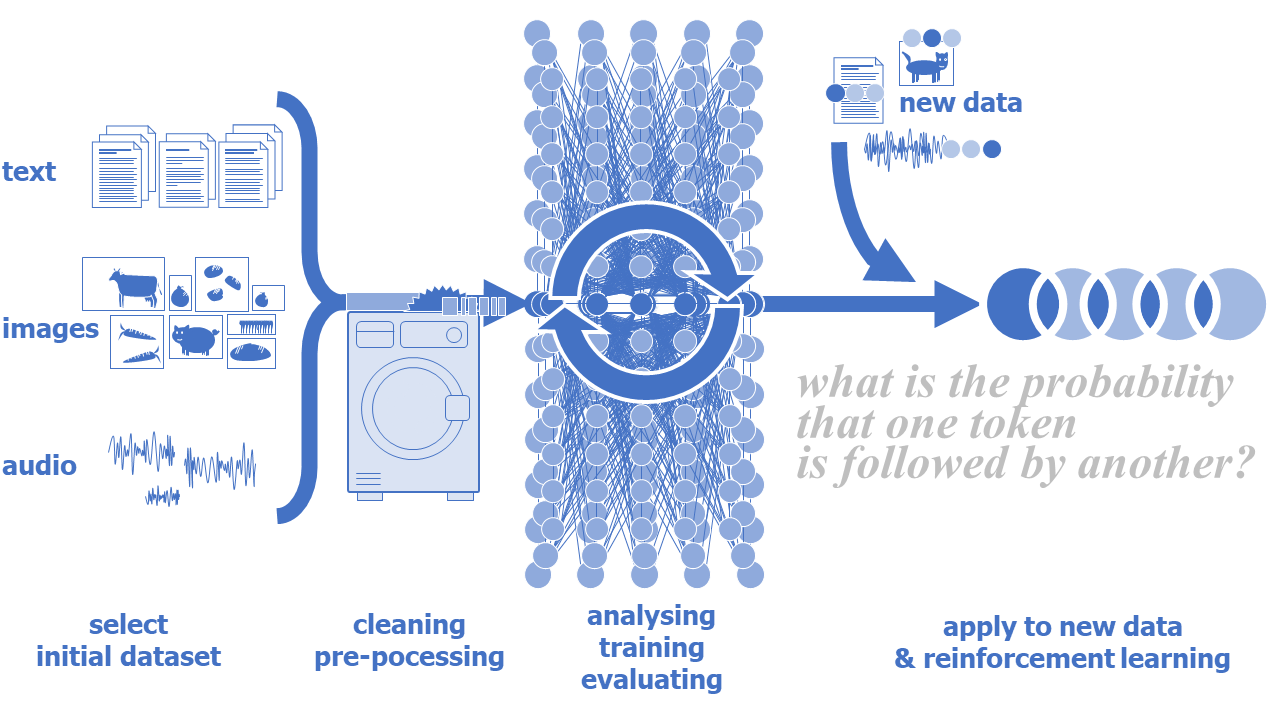
Example:
If the prompt "Artificial intelligence is" is entered, the model calculates, based on the probabilities learned during training, which words are most likely to follow next. A hypothetical distribution for the immediate next token might look like this:
possible next token probability (%) a 31.4% an 22.7% important 15.2% a key technology 9.6% relevant 6.9% unstoppable 4.2% part of our everyday life 2.3% the future 1.8% a myth 1.1% [other] 4.8% The model then "decides" on the token with the highest probability (greedy sampling), selects one randomly according to the probability distribution (sampling), or uses a mixed strategy (e.g. temperature sampling or top-k sampling).
Important: Depending on the sampling mode, the result for the same prompt may vary. Deterministic settings (e.g. temperature = 0) will always produce the same result, whereas stochastic methods (e.g. temperature > 0, top-k or nucleus sampling) create diverse outputs to increase creativity.
As a result, the same prompt like "Artificial intelligence is" might be followed by "a key technology" or "a myth" - depending on randomness and sampling settings.
If, for instance, "a" is selected, the model proceeds to calculate new probabilities for the next token, such as:
"Artificial intelligence is a..."
possible next token probability (%) technology 38.5% development 17.2% challenge 13.4% form of machine learning 9.1% supportive agent 6.6% threat 4.8% [other] 10.4% In this way, the model generates text token by token, reflecting the most statistically likely word sequence - but not necessarily a factually validated or logically sound statement.
This recursive probability calculation occurs thousands of times per second. It explains why LLMs are capable of generating linguistically impressive results without actually "understanding" the content.
LLMs are predictive text generators. They do not possess understanding in the human sense but generate text that is linguistically plausible and statistically likely. They have no semantic model of the world and no awareness of truth, context or meaning.
On the one hand, this results in remarkable capabilities in handling language:
- Contextualised wording of texts
- High level of grammatical accuracy
- Stylistic adaptability to different genres and formats
- Imitation of rhetorical structures
- Switching perspectives and roles (e.g. simulating expert reports, interviews, or dialogues)
At the same time, there are structural limitations and risks that must be critically assessed when using LLMs in academic contexts:
-
Hallucinations: LLMs may invent information, such as non-existent studies, sources, authors or facts. These outputs may sound convincing but are factually incorrect.
-
False references: Citations or bibliographic entries are often fabricated and do not match any real publication - especially in models without access to external databases.
-
Outdated knowledge: Training data is typically limited to a specific time frame. As a result, recent developments may not be reflected.
-
No traceability: LLMs cannot indicate the origin of specific knowledge, as they do not contain explicit documentation or internal citation structures.
-
Bias and stereotypes: Because LLMs are trained on publicly available text, they may replicate social prejudices, imbalanced narratives or discriminatory content.
-
Linguistic superficiality: Although the texts appear coherent, they often remain vague, uncritical and lacking in theoretical depth - particularly in response to complex academic questions.
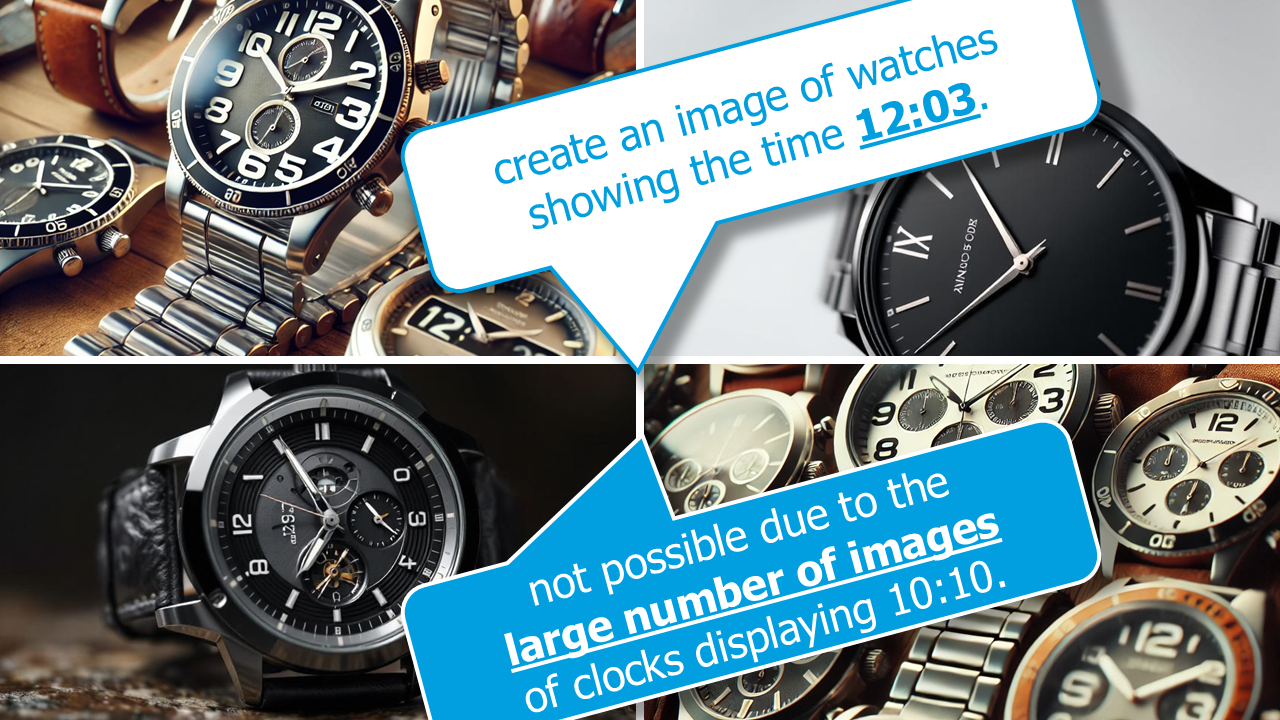
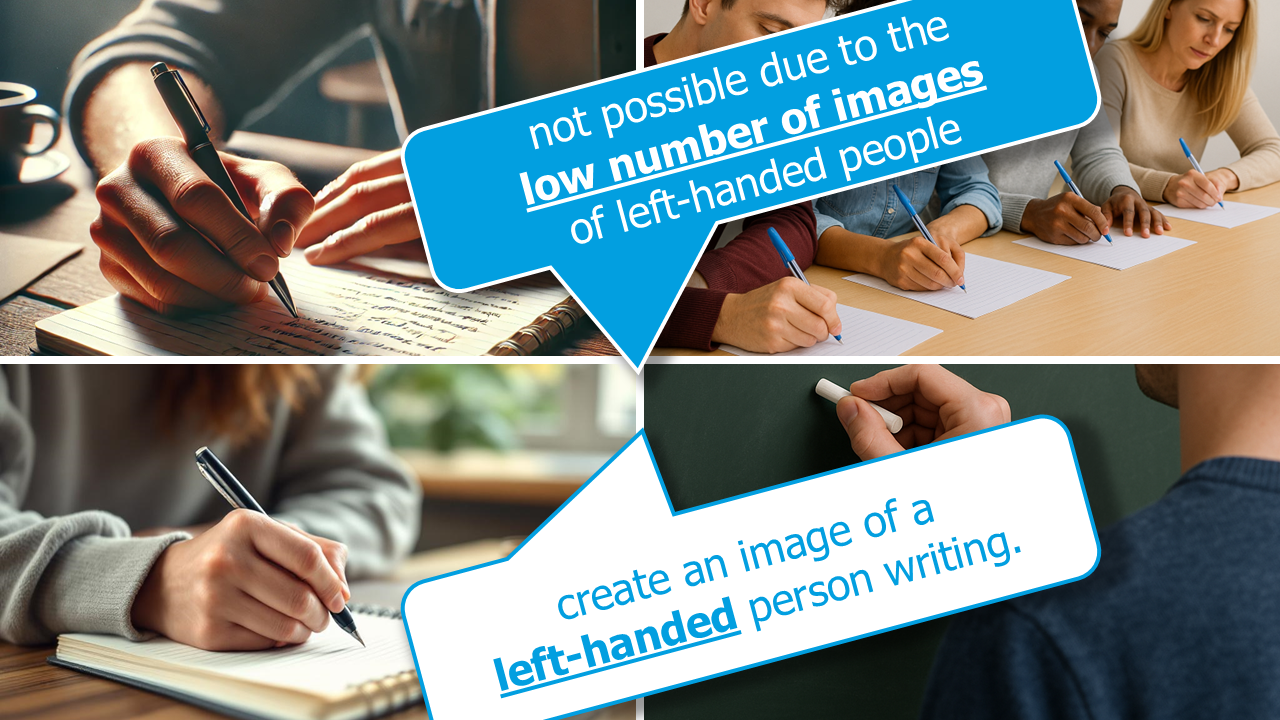
In academic practice, this means that LLMs can serve as a tool for linguistic support or idea generation - but not as a reliable source for factual information or scholarly references.
For further insights into how large language models (LLMs) work... ^ top
... the visualisation of text generation provided by soekia or Look into the Mind of the Machine von moebio.com is highly recommended. Please note that when accessing these external websites, certain data (e.g. IP address, timestamp, browser information) will be transmitted to the website operator. Information on how this data is handled can be found in the respective privacy policies.
4.2 Legal Framework and Copyright in the Context of AI ^ top
The use of Artificial Intelligence (AI) in academic study and research is not only a methodological or didactic issue - it also involves legal foundations, particularly concerning transparency, copyright, and accountability. Two international frameworks - the OECD Principles for Trustworthy AI and the EU AI Act - provide a normative reference. In addition, national copyright laws and university-specific requirements regarding the declaration and citation of AI use must be observed.
4.2.1 OECD Principles for Trustworthy AI ^ top
The OECD Principles on Artificial Intelligence were adopted in 2019 as the Recommendation of the Council on Artificial Intelligence (OECD/LEGAL/0449). They define five overarching principles for trustworthy AI systems and serve as an ethical and legal orientation framework.
-
Inclusion and well-being: AI systems should serve humans, improve quality of life, and promote social progress.
-
Human-centred values and fairness: AI must respect human rights and avoid discriminatory outcomes.
-
Transparency and accountability: Decisions made by AI systems must be explainable, verifiable, and well documented.
-
Robustness and safety: Systems should be reliable, secure, and protected from manipulation.
-
Accountability: Humans remain responsible for the use and consequences of AI - not the machine.
4.2.2 EU AI Act ^ top
The Artificial Intelligence Act (EU 2024/1689) entered into force on 1 August 2024, with phased implementation until 2026-2027. It represents a globally pioneering legal framework that categorises AI systems according to risk and sets binding requirements for providers and users.
Risk-Based Regulatory Approach ^ top
The EU AI Act follows a tiered, risk-based regulatory model, dividing all AI systems into four categories. Depending on their potential impact on fundamental rights, safety or democratic values, different requirements apply. This approach enables a differentiated regulation that considers the diverse fields of AI application - including science, business and public administration.
| Risk Level | Description | Regulatory Consequence |
|---|---|---|
| Prohibited | AI applications that manipulate, surveil or discriminate against humans | Strict ban within the EU |
| High-Risk | Systems affecting safety, fundamental rights or life paths | Registration, risk management, audit duties |
| Limited Risk | Applications with lower but relevant impacts on users | Transparency obligation for end users |
| Minimal Risk | Everyday AI uses with no significant risks | No regulatory requirements |
Use Cases:
-
Universities: The use of AI-based exam software for automated assessment or cheating detection may be considered high-risk - especially if decisions are made without human oversight. Transparent criteria and demonstrably non-discriminatory evaluations must be ensured.
-
Real Estate Sector: AI systems for automated property valuation or tenant selection may fall under the limited or high-risk category - particularly if they process sensitive personal data or facilitate discrimination.
-
Facility Management: The use of AI-driven surveillance or hazard detection systems in buildings may classify as high-risk. This requires thorough documentation, risk assessments, and human oversight mechanisms.
-
Energy Sector: AI applications controlling critical infrastructure such as power grids or district heating are typically classified as high-risk, especially when affecting supply security or the environment.
-
Sustainability Management: AI-assisted environmental impact assessments or emission forecasts are usually considered limited risk. Nonetheless, transparent data sources and traceable models are essential to avoid misinterpretations or flawed decisions.
Transparency Obligations for General-Purpose AI (GPAI) ^ top
General-purpose AI systems (GPAI) have been subject to specific transparency obligations since the EU AI Act came into force. These requirements apply in particular to the development and use of language models such as ChatGPT, Claude or Luminous, but also to other generative or multimodal AI systems. The aim of transparency is to ensure that users and regulatory authorities can understand how a model was trained, what data it relies on, and in which contexts its application becomes legally, ethically or copyright relevant.
| Requirement | Contentual Obligation |
|---|---|
| Technical Documentation | Description of model architecture, training parameters and functional logic |
| Training Data Information | Summary of data sources, including notes on copyright and data protection |
| Labelling Requirement for AI-Content | Obligation to clearly mark generated content (e.g. text, image, audio, video) as AI-produced |
| Documentation of Use Cases | Description of potential application scenarios and associated risks |
Use Cases:
-
Higher Education: AI-powered writing assistants such as ChatGPT must be used transparently and clearly labelled when applied in the preparation of academic texts. For automatically generated passages, disclosure of the prompting and the use of AI in term papers or theses is mandatory. In published research based on AI-generated content or data, the origin and limitations of the AI output must be stated.
-
Real Estate Industry: When generative models are used for automated text generation in brochures or appraisals, it must be transparent whether the content was machine-generated. This is especially important for legally sensitive claims regarding valuation, sustainability, or investment decisions.
-
Facility Management: The use of generative AI for creating maintenance reports, safety assessments or procedural instructions requires clear labelling—especially when such documents are used for internal decision-making or external certification purposes.
-
Energy Sector: AI-generated simulations or energy forecasts used to support investment decisions, grid management or sustainability reports must be clearly marked as such. This also applies to automated sustainability indicators (e.g. CO2 footprints), which must be disclosed appropriately.
-
Sustainability Management: When environmental reports, indicator sets or strategic documents are partially written or formulated by GPAI systems, the specific AI tools used must be named. It must be clear whether the statements are based on verified data or on plausible but unverifiable AI output.
Example: Labelling AI-Generated Texts
Some textual sections of this environmental report were produced using a generative language model (ChatGPT, OpenAI - status: August 2025). The AI-supported text generation was primarily used for linguistic refinement of technical content and for structuring explanatory texts in the following sections:
- Section 2.1 "Introduction to the Organisation’s Sustainability Understanding"
- Section 4.2 "Potential of Digital Technologies in Energy Management"
- Glossary definitions (e.g. Scope emissions, circular economy, biodiversity indicators)
The content was generated based on defined prompt instructions, editorially reviewed and fact-checked by qualified personnel. No automated data analysis or decision-making was carried out by the AI. Responsibility for content, accuracy and interpretative value lies entirely with the publishing institution.
Prompt Examples (Extract):
Prompt 1:
"Write a clear introduction to the concept of circular economy for use in an environmental report by a regional energy provider."Prompt 2:
"Explain in factual language how AI-supported consumption forecasts can improve operational energy management - target audience: sustainability report of a university."In line with transparency requirements under the EU Regulation (AI Act), the use of AI was documented and can be disclosed upon request.
Extended Obligations for Systemically Risky GPAI ^ top
In addition to general transparency requirements, specific regulations apply to so-called "systemically risky General-Purpose AI" models (e.g. very large language models with significant reach). These models have a heightened potential to influence socially relevant processes, such as through mass deployment, integration into safety-critical systems or involvement in sensitive decision-making.
| Requirement | Content-based Obligation |
|---|---|
| Security Assessments and Risk Evaluation | Systematic identification, analysis and minimisation of potential harms caused by the model |
| Risk Reporting Mechanism | Enablement of user reporting in cases of malfunction or fundamental rights violations |
| IT Security and Robustness | Protection against unauthorised use, model tampering and data exfiltration |
| Registration with EU Database | Obligation to officially register the model in the EU GPAI database |
Use Cases:
-
Higher Education: The use of large generative AI models in research, teaching or administration - such as in automated feedback tools, chatbots or analysis systems - requires additional safety precautions when these models are widely deployed or have access to sensitive data. The use must be documented, monitored and controlled.
-
Real Estate Sector: When generative AI systems are integrated into customer portals, portfolio analyses or automated reporting processes, strong safeguards are essential - particularly to avoid errors or discriminatory content. If a systemically widespread model (e.g. GPT‑4) is used, a formal risk assessment is required.
-
Facility Management: Advanced FM systems using generative models for predictive maintenance, communication or analysis of technical data may be considered systemically risky - especially when connected to critical infrastructure. Ongoing risk management is legally required in such cases.
-
Energy Sector: In scenarios where GPAI is used to manage energy flows, grid stability or emissions forecasts, the regulatory demands are particularly strict. Large-scale models must be protected from manipulation and undergo regular technical and ethical evaluations.
-
Sustainability Management: GPAI can be employed to simulate complex scenarios or automate sustainability reporting. Where systemically relevant models are used, obligations include IT security, model transparency and the implementation of risk reporting mechanisms - especially when governance processes or external communications are affected.
4.2.3 General Data Protection Regulation (GDPR) ^ top
The General Data Protection Regulation (GDPR) is a regulation of the European Union that governs the processing of personal data. It entered into force on 25 May 2018 and is directly applicable in all EU member states. Its aim is to harmonise data protection standards across the EU and to strengthen the right to privacy for individuals.
The GDPR replaced the earlier Data Protection Directive from 1995 and sets out comprehensive rules on the rights of data subjects, the duties of data controllers and processors, and mechanisms for enforcement and accountability. It applies to all organisations processing personal data of EU citizens - regardless of whether the organisation is located within or outside the EU.
Key principles of the regulation include lawfulness, fairness, transparency, purpose limitation, data minimisation and accountability. The regulation strengthens the rights of individuals to control their data and imposes significant fines for non-compliance. It is widely regarded as a milestone in European data protection law - especially in the digital age, where data-driven technologies such as artificial intelligence play an increasingly central role.
Based on: General Data Protection Regulation © 2025 by [Wikipedia contributors] - licensed under Creative Commons Attribution 4.0 International, edited and summarised by Christian H. Huber (2025).
APA reference:
Wikipedia contributors. (2025, July 26). General Data Protection Regulation. Wikipedia. https://en.wikipedia.org/w/index.php?title=General_Data_Protection_Regulation&oldid=1302671099. Licensed under CC BY 4.0.
The use of generative AI in academic or professional contexts raises fundamental questions about data protection. Although artificial intelligence is not explicitly regulated under the GDPR, core data protection principles are directly applicable - particularly where personal, sensitive or confidential information is entered into or processed by AI systems.
As such, the General Data Protection Regulation (GDPR) serves as a key legal framework for the use of AI in many scenarios - whether publicly available tools or locally deployed models are used.
The following requirements apply generally under GDPR - not only in relation to AI but also in the context of surveys, interviews and other forms of data collection and analysis.
| Principle | Requirement |
|---|---|
| Purpose Limitation | Data may only be processed for a clearly defined and legitimate purpose. |
| Data Minimisation | Only the minimum amount of personal data necessary for the purpose may be processed. |
| Transparency | Data subjects must be informed about the nature, scope and purpose of the data processing. |
| Legal Basis | Each processing operation must be based on a valid legal ground (e.g. consent, contract, statutory obligation). |
| Data Subject Rights | Individuals have the right to access, rectification, erasure, restriction and objection. |
| Security & Confidentiality |
Common Data Protection Issues in the Use of Generative AI ^ top
-
Many AI providers store and analyse user inputs to improve their models. This practice may conflict with the intended purpose or violate data minimisation principles.
-
Inputs containing personal data (e.g. names, student ID numbers, addresses, health-related information) are considered highly sensitive and require special protection.
-
The use of generative AI in teaching, research or practice-based projects may unintentionally disclose internal or confidential data to external parties.
-
Responsibilities for GDPR-compliant AI usage are often unclear in academic and organisational settings.
Use Cases:
-
Higher Education: Students enter personal information (e.g. case studies, personal experiences, project data) into a publicly accessible AI tool without prior anonymisation. This poses a high risk, particularly in the context of final theses or course evaluations.
-
Facility Management: Sensitive data from building monitoring systems (e.g. movement profiles, energy consumption of individual rooms) is processed by an AI system that stores the input for further use, without explicit consent from the individuals concerned.
-
Real Estate Sector: Customer requests containing names, income statements or contract details are input into a generative model to create automated response suggestions. Such use may breach Article 6 of the GDPR.
-
Energy Sector: Consumption data from smart meters is used to generate forecasts via AI. Sharing this data with third-party providers without prior legal assessment may constitute a violation of data protection regulations.
-
Sustainability Management: Environmental data with personal reference (e.g. noise complaints) is entered into AI systems during practice-based projects with municipalities or companies - without documented risk assessments or technical safeguards.
Recommendations for GDPR-Compliant Use of AI ^ top
| Measure | Explanation |
|---|---|
| Anonymise Inputs | All personal data should be removed or replaced before using an AI tool. |
| Review Terms of Use | Check whether the provider stores, shares or further processes the data for other purposes. |
| Fulfil Information Obligation | Inform affected persons about how their data will be used (e.g. in projects or research studies). |
| Avoid Sensitive Data | Do not enter health data, political opinions or performance-related personal data without prior consideration. |
| Prefer Local Solutions | If possible, use locally operated, GDPR-compliant AI systems. |
| Consult Data Protection Officer | In case of uncertainty, the involvement of the data protection officer is mandatory. |
In addition to careful tool selection and data minimisation, particular attention must be paid to the risks of automated decision-making involving personal data. According to Article 22(1) of the GDPR, it is generally prohibited to subject individuals to decisions based solely on automated processing if these decisions produce legal effects or similarly significant impacts.
This applies, for example, to cases where an AI system independently determines admission to degree programmes, awards marks, or selects applicants - without human review. Such processing is only permissible in exceptional cases, e.g. with explicit consent or when necessary for the performance of a contract. In any such scenario, protective safeguards such as transparency, contestability and human oversight must be ensured.
| Example Scenario | Explanation |
|---|---|
| AI-Based University Admissions | A large language model (LLM) evaluates motivation letters without human intervention. Prohibited under GDPR unless consent is obtained. |
| Staff Selection in FM Projects | An AI tool generates a ranking based on historical data, without transparent criteria or traceability. |
| Automated Scoring for Energy Contracts | An AI system assigns user risk profiles (e.g. for dynamic pricing) without sufficient transparency and with potential for discrimination. |
4.2.4 Copyright and Ownership of AI-Generated Content ^ top
The legal status of content generated by generative AI remains complex and unresolved. The EU AI Act does not directly regulate this issue but refers to existing national copyright laws and transparency obligations. In practice, a tension arises between technological innovation, legal accountability and academic integrity.
| Question | Legal Assessment |
|---|---|
| Can AI be a creator or rightsholder? | No. Only natural persons can hold copyright. AI systems have no legal personhood. |
| Who owns the output? | The person who uses or publishes the content - depending on terms of use and tool licensing. |
| Is AI-generated content protected by copyright? | Only if a human contributes significantly to the creative process (originality). |
| Must AI use be documented? | Yes - in scientific and reporting contexts, documentation is mandatory. |
Application Examples:
-
Higher Education: If a section of a sustainability report is generated using AI, it must be clarified whether protected third-party content has been incorporated. This also applies to AI-generated graphics, especially when training data may have included copyrighted materials.
-
Real Estate: Automatically generated market analyses or location ratings must clearly reference the data sources used. In the case of AI-generated property descriptions for listing platforms, the risk of unintentional replication of protected templates must be assessed.
-
Facility Management: When AI is used to generate reports, instructions or dashboards, it must be determined whether original, protectable creative contributions are involved - such as visual interfaces created with AI assistance.
-
Energy Sector: AI-generated reports on emissions or energy efficiency indicators may contain copyrighted elements, especially when including layout, phrasing, or visualisations beyond mere technical representation.
-
Sustainability Management: When generative AI supports the creation of texts or visuals for environmental reports or CSR communications, a clear distinction must be made between original human input and AI support - particularly in publicly funded projects or certification processes.
4.3.1 Potential and Opportunities ^ top
Generative AI can meaningfully support students and researchers in various phases of academic work - especially in tasks related to language, structure, or organisation. These functions may enhance academic independence and efficiency - provided they are used with purpose, critical reflection, and awareness of source integrity.
| Application Area | Examples of Potential Use |
|---|---|
| Idea Generation | Brainstorming topics, perspectives, or arguments |
| Research Preparation | Structuring search terms, suggesting research questions |
| Writing Support | Drafting text, rephrasing, summarising |
| Translation and Style Guidance | Adjusting texts to academic language registers |
| Structure and Outline | Suggesting structures for abstracts, chapters, or arguments |
| Data Analysis and Coding | Support with scripts in Python, R or LaTeX |
| Learning Support | Explaining concepts, definitions, and examination formats |
4.3.2 Challenges and Limitations ^ top
Despite the remarkable capabilities of generative AI, there are numerous limitations that require critical reflection—especially within academic contexts:
-
Misinformation and Hallucinations
A core issue in using generative AI is the risk of misinformation. Even when linguistically correct and stylistically coherent, AI-generated content may be factually incorrect, fabricated, or misleading. Language models are not based on a verified database of facts; they rely on statistical probability models. These models predict which word or phrase is most likely to follow in a given context—regardless of its factual accuracy. In other words: they do not produce "truths" but plausible sequences of words.For instance, when asked to provide a reference, quotation, or theory, a model might generate content that appears convincing in form but is entirely fabricated. This phenomenon is known as hallucination—and it is particularly common with longer, complex prompts or questions relating to niche academic subjects.
A particularly problematic outcome is the generation of non-existent academic sources or authors. In such cases, models combine plausible names, book titles, publication years, and publisher locations into entirely fictional citations. Students who use such references without verification risk committing academic misconduct or including false citations in their scholarly work.
The presentation of theories, concepts, or studies may also be inaccurate. Models tend to oversimplify, decontextualise, or distort scholarly arguments. They may conflate different approaches, invent empirical relationships, or attribute content to well-known scholars that these individuals have never expressed. This is especially deceptive because such responses are often phrased in polished academic language, giving the impression of scholarly accuracy.
In addition, language models often produce shallow or vague content, particularly when prompts are too general or ambiguous. The result may be formulaic texts that simplify complex issues and fail to provide adequate academic insight. In scientific writing, this can lead to the uncritical adoption of flawed arguments, inconsistent logic, or misinterpreted theoretical frameworks.
Within study and research contexts, this means: generative AI can offer inspiration, suggest phrasing, or support structural tasks—but it cannot replace independent research, critical engagement with sources, or content-based reflection.
Every AI-generated output must be verified, contextualised, and—if used—supported by academically sound references. -
Bias and Stereotypes
Generative AI is based on the principle of learning statistical correlations from large volumes of text data to produce plausible new content. Language models do not "understand" content or the societal contexts behind it. Their outputs are solely based on patterns present in the training data—such as frequency, sequence, and weighting of certain linguistic structures. These data mostly originate from publicly available sources such as books, websites, forums, or social media.Crucially, it is not the models themselves that possess prejudices or stereotypes. Bias arises from the way data are selected, curated, and processed—and from how the system is configured during use. The model architecture is only one part of the equation. Equally important are the training data, the training method (e.g. through human feedback), the design of the prompts, and the sampling parameters used during text generation—such as the so-called temperature, which influences whether a model favours safe or creative continuations.
Since most training data come from dominant linguistic and knowledge domains, they reflect those perspectives, norms, and exclusions. Many social groups are either underrepresented or stereotypically portrayed in such corpora. This includes people with marginalised gender identities, non-Western cultural backgrounds, or socially disadvantaged life realities. Language models do not just replicate these disparities—they often amplify them. What appears more frequently in the training data is considered statistically likely—and therefore reproduced more often.
For example: When asked about job titles or role models, models may tend to favour masculine-coded terms, as these occur more frequently in historical and statistical contexts. When asked about social conflicts or inequalities, they often produce neutral or relativising responses, since critical or resistant perspectives are less prominently represented—or algorithmically classified as "outliers".
This imbalance is further reinforced by the economic conditions under which many AI systems are developed. Publicly available content is often used as training data without the consent of the original authors, reducing especially creative or activist contributions to mere datapoints. At the same time, powerful models are typically accessible only via centralised platforms run by large technology companies, making access to AI tools dependent on financial and infrastructural resources.
Moreover, the optimisation goals of many AI systems—such as efficiency, productivity, or scalability—align with market logic and are not always compatible with pedagogical or critical-social objectives. Content that challenges such structures or presents alternative viewpoints is often downplayed, shortened, or framed as less relevant. As a result, it may appear that certain perspectives are more "objective" or "appropriate"—when in fact this is simply the outcome of statistical frequency in an unequal data landscape.
These systemic biases are particularly problematic in academic contexts. They do not merely affect the quality of individual outputs—they also shape which topics are seen as important, which positions are perceived as legitimate, and which forms of knowledge are made available at all.
Anyone using AI tools in academic work must be aware of these mechanisms—and take responsibility: by critically evaluating outputs, conducting counter-research, and transparently reflecting on AI use in their own writing process. -
False Objectivity
Language models produce texts that often give the impression of being objective, accurate, and authoritative. The language used is typically well-structured, grammatically correct, and often even academic in tone. This constitutes a core challenge: AI-generated content appears objective, although it lacks actual content validation, evaluative judgement, or contextualisation.Unlike human authors, generative AI systems possess no intention, no argumentative strategy, and no capacity for reflection. They generate text by predicting the statistically most probable next word—based on the given prompt. This results in a surface-level coherence that is easily mistaken for factual reliability.
This illusion of objectivity is particularly problematic in academic contexts. Students may assume that a well-formulated and coherent text must also be factually correct—an assumption that can lead to uncritical adoption and a lack of verification. Furthermore, many language models rely on common phrases, general statements, or popular narratives that sound plausible but do not meet the standards of evidence-based academic discourse.
Example: In response to a question about the causes of social inequality, a language model might generate a fluent paragraph combining terms such as "equal opportunities", "education", and "economic development". However, the response remains vague, lacks theoretical grounding, and offers no empirical support. If sources are mentioned at all, they are often fabricated or incomplete.
The problem becomes even more apparent when language models address topics requiring ethical consideration, multidimensional analysis, or perspectival thinking. In such cases, the model not only lacks facts but also the ability to identify, weigh, or critically reject different interpretive frameworks. Nonetheless, the output is often perceived as neutral or even authoritative—an impression reinforced by the professional tone of the language.
In academic study and research, this means: Using generative AI requires heightened awareness of the distinction between linguistic form and substantive quality. Just because a text sounds coherent does not mean it is accurate, relevant, or academically valid. Critical reading, independent judgement, and the deliberate use of verifiable sources remain essential.
-
False Objectivity
Language models frequently produce texts that create an impression of objectivity, accuracy, and authority. Their language is typically well-structured, grammatically correct, and often adopts an academic tone. This presents a fundamental challenge: AI-generated content may appear objective, despite lacking any actual content validation, evaluative reasoning, or contextual understanding.Unlike human authors, generative AI systems have no intention, argumentative logic, or capacity for reflection. They generate text by predicting the statistically most likely next word—based solely on the input prompt. This process produces superficially coherent language that is easily mistaken for reliable content.
This illusion of objectivity is particularly problematic in academic contexts. Students may assume that a well-phrased, logically structured paragraph is also factually correct—an assumption that can result in uncritical acceptance and a failure to verify information. Moreover, many language models reproduce formulaic expressions, generalisations, or widely held assumptions that may sound convincing but do not meet the standards of evidence-based academic argumentation.
Example: When asked about the causes of social inequality, a language model might generate a fluent paragraph that links terms such as "equal opportunities", "education", and "economic development". Yet the statement remains vague, theoretically unsubstantiated, and lacking empirical evidence. Where sources are cited, they are often incomplete or entirely fabricated.
The issue becomes even more pronounced when AI is used to discuss topics that demand ethical judgement, multidimensional analysis, or sensitivity to divergent viewpoints. In such cases, models do not merely lack factual accuracy—they also fail to recognise, compare, or critically assess different interpretive frameworks. Nevertheless, their outputs are often perceived as neutral or even authoritative—an effect reinforced by the confident and formal style of delivery.
In academic study and research, this implies: Using generative AI demands a keen awareness of the difference between linguistic polish and substantive rigour. A coherent-sounding paragraph is not necessarily correct, relevant, or academically sound. Critical reading, independent judgement, and the careful use of verifiable sources remain indispensable.
-
Violations of Academic Integrity
The undeclared use of generative AI in academic work can have serious consequences. Especially when text passages—whether directly copied or heavily paraphrased—are generated automatically without disclosure, questions of academic integrity arise. Such usage may create the impression that the content represents original intellectual work, even though it was produced algorithmically. In such cases, examiners or institutions may interpret this as an attempt to deceive—particularly in the context of final theses or graded assignments.A lack of transparent labelling of AI tools increases the risk that poorly cited or incomplete references are perceived as plagiarism. Most language models do not provide reliable sources and may fabricate bibliographic references. Anyone who incorporates such content without verification violates fundamental standards of academic referencing. Copyright law may also be affected—for instance, when AI-generated text is combined with unlicensed third-party material. In addition, university regulations often require an explicit declaration of independent authorship for submitted academic work; failure to comply may breach examination policies.
An equally important concern is the erosion of individual responsibility within the academic process. Students who rely on AI-generated output without contextualising, revising, or critically evaluating it relinquish part of their scholarly judgement and creative responsibility. The ability to analyse complex issues, synthesise arguments from various sources, and draw independent conclusions remains undeveloped—despite being at the core of academic training.
Science depends on transparency, traceability, and personal accountability. Anyone using generative AI in their academic work must disclose this clearly, mark it appropriately, and integrate the generated output critically into their argumentation. Only in this way can the potential of this technology be aligned with the principles of good academic practice.
-
Data Protection Risks
The use of generative AI is not only a matter of efficiency or functionality—it also raises critical concerns regarding data protection and confidentiality. Many AI-based tools, particularly web-based language models, store user inputs permanently on external servers—often outside the jurisdiction of European data protection laws. These inputs may be reused for training purposes, analysed, or even made accessible to third parties. For students, lecturers, and researchers, this means that any prompt formulation must avoid disclosing personal or sensitive information.Special caution is necessary when working with company-related data in the context of academic studies—such as in practical projects, research collaborations, bachelor's and master's theses, or case-based teaching. These may involve confidential insights into internal processes, strategic decisions, financial figures, or employee data. Inputting such information into generative AI tools can breach contractual non-disclosure agreements or even infringe data protection and competition laws.
Empirical research data—such as from interviews, observations, or surveys—often include sensitive content. Even if names are anonymised, limited contextual details (e.g. sector, location, role) may still allow identification of individuals or organisations. When such data is entered into AI systems for analysis or text processing, it risks being stored, processed, or re-used in future outputs—potentially beyond the control of the university or researcher.
Furthermore, many higher education institutions have clear internal guidelines regulating the use of external software in teaching and assessment. These include the use of cloud services, the admissibility of commercial tools during examinations, or participation in research collaborations with third parties. Breaches of these regulations may lead to legal or academic consequences—such as the annulment of exam results or the loss of strategic project partnerships.
Against this background, it is essential to clarify the following questions before using generative AI tools:
-
Does my prompt contain information that can be linked to a real company or an identifiable individual?
-
Am I violating applicable data protection regulations or confidentiality agreements by using this tool?
-
Does the chosen platform comply with the requirements of the General Data Protection Regulation (GDPR)?
-
Are there university-specific guidelines or recommendations for the use of AI in teaching, research, or final theses?
A responsible use of generative AI also involves carefully considering the nature and sensitivity of processed data, making transparent decisions, and opting for privacy-preserving or alternative approaches where appropriate. This includes avoiding real or identifiable data by using fictionalised examples in prompt design and choosing privacy-compliant systems—such as locally hosted AI applications or institutionally approved tools with verified data protection standards.
-
4.3.3 Scientific Standards & Disclosure Requirements ^ top
Transparency, traceability, and independent academic work are fundamental principles of scientific practice. These standards apply without exception to the use of generative AI. Students, lecturers, and researchers who use tools such as Mistral, ChatGPT, Claude, or Gemini in their work must clearly state how and for what purpose these tools were employed.
The use of AI is not inherently inadmissible—it can support specific phases of the academic process. However, it is crucial that such use is properly disclosed, critically assessed, and not mistaken as a substitute for independent academic work. In particular, failure to declare the use of AI in exam-related or final theses may constitute a breach of academic integrity.
The appropriate form of disclosure depends on how generative AI was used. Three typical scenarios can be distinguished:
-
Use for idea generation, research planning, or structuring support
If a language model was used to structure topics, formulate research questions, or receive suggestions for outlines—without directly incorporating generated text—then formal citation is not required. However, a brief note should still be included to ensure transparency.
Example Disclosure:
The language model [NAME OF SERVICE, PROVIDER, VERSION OR PERIOD OF USE] was used in an exploratory manner for [DESCRIPTION OF USE, E.G. GENERATING TOPIC IDEAS, DEVELOPING STRUCTURE, ETC.]. The generated output was not directly adopted but served exclusively as orientation and inspiration. All content was reviewed and revised where necessary. Full responsibility for the content of this work remains with the author.
-
Incorporation of AI-Generated Text (Verbatim or Paraphrased)
If AI-generated text—either in whole or in part—is included in the work, at least four actions are required:
-
Transparent labelling within the main text
-
Inclusion of the full prompt that led to the generated text
-
Appendix containing the original output (e.g. chat log or screenshot)
-
Citation in the reference list with tool name, version, and URL
Disclosure - Example of Verbatim Use:
In response to the question "Name five principles for avoiding plagiarism in academic writing", ChatGPT generated the following text:
"Plagiarism in academic writing can seriously damage a researcher's or student’s reputation and lead to severe academic and professional consequences. To avoid plagiarism, the following five principles should be observed:
- Use your own words: Even when information is taken from a source, it should be rephrased in your own language. This demonstrates understanding and the ability to contextualise the material.
- Cite and reference: Every time information, data or ideas are drawn from another source, they must be cited properly. This applies to both direct quotations and paraphrased content. Citation styles (e.g. APA, MLA, Chicago) may vary, but consistency is essential.
- Conduct thorough literature research: Ensure that all relevant sources on the topic are reviewed. This reduces the risk of unintentionally presenting others’ ideas or findings as your own.
- Use plagiarism detection software: Many tools are available to scan texts for plagiarism. These compare the content to numerous internet and academic database sources to detect similarities.
- Understand and respect copyright: It’s important to understand what copyright entails and how it applies to academic work. Copying and pasting images, graphics or longer passages without permission or proper citation may constitute plagiarism." (OpenAI, 2023)
Disclosure - Example of Paraphrased Use:
In response to the question "Name five principles for avoiding plagiarism in academic writing", ChatGPT generated a text stating that correct citation, original phrasing, thorough literature research, the use of plagiarism detection tools, and awareness of copyright are key elements (OpenAI, 2023; see Appendix A for the AI-generated output). In the reference list:
OpenAI. (2023). ChatGPT (Version as of 25 September) [Large Language Model]. https://chat.openai.com/chat -
-
Use for Language Editing or Stylistic Revision
When generative AI is employed to refine, simplify, or revise the style of one’s own text, it constitutes a form of editing—comparable to spelling and style correction functions in word processing software. Editing and proofreading do not involve checking for content accuracy or completeness. Structural changes, if any, are minimal. There is no complete rewriting of the text and no translation. The sole focus is on improving grammar, clarity, and tone.
With suitable prompts, a generative AI or LLM can assist in the linguistic refinement of self-written texts. However, no content-related changes are permitted—only stylistic and linguistic adjustments.
Example Prompt
You are acting as a scientific editing tool for academic texts in [ENGLISH / GERMAN - insert preferred language].
Please revise the following text with focus on:
- Spelling, punctuation, and grammar
- Stylistic clarity and readability, including:
- Simplifying overly complex sentence structures where appropriate,
- Avoiding unnecessary repetition,
- Clarifying vague or weak expressions
- Consistency in terminology and spelling
- Maintaining a neutral, factual, and academically appropriate tone
Limitations:
- No changes or additions to content
- No restructuring of paragraphs or outline levels
- No fabrication or insertion of quotations, data, or sources
- The argumentation structure and all citations remain unchanged
Goal:
The edited text should meet the formal requirements of a bachelor’s / master’s thesis [or: seminar paper, academic article, etc.] at a German- or English-speaking university.Output format:
Provide the revised text in the following format:
"Original Section -> Revised Section"Here is the text to be edited: [Text]
Disclosure
[NAME OF TOOL / SERVICE] by [NAME OF PROVIDER, VERSION OR TIMEFRAME USED] was applied for the editing (linguistic and stylistic revision) of the author’s self-written text. No changes or additions were made to the content. The final result was reviewed and adjusted if necessary. The author retains full responsibility for the published content.
-
Use for Image Generation

Use the AI-label from AI-label.org to mark AI-generated content.
4.4 Effective Prompting ^ top
Generative AI is not an autonomous knowledge system but responds to targeted user input—so-called prompts. The quality of the generated output largely depends on the clarity, precision, and goal orientation of the prompt.
While short keywords often lead to general or irrelevant results, a thoughtfully composed prompt can produce differentiated, content-relevant, and structurally coherent responses. This is especially true in academic contexts, where accuracy, traceability, and appropriate language use are essential.
4.4.1 How Language Models Process Prompts ^ top
Interacting with a language model is less like conversing with a person and more like navigating a vast, partially illuminated web of knowledge. Many observable phenomena can be traced back to the architecture of modern language models—particularly the so-called Transformer architecture, which underlies models such as ChatGPT.
Language models generate text based on statistical probabilities. They do not build semantic understanding but instead predict the most likely next token (text element) given the previous context. This process is based on a large corpus of training data from which recurring patterns are extracted. The processing relies on a self-attention mechanism, which enables the model to detect and weight relationships between tokens within the same input. It analyses each token in the context of all others in the prompt and determines mathematically which of them are most relevant for the next prediction. This results in a dynamic weighting that can model grammatical dependencies, thematic coherence, or contextual links—regardless of word order in the sentence.
While these mechanisms allow for coherent text production, they also limit understanding, contextual depth, and purposeful direction. The following phenomena illustrate how this affects prompting.
-
Limited Focus
The self-attention mechanism analyses all tokens simultaneously but concentrates its weighting on what is statistically emphasised in the current prompt. The model’s focus resembles a narrow beam of light in a large room—only the area actively triggered by the prompt is "illuminated". Everything not currently highlighted may be ignored—even if it was part of the conversation before.
Example: If a coding error is corrected but not referenced again in the next prompt, the model might repeat the same error because the focus has shifted.
-
No True Memory
Despite receiving the chat history as input, the model has no long-term memory. There is no stable state management or lasting recall of previous corrections. Context is processed statistically and loses significance once it falls outside the active context window or is overwritten by new input.
This poses a challenge for complex tasks such as multi-step coding or iterative text development, where the model cannot maintain consistent continuity.
-
Statistical Averaging
Language models are trained to generate outputs that are statistically plausible. As a result, they tend to favour frequent, established, or linguistically safe expressions. Less conventional, more complex, or highly creative content appears less often in the training data and is therefore less likely to be generated—even if such content would be more appropriate.
This leads to superficiality in content and a tendency to rely on clichés or formulaic structures.
-
Lack of Prompt Clarity
Since the model has no inherent goal, it relies entirely on how the prompt is formulated. Vague, ambiguous, or overly broad instructions prompt the model to explore multiple possible interpretations. This can result in a lack of structure, disjointed reasoning, or mismatched response formats.
In such cases, the "beam of light" becomes diffused and fails to target the intended focus.
-
Prompt-Based Forgetting
Each new prompt represents a context shift for the model. Without explicit references to prior content, the statistical relevance of earlier input fades or is ignored. Even recent corrections may be neglected unless reactivated.
This makes multi-step tasks with intermediate results or iterative feedback cycles more difficult to manage.
-
Limited Domain and World Knowledge
A model’s knowledge is strictly based on its training data, which is neither complete nor up to date. Specialised topics, recent research, or licensed content (such as academic journal articles) are often underrepresented. The model's ability to synthesise information across sources is also limited.
In such cases, the model defaults to popular narratives or simplified explanations.
-
Lack of Intentionality
A transformer model does not possess any cognitive aim or intentional reasoning. It does not plan, evaluate, or pursue an understanding. It merely reacts to input by predicting the next plausible token. It does not check for consistency, construct arguments, or assess results.
Without targeted guidance through the prompt, the model remains in a reactive mode—it does not progress, reflect, or learn.
The effectiveness of generative AI depends not solely on the model itself, but significantly on the quality of the prompt. A language model is a powerful tool—but one without intent, understanding, or direction. Users who craft precise, context-aware prompts can compensate for these structural limitations and achieve higher-quality results.
The metaphor of the flashlight offers guidance: Only what lies within the prompt’s beam is processed. Clear, focused inputs, active references, and structured expectations are key to better answers.
4.4.2 Examples of Effective Prompt Engineering ^ top
-
Original Text 2: The present systematic review analyses the approaches and results of international studies on the topic of user satisfaction. Below an overview summarizes the most important results:
• A growing interest in recent years in the subject "user satisfaction" and related topics was examined.
• Fewer studies give an overview of different countries.
• The studies mainly focus on a single type of building.
• No comparison between building types and countries is shown.
• Questionnaires are by far the most common collection type.
• There is no uniform questions design.
• The examined target is defined differently for different building typologies and the common target "user satisfaction" is followed by "productivity" and the small but significant proportion of "customer - or clientele loyalty".
• Explanatory variables cannot be clearly identified in the studies.
• Explanatory variables differ for different building types.
• The detection of criteria does not reflect the importance of the criteria as an influence on user satisfaction.
Huber, C., Koch, D., & Busko, S. (2014). An international comparison of user satisfaction in buildings from the perspective of facility management. International Journal of Facility Management, 5(2), 10. ↩ -
Original Text 3: A comparison of the correlation coefficients of individual studies has been impossible due to the large differences in the survey design. For this reason we weighed the most important results and compared them. Figure 7 shows that in all studies of office buildings, where temperature sensation as a variable had been examined, a high influence on user satisfaction could be noticed. This was the case in just 60% of the studies which examined the variable "temperature" on user satisfaction in residential real estate, this, however, with a high impact.
Huber, C., Koch, D., & Busko, S. (2014). An international comparison of user satisfaction in buildings from the perspective of facility management. International Journal of Facility Management, 5(2), 8. ↩ -
Original Text 4: Der Begriff Nutzerzufriedenheit ist in der Literatur sehr weitläufig definiert und ist für die Gebäudetypologien unterschiedlich. Zanuzdana, Khan und Kraemer (2012) geben hierbei einen kurzen Literaturüberblick im Bereich Wohnimmobilien und Nutzerzufriedenheit ("residential satisfaction"). Im Bereich Wohnimmobilien gibt es hierbei unterschiedliche Spezialisierungen, bspw. fokussieren Perez et al. (2001) ihre Analysen auf Nutzerzufriedenheit hinsichtlich altersgerechten Wohnen, worauf sich auch ihr Literaturüberblick fokussiert. Muhammad, Sapri, and Sipan (2013) untersuchen das Wohlbefinden ("wellbeing") in Gebäuden im Hochschulwesen. Hui (2013) zeigt den Einfluss von FM-Services hinsichtlich Kundenzufriedenheit ("customer satisfaction") in Shopping Centern und gibt hierzu einen Literaturüberblick. Appel-Meulenbroek, Groenen, and Janssen (2011) wiederum untersuchen prozessorientierte Bürokonzepte hinsichtlich Mitarbeiterzufriedenheit und Produktivität. Dabei geben Sie ebenfalls einen breiten Literaturüberblick im Bereich Büro bzw. Arbeitsstätten ("workplace").
Busko, S., Huber, C., & Koch, D. (2014). Impact factors on user satisfaction: An international, systematic literature overview. Journal for Facility Management, 9, 8-22. DOI: 10.34749/jfm.2014.2061 ↩
