![Creative Commons 4.0 International Licence [CC BY 4.0]](https://melearning.online/compendium/themes/simpletwo/images/meLearning/cc-by-large.png)

Academic Language
Fundamentals, characteristics, and principles of objective, precise, and inclusive academic language
AI-modifiedAI Use Information for this Web Page
The textual content of this page is AI modified.
- AI status: Modified with AI
- Scope: Entire page textual content
- Human oversight: Reviewed by Christian Huber before publication
- Details of AI usage: This page text was processed with AI assistance. The content was originally authored by Christian Huber and subsequently refined using language models to improve structure, consistency, and terminology. All AI-generated suggestions were manually reviewed and approved by Christian Huber before publication. The AI did not generate novel content but supported optimisation of existing material.
- Known limitations: AI-assisted text refinement may produce stylistic over-corrections; synonym suggestions may lack domain-specific precision; consistency checks may not account for intentional stylistic variation; applied grammar rules may reflect language model bias rather than prescriptive standards; estimated accuracy for editing suggestions: 94–97%.
- Example prompt used:
Example: "Improve clarity and consistency in this text whilst preserving the original voice. Check grammar, fix repetition, and ensure terminology is standardised. Suggest changes only, do not modify content." - Data flow: No personal data included. No data retention by model provider beyond session duration. No external storage or third-party sharing.
- Liability for AI errors: Liability for content accuracy rests with Christian Huber. Disclaimer: AI system recommendations are not binding and do not guarantee correctness.
- Content created: 15 September 2025
- Reviewed by: Christian Huber


Summary
Note: This summary was produced with AI support, then reviewed and approved.
- Academic language is more than a neutral medium. It structures thinking, makes results verifiable and embeds research in the wider discourse. It differs from everyday language through clarity, precision and objectivity.
- The core principles include brevity, precision, consistency and logical stringency. The KISS principle keep it short and simple requires presenting content concisely and clearly. Lean Writing avoids linguistic waste and highlights key messages. Precision and objectivity arise from clear terms, transparent reasoning and the avoidance of subjective judgements.
- Stylistic requirements concern sentence structure, syntax and word choice. Clear main clauses, consistent terminology and a preference for active formulations improve readability and flow. Redundancy, filler words and narrative elements are considered obstructive.
- Audience orientation is central. Language must be chosen so that it matches the prior knowledge and needs of the readers whether expert community, interdisciplinary groups or a broader public.
- Gender sensitive, diversity aware and inclusive formulations are not a moral addition but increase academic precision. They prevent misunderstandings, ensure comparability and make it clear who or what is meant.
Topics & Content
- 1. Academic Language as the Foundation for Clear and Precise Knowledge Communication
- Reflection Task / Activity
- 2 Fundamental Principles & Stylistic Requirements
- 2.1 KISS Principle (Keep It Short and Simple)
- Reflection Task / Activity
- 2.2 Lean Text & Lean Writing
- 2.3 Precision and Objectivity
- Reflection Task / Activity
- 2.4 Conciseness and Reduction of Redundancy
- 2.5 Logic and Consistency
- 2.6 Sentence Structure, Syntax & Word Choice
- 2.7 Avoidance of Filler Words, Narrative Elements, and Personal Opinions
- Reflection Task / Activity
- 2.8 Audience Orientation
- Possible forms of audience orientation in academic communication
- 3 Gender-Inclusive, Diversity-Sensitive & Inclusive Language & Communication
- Why a "meant to include all" preamble is not sufficient
- Distinction between gender-inclusive, diversity-sensitive, and inclusive
- 3.1 Fundamentals and Objectives
- 3.1.1 Terminology
- 3.1.2 Core Principles of Linguistic Precision
- Representational Precision
- Traceability
- Comparability
- 3.2 Principles of Precise Formulations
- 3.3 Forms of Linguistic Precision in Inclusive Communication
- 3.3.1 Masculine-Default Terms
- 3.3.2 Paired Gender Forms
- 3.3.3 Gender-Neutral Terms
- 3.3.4 Explicitly Inclusive Phrasing
- 3.3.5 Non-Binary Pronouns and Neopronouns
- 3.3.6 Broader Inclusive Language: Beyond Gender
- 3.3.7 Institutional Titles & Salutations
- Reflection Task / Activity
- 3.4 Inclusive Language
- 3.4.1 Core Principles of Inclusive Language
- 3.4.2 Challenges and Approaches
- 3.5 Easy Read Language
- 3.5.1 Core Principles of Easy Read
- 3.5.2 Challenges and Solutions
- 3.6 Plain Language
- 3.6.1 Core Principles of Plain Language
- 3.6.2 Challenges and Solutions
- 3.6.3 Differences Between Plain Language and Easy Read
- 3.6.4 Relevance for Academic and Higher Education Communication
- 3.7 Intercultural Challenges in Translating Inclusive Expressions
- 3.7.1 Structural & Cultural Discontinuities
- 3.7.2 Strategies for Effective Inclusive Translation
- 3.8 Inclusive Communication in Visual Representations
- 3.9 Names in an International Context
- Examples of international naming conventions
- Guidance for academic practice
- Special cases: name particles (van, von, de, di …)
- Reflection Task / Activity
1. Academic Language as the Foundation for Clear and Precise Knowledge Communication ^ top
In academia, language is far more than a mere tool for communication. It serves as a central instrument for generating, conveying, and safeguarding knowledge. Through language, research findings are documented, made verifiable, and embedded within the academic discourse. At the same time, it is the medium through which complex ideas are organised, refined, and presented in a comprehensible form.
Reflection Task / Activity ^ top
Write down (5–10 sentences): What does academic language mean to you?
What experience do you have with it – where do you need it, and where do you feel unsure?
No research – just your own view.

Enter your notes into an AI. Ask:
“What blind spots or incomplete assumptions are there?”
“Where would a linguist correct me?”

Read the answer. Do I agree or disagree? Note down: Where is the AI wrong – and explain why.

After the chapter: Compare your position with the text.
Did the AI challenge you fairly? Where was it wrong?
What have you come to realise anew?
Academic language follows its own rules and conventions, derived from the fundamental principles of scholarly work. While everyday language is often shaped by situational contexts, informal expressions, and personal nuances, academic language aims for the highest possible clarity, accuracy, and objectivity. It must ensure that statements can be understood unambiguously, regardless of the author’s identity, cultural background, or the reader’s individual interpretative tendencies.
These specific requirements have historical and functional roots. Since the emergence of modern science in the 17th century, it has been essential to record research results in a way that allows others to reproduce, verify, and build upon them. This gave rise to a tradition of writing characterised by systematic presentation, terminological consistency, and logical argumentation. Central to this is traceability: every claim must be supported by verifiable data, sound theories, or recognised scholarly literature.
An academic text thus fulfils several functions at once:
-
Informative function:
Providing all relevant facts, data, and methods in a complete and precise manner. -
Argumentative function
Developing a logical and consistent line of reasoning that leads to well-founded conclusions. -
Documentary function
Recording procedures and results in a form that enables third parties to review and reproduce them. -
Integrative function
Embedding one’s own research into the existing academic discourse by referring to previous work.
The linguistic design has a direct impact on academic quality. Imprecise wording, unnecessary complexity, or inconsistent terminology make comprehension more difficult and weaken the persuasiveness of the argument. Conversely, precise, consistent, and audience-oriented expression enhances readability, facilitates reception, and supports the integration of the work into scholarly exchange.
A precise academic style requires the unambiguous use of terms, avoiding unnecessary scope for interpretation. This includes explicitly addressing all relevant groups where necessary for understanding or data accuracy. Formulations that use only one gender form can lead to ambiguity and distort meaning—particularly if it is unclear whether a statement refers to a subgroup or the whole population. The aim, therefore, is a formulation practice that is technically correct, clear, and institutionally accepted, without compromising content precision.
Engaging with academic language is not merely a formal step at the end of the writing process, but an integral part of research itself. The choice of terms, sentence structure, paragraph organisation, and consistent use of defined terminology are all elements that must be considered from the outset.
2 Fundamental Principles & Stylistic Requirements ^ top
Academic texts follow specific linguistic and structural principles aimed at precision, traceability, and consistency. These core principles ensure that content is clearly understandable, logical connections remain evident, and the work can be positioned within the academic discourse.
Stylistic requirements do not arise from subjective preferences but from the objective of presenting information in a form that is as exact and reproducible as possible, regardless of individual interpretation. Every formulation should be verifiable, technically accurate, and free from unnecessary complexity. At the same time, the language must be structured, readable, and tailored to the intended audience.
The following sections provide an overview of key principles that should be consistently observed when writing academic work. They apply to both the organisation of content and the linguistic expression, ranging from general guidelines such as the KISS principle to concrete aspects such as sentence structure, word choice, and the avoidance of certain stylistic devices. The aim is to achieve a consistent and transparent writing standard that meets academic requirements and supports the substantive quality of the work.
2.1 KISS Principle (Keep It Short and Simple) ^ top
The KISS principle is a central guideline for academic writing. It stands for "Keep It Short and Simple" and describes the requirement to present content as concisely as possible while providing the necessary level of detail. Complex topics do not become "more academic" through long, convoluted sentences; rather, they often become more difficult to understand and more prone to error. The objective is to convey the core message clearly, precisely, and without unnecessary linguistic detours.
"Short" in this context means that statements are reduced to their essentials. Every sentence should contain a clear piece of information and contribute directly to the argument. Redundant clauses, lengthy introductions, or repeated explanations should be avoided. "Simple" does not refer to simplifying the content but to achieving linguistic clarity. Technical terms are used deliberately where they serve accuracy, rather than for their own sake.
The use of the KISS principle offers several advantages:
-
Improved comprehensibility
Key statements are accessible to all readers, even those outside the immediate field. -
Greater precision
Focusing on relevant content minimises scope for interpretation. -
Efficient argumentation
Every formulation clearly contributes to the reasoning. -
Academic traceability
The structure of the argument remains clear and verifiable.
In practice, this means critically reviewing sentences and paragraphs: if the text contains elements that do not add substantive value, they should be removed or rephrased. Ambiguous formulations should be replaced until the line of thought is understandable without additional explanation.
The KISS principle can be illustrated with the following example. In the KISS-compliant formulation, the core statement of Huber et al. (2014) is conveyed in a single, clearly structured sentence. This version is concise, precise, and contains only the relevant information that directly supports the statement.
According to Huber et al. (2014), international research on user satisfaction is methodologically inconsistent and substantively difficult to compare, as studies use different building types, questionnaires, and objectives (p. 10).
The negative example, by contrast, is unnecessarily long and convoluted. Redundant introductions ("it is currently the case that …"), repetitions, and unnecessary embellishments disrupt the flow of reading.
As Huber et al. (2014) point out, it is currently the case that in international research dealing with user satisfaction, there is neither methodological consistency nor substantive comparability. Rather, it appears that the majority of the studies examined focus on only certain building types, use various kinds of questionnaires, and pursue differing research objectives in their work (p. 10).
The difference between the two versions lies in the fact that the KISS-compliant version omits superfluous parts, states the technical content directly, and condenses the logical relationships into a single sentence. The negative example, on the other hand, employs an elaborate style that stretches the statement without increasing precision, thereby reducing readability.
The KISS principle is not a call for linguistic minimalism but a methodological approach to maximise the readability and clarity of academic texts. It forms the basis for the subsequent style principles, such as lean text, precision, and consistency.
Reflection Task / Activity ^ top
Find a blog post, YouTube transcript or online comment (at least 300 words).

Write your OWN abridged version following the KISS principle.
Make a note of: Which sentences are you deleting, which are you combining – and why?

Give the AI your version:
“Here is my abridged version. Where have I applied the KISS principle well,
and where not? What would you do differently?”

Read the AI’s response. Where do I agree, and where do I disagree?
Write down: my final version and why.

After the chapter: Compare your first attempt with the KISS principles
in the text. Where did you get it right intuitively, and where should you have understood it better?
2.2 Lean Text & Lean Writing ^ top
Lean Text and Lean Writing transfer the efficiency-oriented principles of Lean Management to the process of academic writing. Originally, Lean Management aims to eliminate waste in production and work processes to optimise the use of resources and maximise value for the target audience. Applied to the academic context, this means avoiding "linguistic waste" and shaping texts so that they convey the maximum amount of information with the minimum necessary linguistic effort - without compromising precision, scholarly depth, or technical accuracy.
Efficiency in language does not mean treating content superficially or oversimplifying complex matters. Rather, it involves formulating relevant information so clearly and logically that it can be understood immediately, without unnecessary linguistic detours. This approach increases both the sharpness of content and the readability of the text.
The approach can be divided into three core elements:
-
Avoiding linguistic waste
All elements that do not provide substantive value are removed or rephrased. This includes redundant expressions, unnecessary repetitions, and decorative subordinate clauses that slow down the reading process. A sentence should be constructed so that every piece of information serves a purpose and contributes directly to the substantive statement. -
Focusing on core content
Every sentence, paragraph, and chapter must have a clear connection to the overarching research question or topic under discussion. Content that is only marginally relevant or does not advance the argument should be avoided or placed elsewhere. The goal is consistent thematic alignment, ensuring that every text component makes a recognisable contribution to argumentation, reasoning, or presentation of results. -
Clarity over complexity
Academic quality is measured not by the length or complexity of sentences, but by the accuracy and comprehensibility of formulations. Wherever possible, straightforward and clear sentence constructions should be used. Technical terminology is employed deliberately where necessary to achieve precision. Complex ideas should be organised into a logical sequence that can be understood without additional explanatory steps.
It is a common misconception to equate Lean Text with short texts. An academic work may be extensive, provided that every section and every formulation serves a clear substantive purpose. The decisive factor is that readers can grasp the central points without superfluous linguistic detours. This enhances readability, shortens the time needed for comprehension, and reduces the risk of essential messages being obscured by excessive wording.
The principle of Lean Text & Lean Writing can be illustrated clearly with the following example:
Original:
The present systematic review analyses the approaches and results of international studies on the topic of user satisfaction. Below an overview summarises the most important results:
- A growing interest in recent years in the subject "user satisfaction" and related topics was examined.
- Fewer studies give an overview of different countries.
- The studies mainly focus on a single type of building.
- No comparison between building types and countries is shown.
- Questionnaires are by far the most common collection type.
- There is no uniform question design.
- The examined target is defined differently for different building typologies and the common target "user satisfaction" is followed by "productivity" and the small but significant proportion of "customer or clientele loyalty".
- Explanatory variables cannot be clearly identified in the studies.
- Explanatory variables differ for different building types.
- The detection of criteria does not reflect the importance of the criteria as an influence on user satisfaction.
Source: Huber, C., Koch, D., & Busko, S. (2014). An international comparison of user satisfaction in buildings from the perspective of facility management. International Journal of Facility Management, 5(2), 10.
Negative example - linguistically "inflated":
As Huber et al. (2014) state in their systematic investigation, it can currently be observed that, within international research addressing user satisfaction in various buildings, there is neither consistent methodological standardisation nor reliable substantive comparability. Rather, it appears that many of the studies examined focus primarily on certain building types, employ various forms of questionnaires, and differ markedly in their stated objectives. Explanatory variables cannot be clearly derived from the studies and, in addition, vary according to building type, while the recording of individual criteria does not adequately reflect their actual significance as factors influencing user satisfaction (p. 10).
This version attempts to reproduce nearly all details from the original text in full sentences. As a result, it contains lengthy sentence structures, redundant wording, and an overall cumbersome readability.
Optimised version:
International research on user satisfaction is methodologically inconsistent and only partially comparable in substance, as studies tend to focus on a single building type, predominantly use questionnaires with varying target definitions, and differ in their choice of explanatory variables. Comparisons between building types or countries are largely absent (Huber et al., 2014, p. 10).
This version condenses the individual findings into a few logically connected key statements, reducing the same content to a concise set of core points. Superfluous introductions are omitted, and the sentence structure enables readers to grasp the central findings quickly.
The difference between the two versions illustrates the benefit of Lean Text & Lean Writing clearly: while the negative version appears detailed and extensive, the substantive core must be actively extracted. The positive version, by contrast, makes the main message immediately recognisable, arranges the information in a clear structure, and minimises linguistic waste—without any loss of content.
Lean Writing creates "linguistic leanness" that not only improves the flow of reading but also strengthens the academic quality: conciseness, traceability, and clarity are systematically enhanced.
2.3 Precision and Objectivity ^ top
Precision and objectivity are fundamental quality features of academic texts. Precision means that every formulation is unambiguous, technically accurate, and free from unnecessary scope for interpretation. Objectivity requires that content is presented independently of personal opinions, preconceptions, or emotionally charged evaluations.
Precision in language begins with the choice of terminology. Technical terms should be used deliberately and consistently, and once defined, they should not be replaced with synonyms if this could cause ambiguity. General or vague expressions such as "often", "many", or "sometimes" should only be used if supported by empirical data or clearly defined criteria. Quantitative statements should—where possible—be backed by exact figures, and qualitative statements should be supported by clearly specified criteria.
Objectivity requires that presentation is not influenced by subjective impressions or preferences. Instead of evaluative adjectives or unsubstantiated claims, statements should be justified with reference to data, literature, and methodologically validated findings. Subjective phrases such as "in my opinion" or "I think" have no place in academic texts and should be replaced with verifiable assertions.
Negative example - imprecise and insufficiently objective formulation:
Many international studies on user satisfaction differ considerably and are hardly comparable. Frequently, only individual building types are considered, surveys vary greatly in design, and the objectives sometimes appear unclear. Meaningful comparison between countries or building types is virtually absent (Huber et al., 2014, p. 10).
This statement is problematic because "many" is not quantified, "appear unclear" is a subjective assessment, and "meaningful comparison" is not defined or substantiated.
Optimised version:
International research on user satisfaction is methodologically inconsistent and not comparable in substance, as studies each examine a specific building type, use non-standardised questionnaires, and apply differing target definitions. Direct comparison between building types or countries is not undertaken (Huber et al., 2014, p. 10).
Here, the statement is supported by verifiable criteria, evaluative terms are omitted, and the reference to the source is explicit. The core message remains intact but is formulated to be understood without interpretative ambiguity.
Precision and objectivity are therefore not merely formal requirements; they are essential to ensuring that academic statements remain credible, traceable, and verifiable within the discipline. They prevent misunderstandings, strengthen the persuasive power of arguments, and ensure the integration of one’s work into the broader academic discourse.
Reflection Task / Activity ^ top
Write three sentences on a specialist topic that are deliberately IMPRECISE
(vague words such as ‘often’, ‘many’; value judgements without evidence; unclear who they refer to).

Revise them YOURSELF into precise, objective sentences.
Make a note of: Which words did you change and why?

Give the AI your imprecise originals:
“Analyse: Where exactly are these sentences imprecise?
Write three more precise versions – each using a different strategy.”

Read the AI’s versions. Which ones are better than mine? Why?
Make a note of: What did I overlook?

After this chapter: Check one of your own texts (essay, report) for inaccuracies.
Do you find such errors more easily now?
2.4 Conciseness and Reduction of Redundancy ^ top
Conciseness in academic writing does not mean treating content superficially or omitting important details. Rather, it refers to limiting the presentation to the extent necessary to explain the subject matter fully, coherently, and precisely. Every sentence should serve a distinct substantive function. Repetitions, content duplications, or lengthy rephrasings without additional informational value should be avoided.
Redundancy often occurs unconsciously—for example, when the same idea is expressed multiple times in slightly altered form, when subordinate clauses merely restate the content of the main clause, or when a finding is repeated from different perspectives without adding new information. Such structures lengthen the text without expanding its substance, making it harder for readers to grasp the key points quickly.
Negative example with redundant content:
International research on user satisfaction is methodologically inconsistent and difficult to compare. This is because the studies do not use the same methods, which makes comparison difficult. In addition, they employ different questionnaires, which further reduces comparability (Huber et al., 2014, p. 10).
In the negative example, the lack of comparability is mentioned several times, unnecessarily extending the text. The explanations given overlap in substance, as they essentially describe the same issue. This results in no clear informational gain, while slowing the reading flow without adding value.
Optimised version:
International research on user satisfaction is methodologically inconsistent, as studies use different survey methods and non-standardised questionnaires (Huber et al., 2014, p. 10).
In the optimised version, the matter is presented clearly and completely in a single sentence. The cause of the limited comparability is identified without repeating the same statement.
Conciseness and reduction strategies not only improve readability but also strengthen argumentative precision. They prevent key statements from being obscured by linguistic repetition and allow even complex subject matter to be presented in a compact and structured form.
2.5 Logic and Consistency ^ top
Logic and consistency are essential prerequisites for the academic quality of a text. Logic refers to the internal structure of the argument: each statement must follow logically from preceding considerations or empirical findings, and conclusions must be clearly derivable from the data and arguments presented. Inconsistencies or contradictions not only weaken persuasiveness but can also call the entire argument into question.
Consistency applies to both the content and formal aspects of a text. In terms of content, consistency means that once-defined terms, concepts, and classifications are used uniformly throughout the work. Technical terms should not be replaced by synonyms if doing so could create ambiguity. Formally, consistency encompasses the consistent application of a chosen citation style, uniform formatting, clearly structured headings, and recurring sentence structures for similar content functions.
Negative example - logically and formally inconsistent:
International research on user satisfaction is difficult to compare. Some studies use similar methods, while others employ entirely different ones. User satisfaction strongly depends on a building’s energy efficiency, which is why an analysis of heating systems is useful. Some works use questionnaires, others interviews. Comparing different building types is therefore complicated.
In the negative example, there is no clear line of reasoning, as the shift from methodological differences to energy efficiency disrupts the argument. Terms such as "comparable" and "complicated" are used inconsistently, without precise definitions. Furthermore, the text alternates between general observations and specific examples without a coherent transition, further undermining cohesion.
Optimised version:
Studies on user satisfaction differ considerably in methodology, as they employ various data collection methods such as questionnaires or interviews and use differing target definitions. These variations make comparison between building types and countries difficult (Huber et al., 2014, p. 10).
In the optimised version, the argument is structured logically: first, the methodological differences are identified, then their impact on comparability is explained. The terminology is consistent, the wording is clear, and the reference to the source is explicit.
Logic and consistency safeguard not only the substantive quality but also the readability and traceability of academic texts. They make it possible to present complex relationships in a structured way and ensure that the argumentation is transparent and verifiable.
2.6 Sentence Structure, Syntax & Word Choice ^ top
Sentence structure, syntax, and word choice are decisive for the clarity, flow, and precision of academic texts. A clearly structured sentence ensures that the intended meaning can be understood without additional explanation. Syntax—the arrangement and linking of sentence elements—should be chosen so that the main focus of the statement appears in a clearly identifiable position, ideally in the main clause.
Core principles for sentence structure in academic writing:
-
Prefer main clauses:
Complex subordinate clause structures reduce readability and increase the risk that key statements are overlooked. -
Observe the theme-rheme / topic-comment structure:
Introduce known information (theme/topic) first, followed by new information (rheme/comment). Example: "User satisfaction studies differ considerably in methodological terms...": Theme = user satisfaction studies, Rheme = methodological differences. "These differences make comparisons more difficult...": Theme = differences (given), Rheme = greater difficulty in comparison (new). -
Active rather than passive:
The active voice highlights the agent and avoids unnecessary detours ("The study analyses …" rather than "It is analysed …"). -
Favour shorter sentences:
A sentence should generally contain only one central piece of information.
Word choice must be technically accurate, precise, and consistent. Once defined, technical terms should be maintained to avoid misunderstandings. Colloquial or metaphorical expressions should be avoided, as they create room for interpretation. Vague quantifications such as "sometimes", "often", or "frequently" should be replaced with concrete data where possible.
Negative example - complicated sentence structure:
In many international studies on user satisfaction, which deal with various building types, although they sometimes use similar methods, their comparability is considerably reduced by the use of completely different questionnaires with varying structures, which are not standardised (Huber et al., 2014, p. 10).
In the negative example, multiple insertions and nested subordinate clauses disrupt the reading flow, making it difficult to grasp the central message immediately. The large gap between subject and predicate adds to the perceived complexity. Repetitions such as "different" and "varying" do not enhance precision but unnecessarily inflate the text. In addition, the quantifier "many" remains vague, as it lacks a concrete, quantifiable basis and therefore leaves room for interpretation.
Optimised version:
International studies on user satisfaction are methodologically difficult to compare, as they examine different building types and use non-standardised questionnaires with varying structures (Huber et al., 2014, p. 10).
Here, the structure is clear, the core statement is immediately identifiable, and terminology is used precisely. The reduced sentence length improves readability.
A consistently clear sentence structure combined with precise word choice not only facilitates understanding but also signals academic rigour and methodological precision.
2.7 Avoidance of Filler Words, Narrative Elements, and Personal Opinions ^ top
Filler words, narrative embellishments, and personal opinions have no place in academic texts, as they do not contribute to substantive precision or traceability. They unnecessarily lengthen texts, interrupt logical flow, and may create the impression of lacking objectivity.
Filler words such as actually, naturally, somewhat, in fact, or basically usually add no substantive information. While they may serve a connective or softening function in everyday speech, they provide no academic value and should be consistently removed.
Narrative elements such as personal anecdotes, story-like openings, or dramatizing expressions are unsuitable for academic writing. Scholarly presentation relies on clarity, structure, and evidence—not on stylistic devices intended to create suspense.
Personal opinions should appear only in explicitly reflective sections or discussion parts, where they are clearly marked as interpretation and supported by arguments. Expressions such as I think, in my opinion, or from my perspective should be avoided unless substantiated by empirical or theoretical evidence.
Negative example with pronounced narrative elements:
When looking at the numerous international studies on user satisfaction, one almost gets the feeling that each research group is telling its own little story. Sometimes an office building is examined, sometimes a hospital, and each time a different questionnaire with its own focus is used. It almost seems as if there is no common thread connecting these works.
In this example, narrative style takes precedence over precise academic presentation. Phrases such as "one almost gets the feeling" and "its own little story" are subjective and anecdotal, making the passage resemble a personal account rather than a substantiated analysis. The use of "sometimes … sometimes …" creates a conversational tone that undermines the rigour and seriousness of an academic text. Moreover, concrete, verifiable details about methodological differences are missing, resulting in low informational value. Overall, the narrative tone distracts from the actual findings and weakens scholarly impact.
Negative example with narrative elements:
In international research on user satisfaction, one building type is examined first, then another, and so it continues across various projects. Each survey uses its own questionnaire with different focuses and objectives, so that in the end hardly a uniform picture emerges (Huber et al., 2014, p. 10).
While factually correct, this text loses academic precision through its narrative sequence ("first … then … and so it continues"), which has the character of a chronological account. This mode of presentation diverts attention from the main finding and fails to provide a concise, consolidated overview. Precise descriptions of methodological differences are missing, so the statement relies more on general description than on clearly defined criteria. As a result, the text is longer and less pointed than is appropriate for scholarly writing.
Optimised version:
International studies on user satisfaction are methodologically inconsistent, which limits the comparability of results (Huber et al., 2014, p. 10).
In the optimised version, the statement is formulated precisely, objectively, and without unnecessary linguistic elements.
Removing filler words, narrative elements, and unsubstantiated opinions sharpens the argument, improves readability, and signals academic rigour.
Reflection Task / Activity ^ top
Find a section of text (5–7 sentences) that is narrative or opinion-based
(blog, podcast transcript, social media).

Revise it YOURSELF for an academic context:
Cut out filler words, remove narrative elements, and replace opinions with neutral statements.

Give the AI your original text:
“Here is my revised text. Have I removed all filler words and opinions?
What have I overlooked? Write an even more objective version.”

Read the AI version. Is it better? In what ways?
Do I agree with all the changes?

Now read one of your old texts. Can you now spot filler words and traces of narrative that you didn’t notice before?
2.8 Audience Orientation ^ top
Audience orientation means that academic texts are written in a way that makes them comprehensible, accessible, and academically appropriate for their intended readership. This does not involve simplifying the content but rather presenting it in a form that aligns with the audience’s prior knowledge, disciplinary background, and expectations.
A central aspect of audience orientation is the consideration of subject-specific prior knowledge. Texts for a specialised academic audience can make greater use of technical terminology and theoretical models, whereas interdisciplinary or international readerships often require additional explanations. Terms that are self-evident in one discipline may need clarification in another.
The structure and organisation of the text should also be tailored to the needs of the target audience. Clear structuring, informative headings, and concise summaries help readers follow the thread of the argument and grasp key points quickly. Examples, illustrations, or tables can be used selectively to clarify complex content.
One notable difference in audience orientation between Anglo-American and many European academic publications lies in the use of visual and humorous elements. In the USA, Canada, and the United Kingdom, academic textbooks and specialist works—particularly in the humanities, social sciences, and natural sciences with a didactic focus—frequently incorporate comics, cartoons, or humorous illustrations. These elements are not intended as entertainment but serve a didactic function: they simplify complex concepts, illustrate abstract relationships, and enhance content memorability.
Such visualisations are particularly common when a work is intended not solely for a narrow specialist audience but also for students, interdisciplinary readers, or a broader academic public. Typical examples include cartoons in psychology or sociology textbooks, humorous illustrations in biology and medical didactics, or pointed drawings in popular science formats based on sound scientific evidence.
This approach is closely linked to the Anglo-American emphasis on clarity, visual appeal, and reader-friendliness. While in many European—particularly German-speaking—academic works, humorous visual elements are often regarded as overly popularising and therefore seldom used, they are an accepted and sometimes established means in Anglo-American publications for making content more accessible without diminishing scholarly credibility.
Possible forms of audience orientation in academic communication ^ top
Audience orientation in academic communication means presenting content in such a way that it is optimally accessible to the intended readership—whether this is a specialist community, an interdisciplinary group, or the general public. This includes the choice of appropriate language, the degree of technical terminology, and the visual or media-based presentation. While an academic article for a specialist journal requires a precise, methodologically dense presentation with clearly defined technical terms, formats such as infographics, graphical abstracts, brochures, podcasts, or videos may place greater emphasis on clarity, reduction of complexity, and visual or auditory structuring. The key is to analyse in advance the audience’s prior knowledge and expectations, and to adapt the communication style—including tone, level of detail, and medium—accordingly. This ensures that academic content is not only correct but also effectively and sustainably communicated.
Audience orientation is essential to ensuring that academic work achieves its intended impact. A text can only convey knowledge effectively if it is presented in a way that enables readers to grasp the content at the intended level of depth and precision.
3 Gender-Inclusive, Diversity-Sensitive & Inclusive Language & Communication ^ top
This chapter makes no moral claim. The focus is on gender-inclusive, diversity-sensitive, and inclusive language as a means of academic precision—taking into account all relevant dimensions of diversity, including, but not limited to, gender, cultural background, language, age, disability, or other identity characteristics—in order to avoid misunderstandings and to ensure that all addressed groups are clearly and respectfully included.
Precision is a key criterion of academic language. It applies not only to the content and methodology of a work but also to its linguistic presentation. Gender-inclusive, diversity-sensitive, and inclusive expressions are not merely matters of style or fairness; they are a means of achieving linguistic accuracy. Imprecise formulations—for example, those that use only one gender form when several are meant—introduce scope for interpretation and can distort meaning. The aim is therefore to choose formulations in all contexts that clearly identify who or what is meant, while also complying with institutional requirements and academic conventions.
Why a "meant to include all" preamble is not sufficient ^ top
In academic writing, so-called gender preambles are sometimes used, for example:
"Throughout this text, the term 'he' is used generically to refer to both men and women."
From an academic perspective, such preambles are not sufficient, as they conflict with the principles of scientific precision. A general statement of inclusion remains a non-verifiable declaration of intent; it cannot be tested methodologically and is not evident from the language itself. Academic communication requires that every statement is transparent and verifiable in its own right. If this clarity is shifted into a preliminary note, the responsibility is placed on the reader’s interpretation, while the text itself provides no linguistic evidence. Generic formulations also create ambiguity. A sentence such as "The researchers analysed the data" could be understood as referring only to men, to a mixed group, or to people of all genders. Since the wording does not specify, room for interpretation arises, which undermines accuracy and weakens clarity. In addition, inconsistency occurs when inclusiveness is promised in a preamble but the body of the text relies on gender-marked forms. This discrepancy between declaration and practice breaks the principle of consistency and reduces comprehensibility. Ultimately, precision is lost because the intended group is not made explicit within each statement. Readers are expected to rely on the preamble, rather than being guided by the wording itself. Academic precision can only be achieved when inclusiveness is made visible directly in the text. This requires the consistent use of neutral terms, explicit pair forms, or other inclusive linguistic strategies.

Gender preambles are not acceptable in academic writing. Inclusiveness must be demonstrated within the text itself through precise and consistent formulations.
Distinction between gender-inclusive, diversity-sensitive, and inclusive ^ top
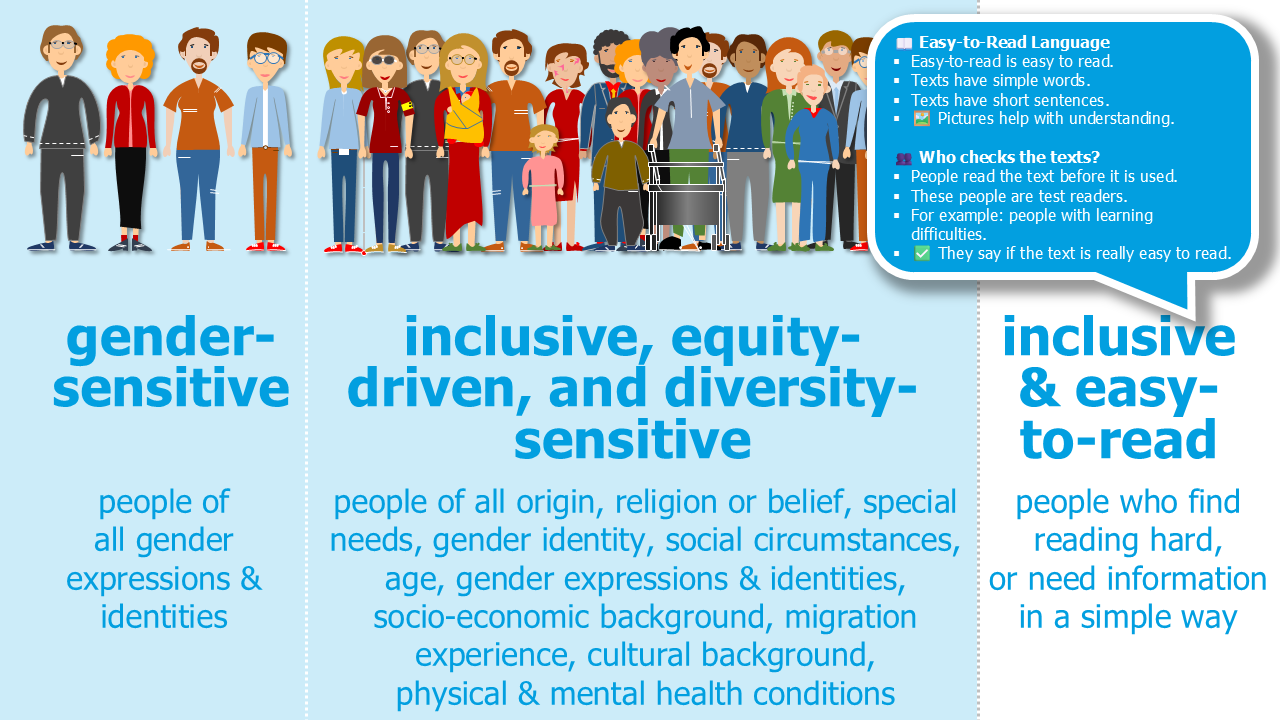
Although the terms gender-inclusive, diversity-sensitive, and inclusive are often used together, they refer to different—though partially overlapping—concepts in academic and public communication. A precise distinction is important to clarify the intended purpose of linguistic choices and to avoid misunderstandings.
-
Gender-inclusive
Formulations that take gender diversity into account and do not use only one gender form when more than one is intended. The aim is to avoid the generic masculine or other forms that explicitly represent only one gender. Examples include paired forms (female and male employees), gender gaps (employees), or gender-neutral terms (team members). -
Diversity-sensitive
Language that, in addition to gender, respectfully and accurately represents other dimensions of human diversity—such as age, cultural background, disability, sexual orientation, religion, or socioeconomic status. Diversity-sensitive formulations avoid stereotyping, discrimination, and unnecessary emphasis on particular characteristics unless they are relevant to the context. -
Inclusive
A comprehensive approach that integrates both gender inclusion and diversity sensitivity, aiming to encompass all relevant groups in language and representation. Inclusive language is concerned not only with formal visibility but also with accessibility, clarity, and representation for all audiences—regardless of linguistic, cognitive, or cultural background.
Interrelation and differences:
Gender-inclusive language is a subset of inclusive language, focusing specifically on gender representation. Diversity-sensitive language broadens the scope to encompass additional dimensions of societal diversity. Inclusive language combines both perspectives, ensuring that texts, images, and other forms of communication are as barrier-free, representative, and comprehensible as possible.
3.1 Fundamentals and Objectives ^ top
The purpose of academic language is to present subject matter in a way that is unambiguous, methodologically transparent, and verifiable by others. A central aspect of this precision is the accurate identification of the groups of people, datasets, and contexts to which statements refer. Gender-inclusive, diversity-sensitive, and inclusive formulations are not an aesthetic choice, but a means of avoiding ambiguity and misinterpretation. If linguistic designations are too general, or if only one gender form is used when multiple groups are meant, interpretative gaps may arise that can alter the intended meaning. The goal is therefore to use expressions that make it clear who or what is meant, while also meeting the disciplinary, institutional, and formal requirements of academic communication.
3.1.1 Terminology ^ top
The term gender refers to different, interconnected dimensions. Biological sex encompasses biological characteristics such as chromosomes, hormones, and primary or secondary sexual characteristics. These are not strictly binary. Gender identity is an internal sense or awareness of belonging to a particular gender, regardless of biological characteristics. Gender expression refers to how a person outwardly presents gender—for example, through clothing, voice, or body language—and does not have to conform to societal expectations.
Sexual orientation is distinct from this: it describes the genders or gender identities to which a person is romantically or sexually attracted. Gender-sensitive language relates exclusively to the linguistic representation of different dimensions of gender, and not to sexual orientation. Misunderstandings occur when these two levels are conflated.
3.1.2 Core Principles of Linguistic Precision ^ top
Precision in academic language means selecting formulations that are clear, unambiguous, and free from unnecessary scope for interpretation. This applies not only to the substantive content but also to the linguistic representation of groups, circumstances, and contexts.
Unclear or inconsistent designations can lead to misunderstandings, misinterpretations, or methodological inaccuracies. In contrast, precise expression helps ensure that research results can be reliably interpreted, verified, and embedded in broader academic contexts.
Representational Precision ^ top
Representational precision refers to the ability of academic language to identify the actual subject matter or group in question with exactness.
-
Over-inclusion occurs when a designation covers a group larger than the one actually meant.
-
Under-inclusion occurs when relevant parts of a group are linguistically excluded, even though they are substantively intended to be included.
In both cases, linguistic imprecision can lead to flawed interpretations, distorted conclusions, or methodological misunderstandings. Especially in academic reporting, it is essential that formulations match exactly the sample, population, or target group studied. Designations should be consistent with the definitions and criteria given in the methodology, allowing readers to understand without further assumptions who or what was included in the analysis.
Representational precision contributes directly to the quality of academic work:
- It prevents results from being applied to groups for which no data exist.
- It ensures that the intended population is correctly and fully identified.
- It facilitates comparability and replication by making it clear which subgroup a statement refers to.
Examples
| Problem type | Negative example | Explanation | Positive example |
|---|---|---|---|
| Under-inclusion | The workmen are dissatisfied with the new building management system. | Unclear whether only male staff or the entire workforce is meant. | The technical services staff rated the new building management system as inadequate. |
| Over-inclusion | The employees attended the energy management training. | Too broad, as not all staff members took part in the training. | The facilities management team attended the energy management training. |
| Under-inclusion | The chairman approved the new safety policy. | The wording refers explicitly to a male role holder, leaving it unclear whether women or non-binary persons in the same role are included. | The chair approved the new safety policy. |
Traceability ^ top
Traceability refers to the capacity of academic language to state the relationship of a claim to the population, sample, variables, and scope of applicability so clearly that readers can identify this information without making additional assumptions.
If such linguistic precision is lacking, scope for interpretation arises, which can reduce the academic value of a study or hinder the reproducibility of its results.
-
Lack of traceability occurs when the group of people or the spatial-temporal scope of a study is not clearly identified.
-
Partial traceability occurs when a target group is specified, but important details such as context, timing, or selection criteria are missing.
In academic reporting, it is essential that the terms used correspond exactly to the definitions and criteria described in the methodology. This enables readers to understand precisely who or what was examined, under which conditions, and in what context.
Traceability therefore makes a direct contribution to the quality of academic work:
- It enables results to be interpreted correctly and placed in the appropriate context.
- It provides the basis for the verification and replication of studies.
- It prevents statements from being overgeneralised or misinterpreted.
Examples
| Problem type | Negative example | Explanation | Positive example |
|---|---|---|---|
| Lack of traceability | The staff are dissatisfied. | It is not clear in which department or context the dissatisfaction arises, nor which specific group was surveyed. | The technical services staff at the Kufstein campus rated the new building management system as inadequate. |
| Partial traceability | The participants attended the energy management training. | Unclear whether they were employees, external specialists, or students, and when the training took place. | The facilities management team at the Vienna site attended the "ISO 50001 Energy Management" training in May 2024. |
| Lack of traceability | The operators reviewed the efficiency. | It remains unclear what type of facility was examined, in which region, and under what conditions—while also explicitly limiting the group to men, leaving open whether women or non-binary operators were included. | The personnel responsible for operating the biomass facility at the Tyrol Industrial Park reviewed its efficiency in Q3 2024 in accordance with ISO 50006. |
Comparability ^ top
Comparability refers to the quality of academic language in using terms, categories, and designations consistently so that results from different studies, datasets, or periods of analysis can be juxtaposed without any loss of meaning.
If such linguistic consistency is lacking, interpretation becomes more difficult or may be distorted, and the integration of results into meta-analyses or systematic reviews is only possible to a limited extent.
- Lack of comparability occurs when identical or very similar matters are described using different terms within the same work.
- Partial comparability occurs when designations are not fully consistent or vary between studies without justification.
Consistency in terminology means that once terms have been defined, they are used unchanged throughout the entire work. This applies both to gender-inclusive personal designations and to titles, roles, or group names. For international accessibility, the same principle applies to translations—established equivalents in the relevant field should be used.
Comparability therefore makes a direct contribution to academic quality:
- It facilitates the comparison of results within a single work and across different studies.
- It prevents misinterpretations caused by inconsistent or shifting terminology.
- It supports the integration of results into broader research contexts.
*Examples
| Problem type | Negative example | Explanation | Positive example |
|---|---|---|---|
| Lack of comparability | The staff rated the measures positively. Employees in the service department were particularly satisfied. | Two different terms ("staff" / "employees in the service department") are used for the same group, making direct comparison more difficult. | The staff in the service department rated the measures positively and were particularly satisfied. |
| Partial comparability | The plant managers in Project A use an energy management system. The responsible persons in Project B also use an energy management system. | Different terms ("plant managers" / "responsible persons") for the same role prevent a clear comparison between projects. | The plant managers in Project A and Project B use an energy management system. |
| Lack of comparability | In Study 1, results were analysed for "customers"; in Study 2, for "female and male customers". | Different linguistic formats for the same target group make it harder to merge results. | In Study 1 and Study 2, results were analysed for "female and male customers". |
A precise, gender-inclusive designation always identifies exactly the intended group, avoids generic terms with potentially misleading implications, and is used consistently throughout the text.
3.2 Principles of Precise Formulations ^ top
Precise formulations are a fundamental requirement for academic quality. They ensure that statements can be interpreted unambiguously, facilitate the replicability of studies, and prevent misinterpretations or inaccurate generalisations. The following five principles form the basis for linguistic precision in academic texts and should be observed in all phases of academic work—from planning to publication.
-
Clarity
Every statement must clearly indicate which group, phenomenon, or context it refers to. Vague or generic formulations such as "the employees" or "the users" are problematic if it is unclear whether all genders, specific functions, or only subgroups are meant. Clarity is achieved through precise and specific designations that accurately identify the population or object of study. -
Completeness when relevant
Characteristics such as gender, age, role, or context should only be mentioned if they are relevant to the research question, methodology, or interpretation of the results. Unnecessary reference to irrelevant characteristics can distort perception or create the impression that these characteristics have particular significance for the findings. Conversely, no relevant characteristic should be omitted if it is central to understanding the statement. -
Consistency
Once defined, terms, technical expressions, and naming conventions must be used consistently throughout the text. Switching between different designations for the same concept (e.g. "staff" and "employees") is only justified if clearly explained—for example, when reproducing terminology from different original sources. Consistency applies both to linguistic form and to the conceptual definition of terms. -
Operationalisability
Linguistic categories must correspond to the variables actually measured. For instance, if a survey collects data on "gender", this must not be tacitly equated with "biological sex" unless this is methodologically justified and documented. The terms used should reflect the actual measurement and be chosen so that they can be understood without additional methodological assumptions. -
Verifiability
Formulations must allow for a clear link to the underlying data. This includes specifying the sample, measurement instrument, time period, and region, where these details are relevant to the statement. Only in this way can external reviewers or readers evaluate the results in the correct context and, if necessary, validate the information.
Examples:
| Principle | Negative example | Explanation | Positive formulation |
|---|---|---|---|
| Clarity | The staff are dissatisfied with the energy management system. | Unclear whether all roles or only a specific department are meant; no specification of which staff members are included. | The technical services staff rated the energy management system as inadequate. |
| Completeness when relevant | Respondents preferred modern heating systems. | Missing information on relevant characteristics (e.g. building type, usage) even though these are important for interpretation. | Tenants in multi-family buildings constructed before 1990 preferred modern heating systems. |
| Consistency | In Section A: "staff", in Section B: "employees" for the same group. | Inconsistent designation makes comparison difficult and may cause confusion. | Use the term "staff" consistently throughout to refer to the same group. |
| Operationalisability | The study recorded participants’ gender. | Unclear whether this refers to biological sex or self-identified gender; no methodological clarification. | The study recorded participants’ self-identified gender, with the response options "female", "male", and "non-binary". |
| Verifiability | The participants were satisfied with the building services. | No information on sample size, location, or timing; insufficient context for external validation. | Fifty-eight members of the facilities management team at the University of Innsbruck rated the building services as satisfactory in April 2024. |
3.3 Forms of Linguistic Precision in Inclusive Communication ^ top
Inclusive and diversity-sensitive writing is not about deploying the most symbols or linguistic devices—but rather about choosing the most precise and contextually appropriate format for each communication need. Every approach has its own strengths and situational suitability. The essential factor is to apply the chosen form consistently and define its usage clearly, thereby minimising misunderstandings and enhancing the readability and coherence of academic texts.
3.3.1 Masculine-Default Terms ^ top
In English, terms such as chairman, fireman, or policeman may historically have been used generically, but they now risk being interpreted as referring only to men. Even if unintended, they can reinforce outdated associations and exclude others.
Where the intention is to include all genders or unspecified groups, it is better to opt for neutral alternatives—such as chair, firefighter, or police officer. This not only improves clarity but also supports equality and modern scholarly tone.
Use masculine-default terms only when explicitly referring to men; otherwise, favour neutral forms for precision and inclusivity.
3.3.2 Paired Gender Forms ^ top
Using both feminine and masculine terms—such as female and male students—can enhance clarity by explicitly including both genders. This approach is particularly clear, though verbose.
Nevertheless, paired forms exclude non-binary or gender-diverse individuals and can disrupt stylistic flow.
Paired gender forms work when emphasising inclusion of women and men, but deserve caution for readability and full diversity coverage.
3.3.3 Gender-Neutral Terms ^ top
Where no gender distinction is necessary, neutral descriptors such as students, staff, team, or professionals are ideal. They are inclusive, precise, and often the best fit for academic contexts.
Use them whenever gender is irrelevant or non-essential to the research context.
Gender-neutral terms are preferred when gender is not a variable of interest; they are inclusive, precise, and style-efficient.
3.3.4 Explicitly Inclusive Phrasing ^ top
In cases where clarity about gender diversity is important, phrases like students of all genders or participants of diverse gender identities can be used purposefully.
This approach explicitly signals inclusivity but should be reserved for moments where such detail supports clarity, relevance, or specific emphasis.
Use explicitly inclusive phrases where inclusion matters—but avoid overuse to maintain readability.
3.3.5 Non-Binary Pronouns and Neopronouns ^ top
English supports inclusive pronouns like they/them in singular use, particularly when gender is unknown or non-binary. Many institutions now accept this usage as standard.
Neopronouns (xe/xem/xyr, ze/hir, etc.) are also used by individuals who prefer them. Their use should always respect personal preference and audience clarity.
Use the pronouns people prefer—this is both inclusive and academically respectful.
3.3.6 Broader Inclusive Language: Beyond Gender ^ top
Inclusive communication extends to dimensions such as disability, ethnicity, age, and more. The following principles help uphold that:
- Person-first language: Say "person with a disability" rather than defining someone by their conditions.
- Avoid stereotypes: Do not generalise attributes to groups (e.g. "disabled people tend to…").
- Respect self-identification: Use the terms individuals prefer for race, ethnicity, religion, etc.
- Restrict references to relevance: Only mention personal attributes when they are pertinent to the research or context.
- Be aware of tone and assumptions: Avoid patronising or othering expressions.
Language that reflects respect for all identities strengthens both clarity and ethical communication.
3.3.7 Institutional Titles & Salutations ^ top
Common conventions—such as Mr, Mrs, or Miss can convey assumptions about marital status or reinforce binary gender norms. Using Ms for women or the gender-neutral Mx avoids unnecessary disclosure of personal details.
Similarly, avoid outdated salutations such as Ladies and gentlemen; consider using everyone, colleagues, or distinguished guests instead.
Another approach is to omit titles entirely and address people by their full name (First name Last name). This avoids gendered forms altogether while maintaining formality and clarity. In written communication, this method can be especially effective in intercultural or international contexts where titles differ or carry different connotations.
Salutations and honorifics should centre respect and neutrality, not assumptions. Titles can be replaced with names alone to achieve both clarity and inclusivity.
Reflection Task / Activity ^ top
Write a short text (150–200 words) on a specialist topic aimed at a mixed audience. Use the writing style of your choice (generic masculine, paired forms, gender gap or neutral terms).

Make a note: Why did you choose this approach?

Submit your text to the AI:
“I have chosen [your choice]. Is this accurate? Where might it be misleading? Please suggest two alternatives using a different writing style.”

Read the AI’s suggestions. Which one is more accurate? Why?
Make a note: Where was my choice too vague?
3.4 Inclusive Language ^ top
Inclusive language is a way of communicating that addresses all relevant groups and avoids excluding people on the basis of gender, ethnicity, age, disability, religion, sexual orientation, or other characteristics. In English, this means avoiding wording that assumes certain identities, reinforces stereotypes, or makes unnecessary reference to personal attributes.
The aim of inclusive language is to ensure that content is accessible, accurate, and respectful to all intended audiences, regardless of their background or personal circumstances. In academic communication, it helps maintain clarity, credibility, and international relevance.
3.4.1 Core Principles of Inclusive Language ^ top
-
Precision
Choose terms that describe the intended group or concept accurately. Avoid vague collective nouns (men, foreigners) unless the scope is deliberately limited to that group. -
Relevance
Mention characteristics such as gender, age, or origin only if they are relevant to the research question, analysis, or context. Irrelevant details can be distracting or unintentionally biased. -
Accessibility
Present information in a clear and straightforward way, using sentence structures and vocabulary that can be understood by readers from varied linguistic, cognitive, and sensory backgrounds. Support with visuals or alternative formats where appropriate. -
Cultural awareness
Choose expressions that are respectful and meaningful across cultures. Avoid idioms, metaphors, or culturally bound references that may confuse or alienate international readers. -
Consistency
Once you have chosen a term or naming convention, use it consistently throughout the text. Switching between terms without reason can create ambiguity.
Examples of inclusive and non-inclusive wording
| Context | Non-inclusive | Explanation | Inclusive |
|---|---|---|---|
| Gender | The chairman welcomed the delegates. | Gender-specific title that excludes or misrepresents women and non-binary people. | The chair welcomed the delegates. |
| Disability | The disabled need special arrangements. | Reduces individuals to a condition and can be stigmatising. | People with disabilities have access to adjustments. |
| Origin | Foreign researchers presented their findings. | Focuses on nationality rather than professional role. | International researchers presented their findings. |
| Age | The elderly participated in the workshop. | Generalises and may carry negative connotations. | Participants over 65 participated in the workshop. |
3.4.2 Challenges and Approaches ^ top
-
Overly complex phrasing
Inclusive wording can sometimes lead to long or cumbersome sentences.
Approach: Use clear, concise alternatives without losing precision (e.g. staff members instead of male and female members of staff). -
Cultural differences in interpretation
A term that is considered inclusive in one region may be outdated or insensitive in another.
Approach: Research current usage in the relevant context and adapt accordingly. -
Institutional conventions
Some academic or professional settings have established style guides that do not yet reflect fully inclusive practice.
Approach: Follow institutional requirements while advocating for updated, evidence-based language policies.
In English, inclusive language is less about grammatical gender and more about avoiding bias, stereotyping, and unnecessary emphasis on personal characteristics.
3.5 Easy Read Language ^ top
Easy Read is a highly simplified form of communication designed to make information accessible to people with learning disabilities, cognitive impairments, or limited proficiency in the language of publication. It is guided by clear, standardised principles and often follows national or institutional accessibility guidelines.
Easy Read is not the same as "simplified English" or "plain language." While plain language focuses on clarity for a broad audience, Easy Read follows strict rules on vocabulary, sentence structure, layout, and visual support to ensure maximum accessibility. In academic settings, it can be used effectively in accessible information materials, inclusive teaching formats, or public engagement activities.
3.5.1 Core Principles of Easy Read ^ top
Easy Read is defined by a fixed set of rules that go beyond general readability guidelines. These rules apply to vocabulary, sentence structure, document design, and the integration of visual support. The aim is to remove barriers by checking every linguistic and design choice for maximum clarity.
-
Vocabulary
- Use simple, familiar words. Introduce technical terms only when unavoidable, and explain them immediately.
- Avoid foreign or specialist words unless an easy definition is provided straight away.
- Prefer concrete terms (e.g. house instead of building infrastructure).
- Avoid ambiguity: explain words with more than one meaning.
- Avoid abbreviations unless they are widely known and spelled out on first use.
-
Sentence structure
- Use short sentences (around 8-10 words in a main clause).
- Express one idea per sentence; avoid nested clauses.
- Use the active voice (e.g. The library lends books rather than Books are lent by the library).
- Avoid double negatives and minimise the use of negative forms.
- Stick to present tense or simple past.
-
Document design
- Keep paragraphs short (3-5 lines).
- Use clear, descriptive headings.
- Present complex information in bullet points or numbered lists.
- Put the most important information first in a paragraph.
- Avoid metaphors and figurative language, which can cause confusion.
-
Visual support
- Use pictures, icons, or diagrams that are clear, relevant, and unambiguous.
- Use large, legible fonts (minimum 14 pt, sans serif).
- Maintain high colour contrast between text and background.
- Apply a clear page structure with wide margins and generous line spacing.
- Use supportive design elements (e.g. info boxes, colour highlights) sparingly to aid comprehension.
Texts in Easy Read should be tested with members of the intended audience before publication to ensure they work as intended.
The strict rules of Easy Read are not a limitation on creativity but a deliberate design choice to ensure accessibility.
Examples: Standard Academic Wording vs. Easy Read
| Context | Standard phrasing | Easy Read |
|---|---|---|
| Project description | The research team analysed the impact of renewable energy systems on regional economic development. | We looked at how new energy systems affect the economy in the region. |
| Methodology | A mixed-methods approach was adopted, combining qualitative interviews and quantitative surveys. | We used two types of research: talking to people and giving them surveys. |
3.5.2 Challenges and Solutions ^ top
-
Limited scope for nuance
The strict limits on vocabulary and sentence length can make it difficult to convey complex concepts.
Solution: Provide short explanations of key technical terms and offer a longer, detailed version in standard academic language for those who want more depth. -
Risk of information loss
Omitting specialised terms or condensing details can remove important context.
Solution: Supply supplementary materials such as glossaries, videos, or side-by-side versions to preserve depth. -
Design and testing effort
Producing Easy Read materials requires careful planning, layout design, and testing with the target audience.
Solution: Involve accessibility specialists early in the process and invite target users to review drafts. -
Lower uptake in higher education
Easy Read is less common in academic writing and may be perceived as "non-academic."
Solution: Use it selectively for accessibility, outreach, or student support materials, and position it as a complement to rather than a replacement for standard academic texts.
Easy Read is a precise and valuable tool for accessibility—its use in higher education should be targeted, purposeful, and informed by audience needs.
3.6 Plain Language ^ top
Plain language is a deliberately simplified style of communication that presents complex information in a way that can be understood by as many people as possible—regardless of educational background, language proficiency, or cognitive ability. It differs from Easy Read in that it follows less rigid rules and allows greater flexibility, while still prioritising clarity and accessibility.
In academic contexts, plain language is rarely used in the main body of scholarly publications, but it can be highly effective in supplementary materials, executive summaries, information leaflets, or public presentations—especially when research findings need to be shared with a non-specialist audience.
The aim is to present information clearly, logically, and accurately without distorting the meaning or reducing the scientific content.
3.6.1 Core Principles of Plain Language ^ top
-
Clear sentence structure
Short sentences with a single main idea; avoid long strings of subordinate clauses. -
Everyday vocabulary
Use technical terms only when necessary, and explain them; limit the use of unfamiliar or specialised words. -
Logical organisation
Divide the text into clearly defined sections with meaningful subheadings. -
Concrete examples
Support abstract statements with real-world or relatable examples. -
Visual support
Use diagrams, tables, icons, or illustrations to clarify key points. -
Active voice
Prefer active constructions to make actions and responsibilities explicit.
Examples: Academic Wording vs. Plain Language
| Context | Academic phrasing | Plain language |
|---|---|---|
| Research result | The implementation of innovative energy concepts led to a significant reduction in primary energy consumption. | New energy systems reduced energy use significantly. |
| Methodology | A quantitative survey was conducted using standardised online questionnaires between April and June 2024. | From April to June 2024, we ran an online survey with set questions. |
| Research context | The findings should be considered in light of recent regulatory developments in the European energy market. | The results are also affected by new EU rules on the energy market. |
3.6.2 Challenges and Solutions ^ top
-
Balancing simplification with accuracy
Simplifying language must not lead to factual distortion.
Solution: Use short, precise sentences and ensure logical structure while retaining key details. -
Targeting diverse audiences
Different readers may require different levels of simplification.
Solution: Create modular content with basic explanations up front and optional in-depth sections for those seeking more detail. -
Avoiding oversimplification
Excessive simplification can make content seem trivial.
Solution: Use a layered approach: start with a simple explanation, then expand on the details for interested readers. -
Shifting from academic style
Moving away from complex academic language can feel unfamiliar to some writers.
Solution: Keep a parallel "full academic" version for formal contexts and use plain language for outreach or accessibility.
Plain language is a bridge between specialist communication and broad public understanding—it requires deliberate choices and a clear understanding of the audience’s needs.
3.6.3 Differences Between Plain Language and Easy Read ^ top
-
Plain Language: Designed for a wide audience who benefit from clear, well-structured communication, but not specifically aimed at people with high comprehension barriers.
-
Easy Read: Follows a stricter set of rules and is specifically tailored to be accessible for people with significant support needs.
3.6.4 Relevance for Academic and Higher Education Communication ^ top
In higher education, Easy Read or plain language can be used effectively for:
- Guides and instructions for administrative processes (e.g. enrolment, exam registration)
- Public engagement materials on research topics with social relevance
- Accessible events where participants have diverse language skills or cognitive backgrounds
Easy Read and plain language are not "simplified" styles in a reductive sense—they are professional communication strategies with defined standards. When used deliberately, they enhance accessibility, inclusion, and participation in academic contexts.
3.7 Intercultural Challenges in Translating Inclusive Expressions ^ top
Inclusive language varies significantly across cultures and linguistic systems. What’s standard and clear in English may not translate directly into other languages, and vice versa.
3.7.1 Structural & Cultural Discontinuities ^ top
Languages without grammatical gender (like English) can't replicate explicit visual gender markers commonly used in languages like German. Inclusive constructs in one language may become invisible or lose impact in the other.
Further, cultural tone and expectations differ. While German academic writing might favour pair forms or visible inclusivity, British academic audiences may expect a more neutral or streamlined presentation.
3.7.2 Strategies for Effective Inclusive Translation ^ top
- Use inclusive phrases such as of all genders or including non-binary individuals to convey diversity that disappears in neutral English equivalents.
- Add a gloss or note, especially in translated academic materials, explaining where inclusive practices were used in the source.
- Opt for gender-neutral English terms even if the original language uses gender-specific forms.
- Incorporate visual inclusivity in multimedia contexts—graphs, infographics, or icons—to compensate where language limits inclusion.
- Respect context: Understand the audience’s cultural and institutional expectations and adapt tone accordingly.
Effective translation of inclusive language depends on clarity, adaptation, and cultural awareness—not literal equivalence.
3.8 Inclusive Communication in Visual Representations ^ top
In academic communication, precision is conveyed not only through written language but also through visual elements such as infographics, charts, photographs, or pictograms. Just like language, visual representations can exclude or distort meaning if they fail to depict certain groups or if they reproduce stereotypes. A diversity-aware and inclusive visual design strengthens the substantive message, enhances accessibility, and increases the credibility of academic work.

-
Representation
Where relevant to the context, visuals should reflect diversity in gender, age groups, cultural backgrounds, and physical abilities. In purely schematic illustrations (e.g. technical diagrams), diversity can be indicated through neutral forms and symbols. -
Consistency between text and image
If the written text refers to a mixed or diverse target group, this should also be evident in the visual representation. Discrepancies between text and image can undermine academic precision. -
Avoidance of stereotypes
Gender roles, occupational associations, or cultural features should not be presented in a clichéd way (e.g. only male engineers in technical diagrams, or only female figures in care-related roles). -
Accessibility
Visual materials should be accessible to all recipients. This includes providing alternative text for screen readers, ensuring sufficient colour contrast, using legible typefaces, and offering clear labelling.
Inclusive visual representations are an integral component of academic precision. They ensure that the intended message is consistently supported and that all relevant groups are visible and accurately represented.
3.9 Names in an International Context ^ top
In academic writing, the clear identification of surnames is essential, as naming conventions vary considerably across cultures. While in German-speaking countries the family name usually follows the given name (Anna Huber), in other linguistic and cultural contexts the surname comes first or follows specific rules. Clear presentation helps to avoid misunderstandings in citations, reference lists, and scholarly communication.
Examples of international naming conventions ^ top
| Region / Culture | Name example | Specific feature / practice |
|---|---|---|
| Austria / Germany | Laura Schneider / Anna Huber / Thomas Müller / Michael Gruber / Alex Hofer / Sascha Bauer | Usual structure: given name followed by surname. In reference lists, surname first (Schneider, L.). Double names are common (Keller-Meier, Leitner-Pirker). Given names such as Sascha, Kim, Alex, Dominique or Andrea can be gender-neutral. |
| China | Li Wei / Zhang Min | Surname comes first (Li, Zhang). Given names such as Wei or Min can be male, female, or neutral. |
| Japan | Tanaka Haruko / Yamamoto Hiroshi / Sato Ren | Traditionally surname first. Ren is a gender-neutral given name. In international contexts, the Western order is often used. |
| Korea | Kim Ji-woo / Park Min-jun | Family name first. Given names usually consist of two syllables. Ji-woo is often gender-neutral. |
| Vietnam | Nguyen Thi Mai / Tran Van Anh | Surname first. Thi often indicates female, Van often male given names. |
| India | Priya Ramesh / Amit Kumar Singh / Anjali Devi | Multi-part naming systems, order varies by region. In South India, the father’s given name is often placed first. |
| Ethiopia | Sara Abebe / Abebe Bekele | Patronymic system: the second name is usually the father’s given name. No family name in the Western sense. |
| Nigeria (Yoruba) | Oluwaseun Adebayo / Yetunde Afolabi | Meaningful, often gender-neutral given names (Oluwaseun). Surnames follow Western structure. |
| Ghana (Akan) | Kofi Mensah / Ama Owusu | Given names often indicate day of birth (Kofi = Friday, male; Ama = Saturday, female). |
| Latin America (Spanish-speaking) | María Fernanda López García / Andrea Morales Ramírez | Two surnames: paternal (López, Morales) and maternal (García, Ramírez). In citations usually the first surname is used. |
| Brazil (Portuguese-speaking) | Fernanda Oliveira Lima / Alex Santana Costa | Multiple surnames are common. The last surname is often considered the main family name. |
| Iceland | Jón Einarsson / Anna Einarsdóttir / Ari Einarbur | Patronymic: -son ("son of"), -dóttir ("daughter of"), increasingly -bur ("child of") as a gender-neutral option. |
| Ukraine | Olena Shevchenko / Taras Shevchenko | Surnames often without gender-specific endings. Patronymics are common (e.g. Oleksandrivna, Oleksandrovych). |
| Georgia | Nino Beridze / Giorgi Beridze | Surnames often end with -dze or -shvili, independent of gender. No gender-specific endings. |
| Serbia | Jelena Petrović / Marko Petrović | Surnames often end with -ić. Given names are gendered, but surnames remain unchanged. |
| Hungary | Nagy Éva / Kovács István | Family name traditionally comes first (Nagy Éva). In international contexts, the Western order is often applied. |
| Czech Republic / Slovakia | Petra Nováková / Jan Novák | Female surnames often end with -ová (Nováková), male with -ák (Novák). |
| Poland | Anna Kowalska / Piotr Kowalski | Gender-specific surname endings (-ska female, -ski male). |
Guidance for academic practice ^ top
-
In reference lists (e.g. according to the American Psychological Association, APA), the surname is always given first, followed by initials.
-
Cultural specifics such as patronymics, double names, or gendered endings must be reproduced fully and correctly.
-
Diacritical marks (e.g. Š, č, Ł) must be retained, as they are part of the name.
-
Gender-neutral given names (e.g. Alex, Ren, Oluwaseun, Ji-woo) require particular attention, as their interpretation can vary culturally.
International naming conventions are diverse. A careful and respectful representation of surnames - taking cultural and gender-specific practices into account - is essential for academic precision and intercultural understanding.
Guidance for academic practice:
-
In reference lists (for example, according to the American Psychological Association, APA), the surname is always placed first, followed by the initials of the given names.
-
Cultural conventions such as patronymics, double surnames or gender-specific endings must be reproduced fully and correctly.
-
Diacritical marks (e.g. Š, č, Ł) must always be retained, as they are an integral part of the name.
-
Gender-neutral given names (e.g. Alex, Ren, Oluwaseun, Ji-woo) require particular attention, as their interpretation can differ across cultures.
International naming conventions are diverse. A careful and respectful use of surnames - taking cultural and gender-specific aspects into account - is essential to ensure academic precision and intercultural understanding.
Special cases: name particles (van, von, de, di …) ^ top
In some languages, particles such as van, von, de, du, di or le are commonly used. For alphabetic order in reference lists, the particle is written as part of the surname, but sorting is based on the main part of the name.
| Language / Culture | Example | Reference list entry | Alphabetical order |
|---|---|---|---|
| Dutch | Vincent van Gogh / Jan van der Meer | van Gogh, V. | under G (Gogh) / under M (Meer) |
| German | Clara von Bülow | von Bülow, C. | under B (Bülow) |
| French | Simone de Beauvoir | de Beauvoir, S. | under B (Beauvoir) |
| Italian | Giovanni di Lorenzo | di Lorenzo, G. | under L (Lorenzo) |
| Spanish | Miguel de Cervantes | de Cervantes, M. | under C (Cervantes) |
Guidance for reference lists:
-
The particle is retained in the name, but it is not used as the sorting element.
-
If in doubt, consult the original source.
-
Consistency is crucial: the chosen form of sorting must be applied throughout the entire reference list.
Name particles form part of the surname but do not determine the alphabetical order.
Reflection Task / Activity ^ top
Write down: Which of these requirements (KISS, precision, objectivity, gender equality) do you find most difficult?

Give the AI your answer:
“Where do I make typical beginner’s mistakes? Which specific strategy will help me the most?”

Read the answer. Try out the strategy on a sample text.
Make a note: Does this work for me, or do I need to approach it differently?

After the chapter: Write down a brief personal commitment:
“In my next texts, I will pay particular attention to: …”